
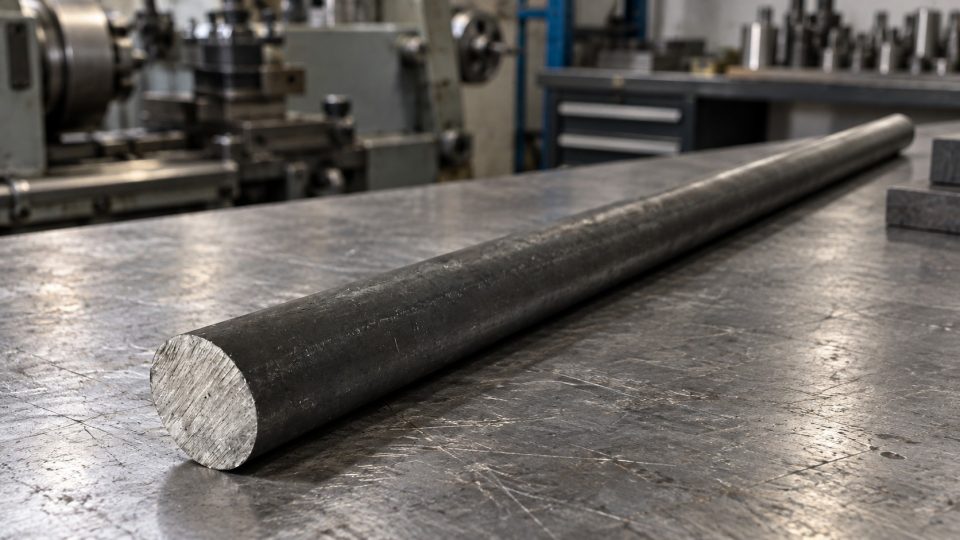
41Cr4, material number 1.7035 and the former Polish designation 40H are used for steel intended for quenching and tempering. However, the name alone does not tell you ...
41Cr4, material number 1.7035 and the former Polish designation 40H are used for steel intended for quenching and tempering. However, the name alone does not tell you the hardness and strength of the bar you are buying. Before ordering, check the delivery condition, cross-section and the component documentation requirements. Annealed material and material that has been quenched and tempered do not have the same properties.
40H, 41Cr4 and 1.7035 — how to read the designations
41Cr4 is the grade designation, and 1.7035 is its material number in the European system. The name 41Cr4 also appears in EN standards; the distinction “41Cr4 only under DIN and 1.7035 under EN” is too simplistic. 40H appears in former Polish nomenclature and comparison tables.
An equivalence table helps interpret an older drawing, but does not replace comparison of the standard requirements and delivery document. Do not overlook additional letters: 41CrS4 / 1.7039 is a separate variant with a specified sulphur range. Do not automatically consider it identical material.
41Cr4 steel composition — what to check in the documentation
The grade belongs to the chromium steels for quenching and tempering. The Deutsche Edelstahlwerke data sheet gives the following mass-percentage ranges for 41Cr4: C 0,38–0,45%, Si max. 0,40%, Mn 0,60–0,90% and Cr 0,90–1,20%. These are grade data from that sheet, not test results for a specific NERON batch. For an order, compare the full composition and material-documentation requirements; do not combine individual values from old PN tables and modern EN data sheets.
What do +A and +QT mean?
- +A means the soft-annealed condition. It does not mean finished material with the properties required after quenching and tempering.
- +QT means the quenched-and-tempered condition. The required properties still have to be related to the cross-section and product documentation.
The Saarstahl data sheet gives a maximum hardness of 241 HB in the +A condition. This must not be equated with hardness after hardening, nor should an HB number be compared directly with an HRC number. State the required condition in your enquiry instead of ordering only “hard 40H steel”.
Why does diameter change strength requirements?
The following examples were taken from the Deutsche Edelstahlwerke data sheet for the quenched-and-tempered condition at room temperature. They are not a declaration of the properties of all NERON bars.
Example diameter Diameter range in the data sheet Proof strength Rp0,2 Tensile strength Rm |
Example diameter Diameter range in the data sheet Proof strength Rp0,2 Tensile strength Rm |
The manufacturer describes these data as typical and specifies where longitudinal samples are taken: up to Ø25 mm from the core, and above that diameter from the near-surface zone, 12,5 mm below it. The table therefore does not describe strength at any point throughout the cross-section. It shows why a single Rm range or the phrase “28–60 HRC” is not enough to specify a component.
Hardening 40H — what cannot be determined from the name alone?
41Cr4 can be quenched and tempered and induction surface-hardened. Surface hardening and achieving properties throughout the cross-section are different requirements. The treatment cycle should take account of the actual material, geometry and intended result. Do not transfer sample-treatment parameters to any arbitrary shaft or forging.
The steel is used for drive components, crankshafts and axles, among other applications, but a list of uses does not replace selection for a specific load. Deutsche Edelstahlwerke also notes the difficult weldability of 41Cr4; do not treat it as ordinary steel for welded structures. If the part is to be welded, material selection and the welding procedure must be resolved before purchasing.
How do you order a 41Cr4 bar from NERON?
In the category of 41Cr4 / 40H / 1.7035 steel select the appropriate product. An example product page for a 41Cr4 Ø16 × 1000 mm bar states the grade, diameter and length. This description alone does not confirm the +QT condition or the strength shown in the table above.
Prepare the following for your enquiry:
- the complete grade and required standard from the component documentation;
- diameter, length, tolerances, quantity and allowance for further machining;
- delivery condition and whether heat treatment has already been performed or is still planned;
- required properties and the location where they must be checked, if specified on the drawing;
- the required material document and batch identification.
PN-EN ISO 683-2:2018-08 applies to the relevant alloy-steel products for quenching and tempering. However, its scope does not cover every product form, such as bright steel products. The appropriate standard must be established for the material being ordered instead of being added automatically to every product page.
Example: if the drawing requires 41Cr4 +QT with confirmed properties, an offer specifying only “41Cr4” is incomplete. Before ordering, send your specification to NERONto confirm compliance of the specific variant. Neither the bar's appearance nor its diameter determines the material condition.
Related articles
Steel for CNC machining — how to select the grade and delivery condition
Select steel for CNC machining according to the finished part requirements and planned manufacturing process. The grade name alone is not enough to select a tool and c...
Read article · 5 min
40HM / 42CrMo4 — what does +QT mean and how do you select a bar?
42CrMo4, designated by material number 1.7225 and compared with the former Polish designation 40HM, is a chromium-molybdenum steel for quenching and tempering. The gra...
Read article · 4 min
X46Cr13 (1.4034) — applications and linear shaft selection
X46Cr13, also designated by the number 1.4034, is a hardenable martensitic stainless steel. It is used for precision guide shafts, among other applications. When purch...
Read article · 5 min