
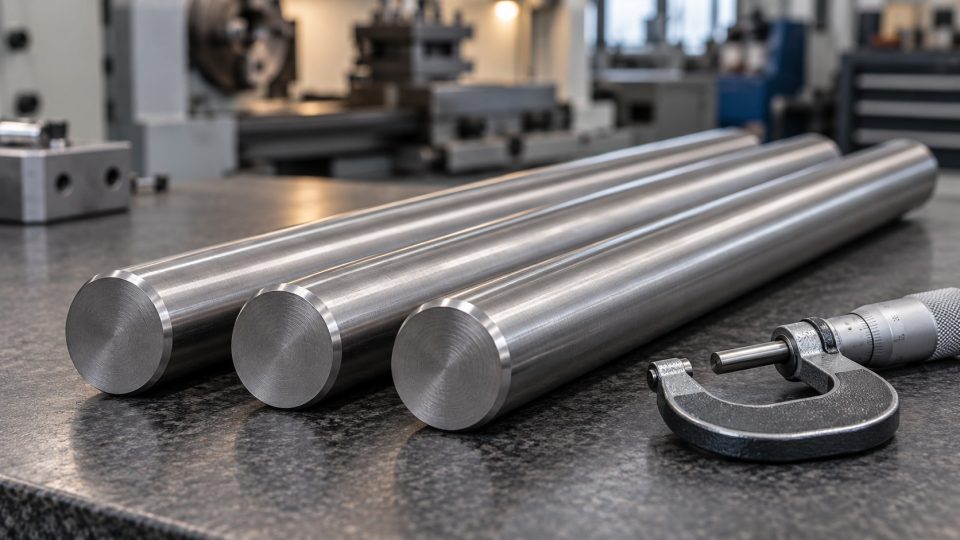
X46Cr13, also designated by the number 1.4034, is a hardenable martensitic stainless steel. It is used for precision guide shafts, among other applications. When purch...
X46Cr13, also designated by the number 1.4034, is a hardenable martensitic stainless steel. It is used for precision guide shafts, among other applications. When purchasing, however, distinguish between the material grade and the finished shaft design. The word “stainless” alone does not confirm resistance to every cleaning agent, and X46Cr13 alone does not specify the diameter tolerance.
When selecting a part for a linear guide, check the operating conditions, bearing or bush requirements and the specifications of the particular design together. The following is a sequence for this check.
What do X46Cr13 and 1.4034 mean?
These are two designations for the same grade. The first is the steel name, the second the material number. They identify the material, not the complete part specification. They do not automatically establish the purchased shaft's length, tolerance, roughness or hardness.
X46Cr13 may attract a magnet. This is a property of this martensitic steel, so magnetic attraction does not rule out stainless steel construction. However, a magnet test does not replace grade identification based on the designation and delivery documentation.
Where is X46Cr13 used?
The grade is used in machine components and tools requiring hardness after appropriate heat treatment. For linear technology, finished precision shafts running with linear bearings or plain bushes are relevant.
This does not mean that any X46Cr13 bar is a ready-made raceway for a ball bearing. The required surface finish and shaft parameters must meet the guide documentation. Use of the grade in a particular industry also does not automatically approve every part for food contact or a medical device.
Can an X46Cr13 shaft corrode?
Yes. The term “stainless” does not mean resistance to all conditions. The grade documentation indicates applications in moderately corrosive, chloride-free environments. Heat treatment condition and surface finish affect resistance. Do not extend this description to any chemical concentration, temperature and contact time.
Before selecting it for a station cleaned with chemicals, check the agent's composition, concentration, temperature and rinsing method. “Operation in damp conditions” alone is too general to confirm material compatibility.
Shaft manufacturer Schaeffler draws attention to the limited corrosion resistance of end faces and softened areas in shafts from this material group. After shortening or additional machining, do not assume that every exposed surface has the same properties.
How do you check a shaft before ordering?
- Start with the drawing and mating part. Establish the required diameter, length, tolerance and bearing or bush type. The material designation does not replace these data.
- Keep diameter and length separate. The notation h6 refers to the shaft diameter tolerance. It is not the cutting length tolerance. Confirm the required length accuracy separately in the order.
- When replacing a shaft, measure at several locations. Clean the surface and compare the diameter outside the visibly worn zone and in the working area. A single result from a worn location may underestimate the identified dimension.
- Select the instrument to suit the measurement purpose. A calliper helps provisionally identify the size. Assessing compliance with a precise tolerance requires an appropriate instrument, such as a micrometer, and a method and measurement uncertainty suited to the permissible deviations. One diameter measurement does not confirm straightness or roundness.
- Confirm the surface design and operating conditions. If the documentation requires specific hardness, roughness or hardened depth, check the data for the appropriate model. Do not assign values based solely on the name X46Cr13.
Selection example — 20 × 500 mm shaft
The NERON range includes the INA W20h6 X46Cr13 /0500 linear shaft. The checked data sheet states a nominal diameter of 20 mm, length of 500 mm, X46Cr13 / 1.4034 material and h6 tolerance.
Example assumption the drawing requires a shaft with a diameter of 20 mm to tolerance h6 and a nominal length of 500 mm. Agreement with these data allows the product to be selected for further verification, but does not yet confirm the entire selection. Bearing requirements, permissible length deviations, load, support spacing and operating environment must be compared separately.
If the device is cleaned with an agent containing chlorides, matching dimensions do not establish chemical resistance. If the documentation requires end machining, its scope and effect on the surface must be established. This example is neither a load capacity calculation nor approval of a particular application.
Three mistakes worth avoiding
- Buying a raw bar instead of a finished guide shaft. A common grade does not ensure the required finish and accuracy.
- Applying one design's data to all X46Cr13 products. Hardness, tolerance and delivery condition are verified for the part being ordered.
- Changing material solely on the basis of diameter. If you are considering other steels used for machine parts, the guide C45 or CF53 — what to check for hardening explains a separate issue. It does not confirm their interchangeability with X46Cr13.
What information should a shaft enquiry include?
Prepare the material designation, diameter and its tolerance, length with permissible deviation, drawing of any end machining and surface requirements. Add the mating part designation and an environmental description, particularly chemicals used. This allows specific designs to be compared instead of selecting solely by the word “stainless”.
Related articles
Steel for CNC machining — how to select the grade and delivery condition
Select steel for CNC machining according to the finished part requirements and planned manufacturing process. The grade name alone is not enough to select a tool and c...
Read article · 5 min
40HM / 42CrMo4 — what does +QT mean and how do you select a bar?
42CrMo4, designated by material number 1.7225 and compared with the former Polish designation 40HM, is a chromium-molybdenum steel for quenching and tempering. The gra...
Read article · 4 min
S235 or S355? Differences and checks before substitution
S355 has a higher minimum yield strength than S235 in a comparable thickness range, but is not an automatic substitute for every S235 component. Before purchasing, com...
Read article · 5 min