
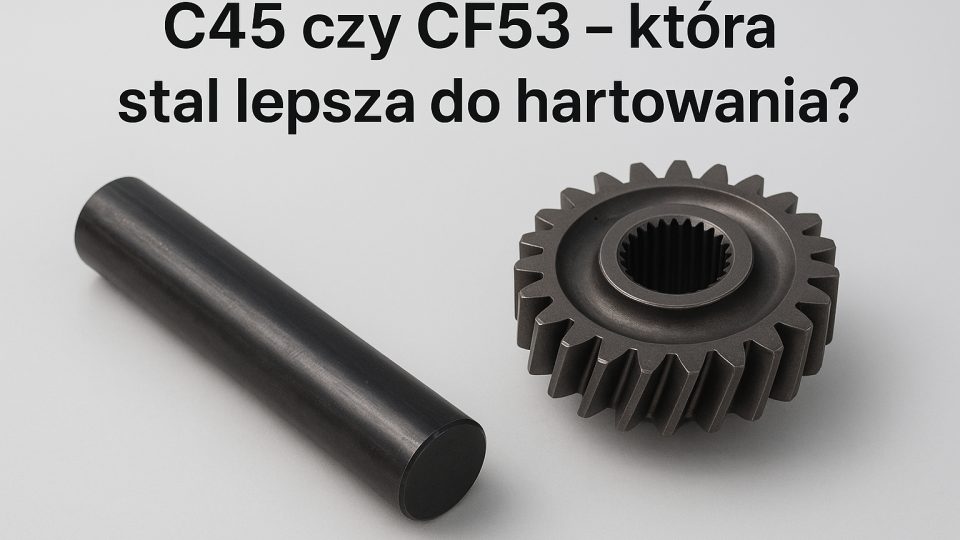
C45 and CF53 do not have a single universal application. When selecting, check whether you are buying material to manufacture a part or a finished shaft with a specifi...
C45 and CF53 do not have a single universal application. When selecting, check whether you are buying material to manufacture a part or a finished shaft with a specified surface and tolerance. The component requirements and delivery condition matter. The steel grade alone does not determine the hardness of the finished part.
C45 is associated with material number 1.0503, and Cf53 with 1.1213. Number 1.3505 refers to bearing steel 100Cr6. These designations must not be used interchangeably.
C45, CF53 and 100Cr6 — comparing the designations
Designation Material number What should you distinguish when buying? |
Designation Material number What should you distinguish when buying? |
Designation Material number What should you distinguish when buying? |
Provide the full designation when ordering. C45E and C45R are separate variants. Do not omit the final letters from order documentation.
When should you consider C45?
C45 is a medium-carbon steel used in mechanical engineering. Its applications include mechanical parts requiring specified properties after processing. It can be quenched and tempered and can also be surface-hardened. Select the process to suit the particular part.
If manufacturing a component to a drawing, first establish the required properties and condition of the material for machining. Delivery-condition designations such as +N and +QT do not indicate identical properties. In the range of C45 steel bars check the specifications of the selected variant and the documentation needed for the order.
When does a finished CF53 shaft matter?
For a linear guide, the entire shaft matters, not just the steel name. Check diameter tolerance, surface quality, straightness and the requirements of the mating bearing. If the design requires a hardened surface, you also need its hardness and case-depth data.
Finished Cf53 shafts may have an induction-hardened and ground surface. This describes a product design. It does not mean that any bar of this grade already has the required properties. When browsing linear guides at NERON, compare the particular component's data sheet with the equipment requirements. A category name does not confirm the grade of every item.
Selection example — machining stock or a finished component?
Assumption you need a shaft for a linear guide working with a particular bearing. Ordering only “a bar of the same diameter” is incomplete. You must also establish the tolerance, surface and heat-treated condition required by the assembly manufacturer.
In the second case, you are manufacturing a mechanical part to a drawing with specified heat treatment. You then order material and delivery condition suited to that process. These two orders cannot be equated merely because both components are cylindrical.
What should you specify to avoid a mistake?
- the full grade and material number stated in the documentation,
- diameter, length and required tolerances,
- delivery condition and whether you are buying material or a finished component,
- surface and heat-treatment requirements,
- a drawing or part designation and the required material document.
Do not assume one hardening temperature or hardness is universal for every C45 or CF53 variant. Determine the heat-treatment cycle for the actual material, cross-section and required properties. If the specification is incomplete, send your requirements to NERONto establish which details of the offered component need confirmation.
Can C45 and CF53 be used interchangeably?
Do not regard them as replacements based only on appearance or diameter. Assess conformity against the part documentation and processing requirements. C45 does not denote a finished hardened and ground shaft, and CF53 is not a designation for 100Cr6. The correct choice follows from the application and confirmed product specifications.
Related articles
Wood screws vs metal screws – understand the differences and avoid installation mistakes
What are the main differences when comparing wood screws with metal screws, and how do they affect correct installation? The main difference lies in thread geometry an...
Read article · 7 min
Everything worth knowing about grease nipples
Modern machinery and equipment depend not only on their design but, above all, on how they are maintained. Correct servicing of lubrication points is one of the most i...
Read article · 6 min
Kluber greases – why does choosing the right lubricant matter?
In precision engineering and heavy industry, there is no room for half measures. Every machine, whatever its purpose, needs proper protection to operate reliably for m...
Read article · 5 min