
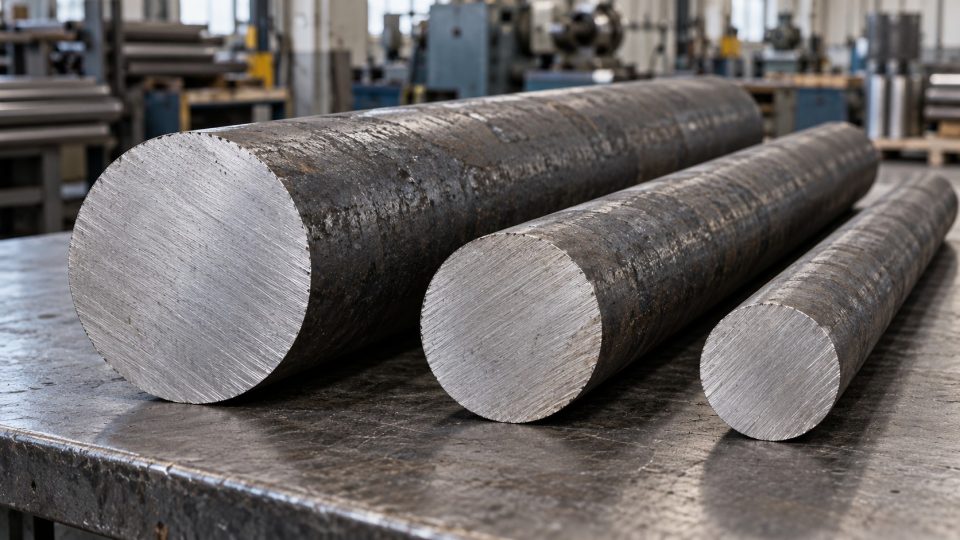
42CrMo4, designated by material number 1.7225 and compared with the former Polish designation 40HM, is a chromium-molybdenum steel for quenching and tempering. The gra...
42CrMo4, designated by material number 1.7225 and compared with the former Polish designation 40HM, is a chromium-molybdenum steel for quenching and tempering. The grade designation alone is not enough when purchasing. Establish the delivery condition, cross-section and required properties as well.
The most important question is are you buying material for subsequent heat treatment, or a bar that has already been quenched and tempered? The answer should come from the order specification, not the surface appearance.
40HM, 42CrMo4 and 1.7225 — how do you read these names?
42CrMo4 is the grade designation and 1.7225 its material number. The name 40HM appears in former Polish terminology and comparison tables. This comparison helps read older documentation, but does not replace comparing standard requirements and delivery documents.
The designation 40HMT may also appear in product offers. Check its meaning in the particular data sheet before purchasing. The unambiguous indication of the quenched and tempered condition is the designation +QT, confirmed in the product specification.
What do +A and +QT mean?
- +A — soft-annealed condition. It does not confirm the properties required after quenching and tempering.
- +QT — quenched and tempered condition. The requirements for the relevant cross-section and product form must still be checked.
Do not simply order a “40HM bar” if the drawing requires 42CrMo4 +QT material. Omitting the delivery condition leaves an important part of the specification unresolved.
Why is there no single strength value for all 42CrMo4 steel?
Properties after heat treatment depend on the cross-section, among other factors. Manufacturer Lucefin's documentation divides the requirements for hot-rolled bars in the quenched and tempered condition into dimensional ranges.
Example of reading this data sheet for tests at room temperature
- Ø30 mm bar falls within the range above 16 up to and including 40 mm. The stated tensile strength range is 1000–1200 MPa.
- Ø130 mm bar falls within the range above 100 up to and including 160 mm. The stated range is 800–950 MPa.
This illustrates how to use the manufacturer's documentation, not a declaration of test results for a specific NERON batch. Do not apply the parameters of a thinner bar to a larger cross-section or the data for one product form to another.
+QT bar, surface hardening and chrome plating — separate information
The +QT condition describes the material's heat treatment. It does not automatically confirm an induction-hardened layer or chrome coating.
When selecting a component running with a seal or bearing, diameter tolerance, roughness, straightness and surface requirements may be needed in addition to grade and material condition. A 42CrMo4 +QT bar alone is therefore not a finished piston rod or guide shaft.
Similarly, a bright surface does not establish the manufacturing method. The differences between stock forms are explained in the guide drawn or rolled steel.
Offer check example — Ø130 × 1000 mm
The NERON data sheet for a 42CrMo4+QT round bar Ø130 × 1000 mm states the grade, +QT condition and nominal dimensions.
Suppose the part documentation requires 42CrMo4 +QT material of this cross-section and length. Matching these data allows the offer to be selected for further checking. It does not yet confirm tolerances, machining allowance or all required batch properties.
Before ordering, compare the following.
- Full grade designation and delivery condition.
- Diameter, length and permissible deviations.
- Mechanical requirements and material document.
- Planned processing, including any heat treatment.
- Surface and finished part requirements.
Do not determine the allowance simply by subtracting the nominal part diameter from the nominal bar diameter. The permissible stock dimensions, its actual condition and manufacturing process are needed.
Can 40HM be replaced with 40H steel?
Do not treat these designations as abbreviations of the same name. 41Cr4 / 1.7035, compared with 40H, is a different grade from 42CrMo4 / 1.7225. Matching diameter and similar appearance do not confirm interchangeability.
If you are considering a material change, compare the part requirements and obtain a decision from the person responsible for selection. A separate guide on 40H / 41Cr4 steel helps interpret its designations.
What must be established if the part will be welded?
42CrMo4 should not be treated as a universal steel for welded structures. The manufacturer's documentation indicates difficult weldability. Material selection and welding technology must be decided before purchasing. A general guide does not replace a procedure for the particular joint.
What should a material enquiry include?
State the grade, delivery condition, dimensions with tolerances, quantity, mechanical requirements, product standard and required material document. Include a drawing if it specifies machining or particular acceptance criteria.
“42CrMo4 +QT, round bar, Ø130 mm, nominal length 1000 mm” is the start of a specification. Add the requirements from the part documentation instead of assuming that the grade name alone settles the entire purchase.
Related articles
Steel for CNC machining — how to select the grade and delivery condition
Select steel for CNC machining according to the finished part requirements and planned manufacturing process. The grade name alone is not enough to select a tool and c...
Read article · 5 min
X46Cr13 (1.4034) — applications and linear shaft selection
X46Cr13, also designated by the number 1.4034, is a hardenable martensitic stainless steel. It is used for precision guide shafts, among other applications. When purch...
Read article · 5 min
S235 or S355? Differences and checks before substitution
S355 has a higher minimum yield strength than S235 in a comparable thickness range, but is not an automatic substitute for every S235 component. Before purchasing, com...
Read article · 5 min