
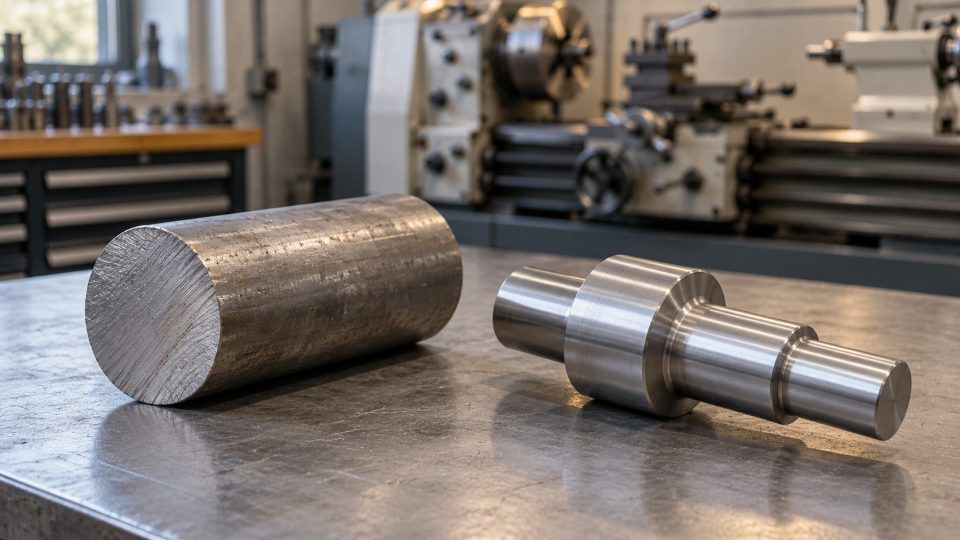
Select steel for CNC machining according to the finished part requirements and planned manufacturing process. The grade name alone is not enough to select a tool and c...
Select steel for CNC machining according to the finished part requirements and planned manufacturing process. The grade name alone is not enough to select a tool and cutting parameters. You also need to know the material condition, hardness and operations to be performed.
This guide helps prepare a bar purchasing specification and data for the manufacturing engineer. It does not identify a single “best CNC grade”. Ease of manufacturing the component is only part of the decision, alongside the required part properties.
Start with the part drawing and sequence of operations
First read the grade, material condition and finished component requirements from the documentation. Establish whether the part will be turned, milled, drilled or threaded, and whether subsequent heat treatment and finishing are planned.
If the drawing requires C45, do not replace it with another steel solely because it is easier to machine or available in the right diameter. A material change must be decided by the person responsible for the part requirements. Similarly, machinability alone does not confirm the required strength, corrosion resistance or weldability.
Keep grade, delivery condition and hardness separate
The grade specifies which material you are ordering. The delivery condition describes how it has been prepared. Hardness is separate information needed for machining planning. Do not infer it from bar brightness or the diameter tolerance designation.
For example, h9 refers to dimensional tolerance, not hardness. The description “C45, drawn, h9” does not by itself specify the heat treatment condition. In contrast, +QT means the quenched and tempered condition. It does not replace stating the actual or required hardness for tool selection. Interpreting this condition is explained in the guide 40HM / 42CrMo4 — what +QT means.
Also establish at which stage fitted surfaces will be produced. If hardening or another operation is planned after turning, the process should include subsequent finishing and dimensional inspection. Do not assume one universal allowance for all grades and processes.
How do material data translate into tool selection?
Tool manufacturers divide workpiece materials into groups and subgroups. They consider composition, structure and properties such as hardness and strength. Only on this basis do they select the tool and initial cutting conditions.
The general label “for steel” is therefore not precise enough. Catalogues include group P for steels and H for hardened materials, among others. Find the assignment of the particular material in that tool manufacturer's documentation. Do not automatically transfer its subgroup numbers to another brand's catalogue.
Do not assume that C45 and C45E are freely interchangeable simply because a similarly named material appears in a cutting table. Compare the exact designation required by the drawing and the delivery data. A tooling table helps plan machining, but does not approve a grade change.
Offer check example — C45 h9 Ø40 × 1000 mm
Suppose the part documentation requires C45 steel and the manufacturing engineer is considering purchasing round stock with a nominal diameter of 40 mm and length of 1000 mm. The data sheet for the drawn C45 h9 bar Ø40 × 1000 mm at NERON allows the offer to be compared with these assumptions.
What can be read from the data sheet?
C45 grade, drawn design, h9 diameter tolerance and nominal cut length dimensions. These data relate to a specific variant, not any bar from the same category.
What remains to be established before cutting?
Heat treatment condition and hardness, the material document required by the customer and stock compatibility with the workholding and machining plan. Tool selection also requires the range of operations to be performed.
What decision follows from the comparison?
An offer meeting part of the description is a candidate for further inspection, not a ready-made manufacturing process. If the documentation requires a specific condition or properties, confirm them before ordering. h9 alone does not settle the entire purchase.
What data is needed to select cutting parameters?
- Exact material and its condition grade designation, available hardness data and delivery documentation.
- Operation for example, rough external turning, finishing, drilling or threading. The term “CNC machining” alone does not describe the same conditions.
- Component geometry and access dimensions of the machined area, drawing requirements and limitations of workholding or tool overhang.
- Specific tooling system tool, insert or milling cutter, holder, and machine tool and coolant capabilities.
- Acceptance criteria tolerances, required surface and finished part inspection method.
Select speed, feed and cutting depth from the recommendations for this defined combination. Treat catalogue values as a starting point for process verification. Copying rotational speeds from a guide without material and tool data does not produce comparable conditions.
What should an enquiry for steel for CNC parts include?
Provide a drawing or unambiguous specification including grade, required condition, dimensions with tolerances, number of cut lengths and required material document. Add planned heat treatment if it affects purchasing requirements. Diameter and length selection should consider the process, not just finished part dimensions.
If the stock form has not been decided, also compare drawn and rolled bar. Before purchasing, resolve three separate questions. Will the material meet the part requirements? Is the selected cut length suitable for the planned machining? Do the material data allow tool selection? Each requires a different check.
Related articles
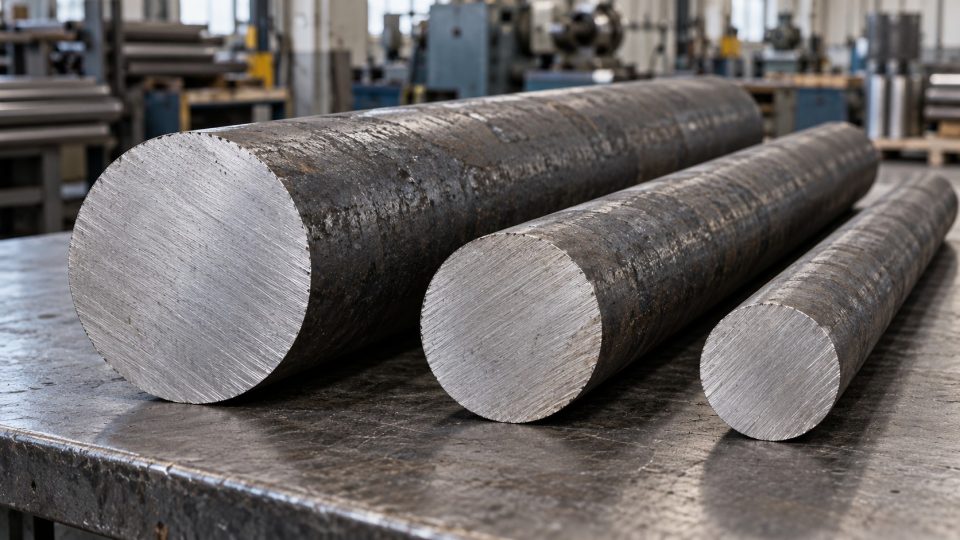
40HM / 42CrMo4 — what does +QT mean and how do you select a bar?
42CrMo4, designated by material number 1.7225 and compared with the former Polish designation 40HM, is a chromium-molybdenum steel for quenching and tempering. The gra...
Read article · 4 min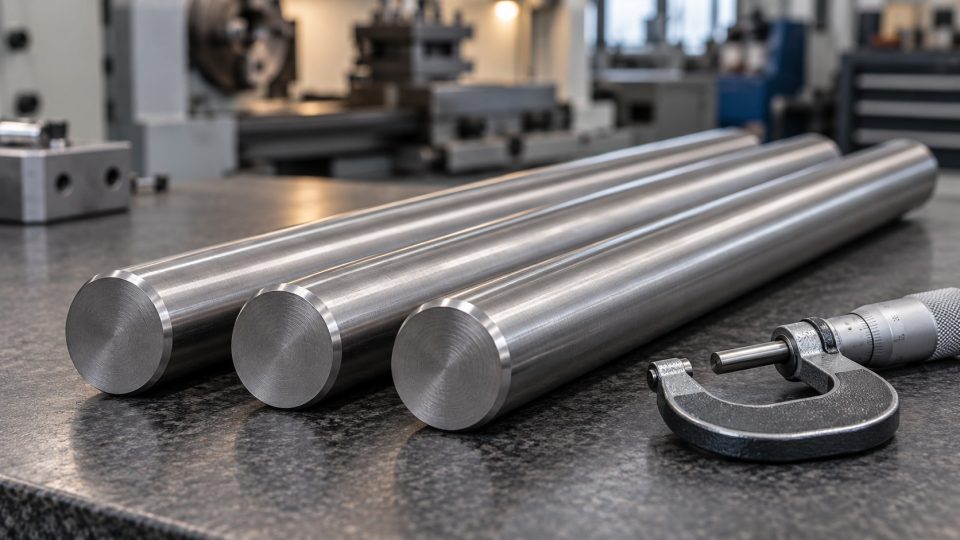
X46Cr13 (1.4034) — applications and linear shaft selection
X46Cr13, also designated by the number 1.4034, is a hardenable martensitic stainless steel. It is used for precision guide shafts, among other applications. When purch...
Read article · 5 min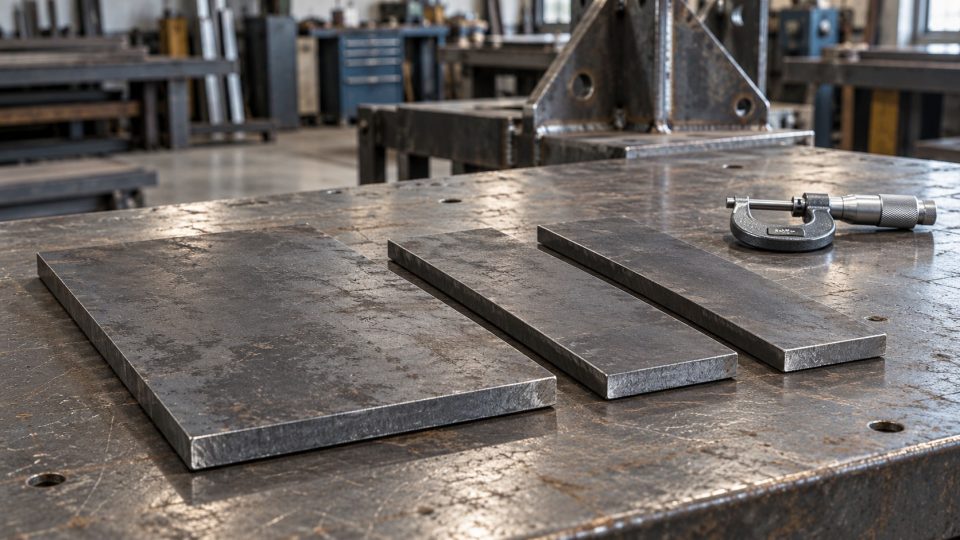
S235 or S355? Differences and checks before substitution
S355 has a higher minimum yield strength than S235 in a comparable thickness range, but is not an automatic substitute for every S235 component. Before purchasing, com...
Read article · 5 min