
S355 has a higher minimum yield strength than S235 in a comparable thickness range, but is not an automatic substitute for every S235 component. Before purchasing, com...
S355 has a higher minimum yield strength than S235 in a comparable thickness range, but is not an automatic substitute for every S235 component. Before purchasing, compare the full grade, product standard, thickness and delivery condition. Also check whether the part documentation permits the material change.
This guide helps compare two grades before ordering plate or other stock. The detailed meaning of letters and suffixes is explained in a separate article on S235 steel designations. Here we focus on differences relevant to material selection and substitution.
S235 and S355 — what are we actually comparing?
In these structural steel designations, the numbers 235 and 355 refer to minimum yield strength within a specified thickness range. Yield strength describes the onset of permanent deformation in an appropriate material test. It is not hardness, tightening torque or the permissible weight on a finished structure.
First choose the correct standard and product form, then compare the numbers. The following two lists apply to hot-rolled S235JR and S355JR plates to EN 10025-2, in the 5–40 mm range. They are not a table of properties for all bars, tubes and hollow sections.
Plate with nominal thickness from 5 up to and including 16 mm
- S235JR minimum yield strength 235 MPa.
- S355JR minimum yield strength 355 MPa.
Plate thicker than 16 mm, up to and including 40 mm
- S235JR minimum yield strength 225 MPa.
- S355JR minimum yield strength 345 MPa.
Crossing the 16 mm boundary changes the required minimum despite the same number in the grade name. Do not copy the values from the first list for thicker plate. These are minima for the specified product range, not measured results for a specific warehouse batch.
Example — why is “S355 plate, 20 mm thick” insufficient?
Example assumption the drawing requires 20 mm plate in grade S355JR to EN 10025-2. For this thickness range, the minimum being compared is 345 MPa, not 355 MPa. An offer described only as “S355” does not yet confirm the JR suffix, delivery condition or material document.
Do not fill in missing data based on dimensions or a photograph. Request confirmation of the full specification. This example does not calculate the load capacity of a bracket, welds or connections. That cannot be established from the material designation alone.
Will S355 be stiffer and deflect less?
Higher yield strength does not mean proportionally greater elastic stiffness. A typical calculation model assumes the same Young's modulus for S235 and S355, namely 210 GPa. For the same geometry, supports and load, with both components operating in the linear elastic range, changing the grade alone does not produce a correspondingly smaller deflection.
This matters when a component “is too flexible”. Replacing S235 with S355 without changing the cross-section may not solve the problem. Deflection, stability and load capacity must be checked separately. Do not reduce thickness simply in the ratio of 235 to 355. Cross-section geometry, connections and support conditions still matter.
Can S355JR be replaced with S235JR or vice versa?
The documentation requires S355JR, but S235JR is available
At the same thickness of the plates being compared, S235JR has a lower required minimum yield strength. Matching dimensions do not suffice to accept it as a substitute. Before purchasing, the person responsible for the documentation must decide and the part requirements must be checked.
The documentation requires S235JR, but S355JR is available
Higher yield strength does not complete the check either. Compare the full specification, planned welding and forming, required documents and whether the design permits substitution. Do not promise greater load capacity for the entire structure solely on the basis of the new grade.
If there is no drawing or documentation for the previous component, a calliper measurement alone will not establish the grade. Measuring dimensions and identifying material are two separate tasks.
Welding S235 and S355 — what must be checked?
Do not select welding technology solely by the number in the name. Assessing cracking risk includes material composition, thickness, hydrogen in the weld, heat input and joint restraint. Before changing the grade, check whether the intended welding procedure specification (WPS) covers the new material and thickness.
There is no single preheating temperature suitable for every S355 plate, nor a rule that “S235 never needs preheating”. Process parameters and filler material should follow the appropriate procedure. This guide does not replace a WPS or select welding parameters for a particular joint.
JR, J0 and J2 — compare the grade suffix too
Do not compare only S235 and S355 while ignoring the suffixes. JR, J0 and J2 distinguish impact test requirements at the relevant temperature. Switching from S235J2 to S355JR does not confirm that all original material requirements are retained despite the higher number at the beginning of the designation. The test temperature alone is not a guaranteed operating temperature for the finished structure.
Likewise, “S355” on a data sheet is not enough to assign the J2 variant or +N condition. The full designation must be agreed for the product being ordered.
What should you send NERON before ordering?
- Material form and standard plate, bar or another product, and the standard stated in the documentation.
- Full grade including suffixes and required delivery condition, instead of simply “S235” or “S355”.
- Dimensions thickness, width, length, tolerances and any surface requirements.
- Planned operations cutting, forming, welding or machining.
- Documents and substitution required material document, quantity and whether another grade has been approved.
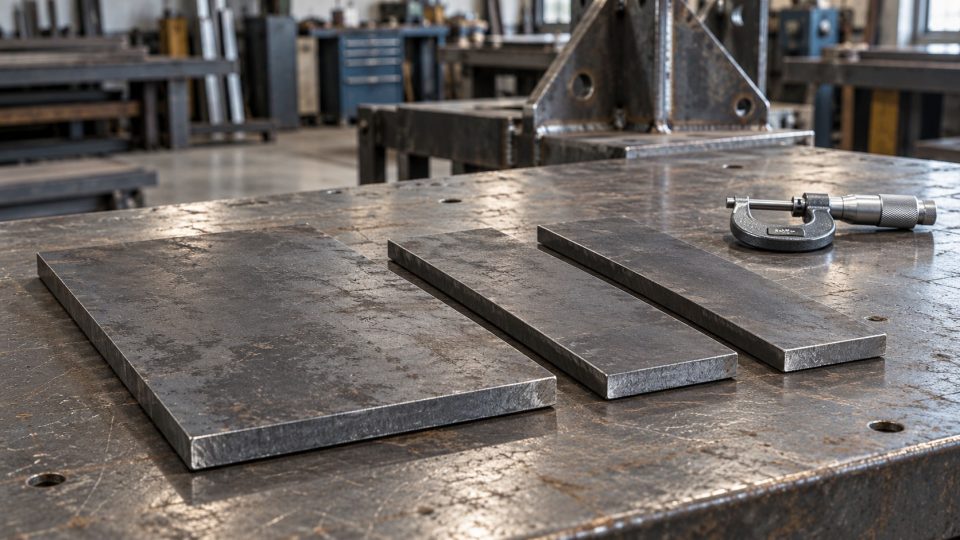
An example material form is shown on the data sheet for an S355 plate blank 20 × 120 × 1130 mm. The data sheet gives the general designation S355. This link does not confirm a JR, J0 or J2 variant or values for a specific batch. If the design requires these data, send the requirements to NERON before ordering.
The cover illustrates stock on a workshop bench. Appearance, colour and machining marks cannot distinguish S235 from S355 or confirm material properties.
Related articles
Steel for CNC machining — how to select the grade and delivery condition
Select steel for CNC machining according to the finished part requirements and planned manufacturing process. The grade name alone is not enough to select a tool and c...
Read article · 5 min
40HM / 42CrMo4 — what does +QT mean and how do you select a bar?
42CrMo4, designated by material number 1.7225 and compared with the former Polish designation 40HM, is a chromium-molybdenum steel for quenching and tempering. The gra...
Read article · 4 min
X46Cr13 (1.4034) — applications and linear shaft selection
X46Cr13, also designated by the number 1.4034, is a hardenable martensitic stainless steel. It is used for precision guide shafts, among other applications. When purch...
Read article · 5 min