
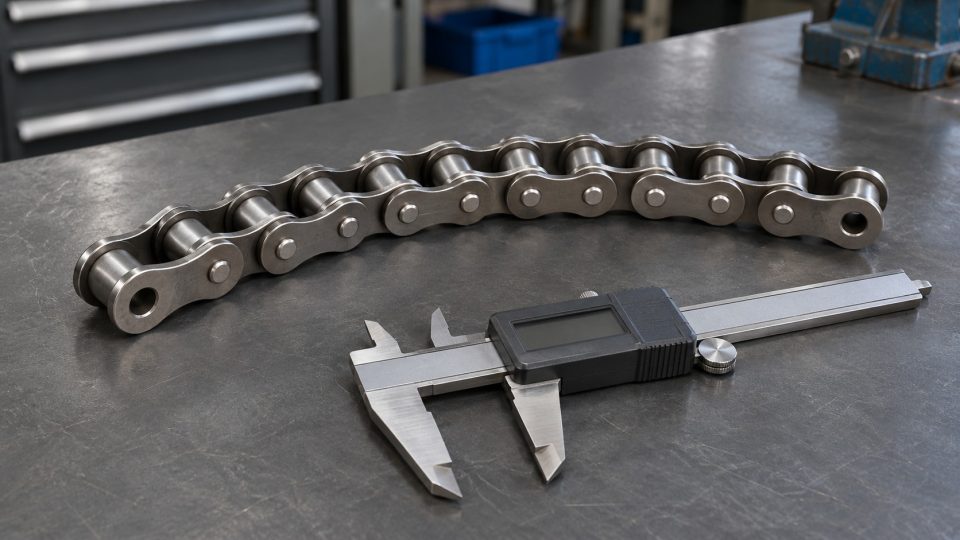
08B-1 and ANSI 40-1 chains have a pitch of 12,7 mm, but are not the same size. They differ in roller diameter and width between inner plates, among other dimensions. T...
08B-1 and ANSI 40-1 chains have a pitch of 12,7 mm, but are not the same size. They differ in roller diameter and width between inner plates, among other dimensions. The description “half-inch chain” is therefore insufficient to order a part for an existing drive. Establish the series, number of strands and design, then check compatibility with the sprockets and machine documentation.
What can you read from the designation 08B-1?
In this designation, 08B identifies the B-series size, and -1 means single-strand, or simplex. The pitch is 1/2 inch, or 12,7 mm. Pitch is the distance between the axes of adjacent pins, not the plate length or roller diameter.
In ANSI catalogues, size 40-1 also appears with the reference 08A-1. The letter A matters. 08A-1 does not mean 08B-1. Do not remove it from the enquiry just because both chains are described as half-inch.
08B-1 and ANSI 40-1 — compare the correct dimensions
The following values come from SKF standard chain tables. The designations d1 max and b1 min retain their meaning from that catalogue, maximum roller diameter and minimum distance between inner plates. This is a catalogue comparison, not a complete standard tolerance table or a measurement result for a particular delivery.
08B-1 — B series, single strand
- Pitch p 12,70 mm.
- Roller diameter d1 max 8,51 mm.
- Width between inner plates b1 min 7,75 mm.
ANSI 40-1 / 08A-1 — A series, single strand
- Pitch p 12,70 mm.
- Roller diameter d1 max 7,95 mm.
- Width between inner plates b1 min 7,85 mm.
Conclusion a shared pitch does not mean matching tooth engagement geometry. Do not approve replacing 08B-1 with ANSI 40-1 based solely on pin spacing or trying the chain on a sprocket.
Use the relevant manufacturer's documentation. For example, for its 40-1 the Renold catalogue specifies a roller diameter of 7,92 mm. Do not combine values from different catalogues into one supposed specification for all designs. A small difference measured on a worn roller does not establish the designation either.
How do you measure an old chain without confusing pitch?
Measure after stopping the drive and securing it against starting. Clean an accessible section and read markings from the plates and packaging or documentation. Record the full designation, including design suffixes.
- Count the roller strands. One strand is a different design from two strands, even at the same pitch.
- Measure from axis to axis. Several pitches are easier to check on a straight section. Ten gaps encompass eleven consecutive pin axes.
- Divide the length by the number of gaps. In an explicit example of an ideal, unworn section, the distance from the first to the eleventh axis is 127,0 mm. The result 127,0 / 10 = 12,7 mm determines pitch, but still does not distinguish 08B-1 from ANSI 40-1.
- Check the rollers and internal clearance. Do not substitute overall width measured over projecting pin ends for width between the plates.
- Compare results with the sprocket designation and catalogue. If the designation is illegible or wear is severe, retain photographs and a sample for identification. Do not order based solely on one calliper measurement.
Joint wear can increase the measured section length. Do not automatically round such a result to a different chain size. Elongation assessment and replacement limits follow the manufacturer's recommendations for that drive.
How do you check a chain and sprocket offer?
An example from the NERON range is the SKF PHC 08B-1X5MTR-AG chain. The data sheet confirms a single-strand design and a 5 m pack. Pack length does not specify the number of links required for the closed loop in your machine. Retain the full designation in the order. Do not omit design suffixes without checking.
For the sprocket, compare series, number of strands, tooth count and shaft mounting. The Hubber 08B-1 Z12 sprocket with hub is a specific example of a sprocket for this series. Its data sheet specifies a pilot bore intended for further machining. A matching 08B-1 designation therefore does not mean a ready fit on any shaft.
Do not confuse a single-strand design with the SKF PHC 08B-2 chain. The suffix -2 means two strands. Selecting a multiple-strand chain requires suitable sprockets and a check of the entire drive.
What should you send for replacement selection?
- Full chain and manufacturer designation, photographs of plates and available machine data.
- Pitch, number of strands, roller diameter and width between inner plates, stating that a used component was measured.
- Required length or number of pitches in the loop and joining method.
- Sprocket designations, tooth count and shaft mounting data.
- Operating conditions including speed, load, shocks, lubrication and environment.
These data separate size identification from drive selection for the load. Breaking strength in a table alone is not a permissible working force. Select the connecting link for the specific series and design according to the manufacturer's documentation, not just “1/2 inch”.
Related articles
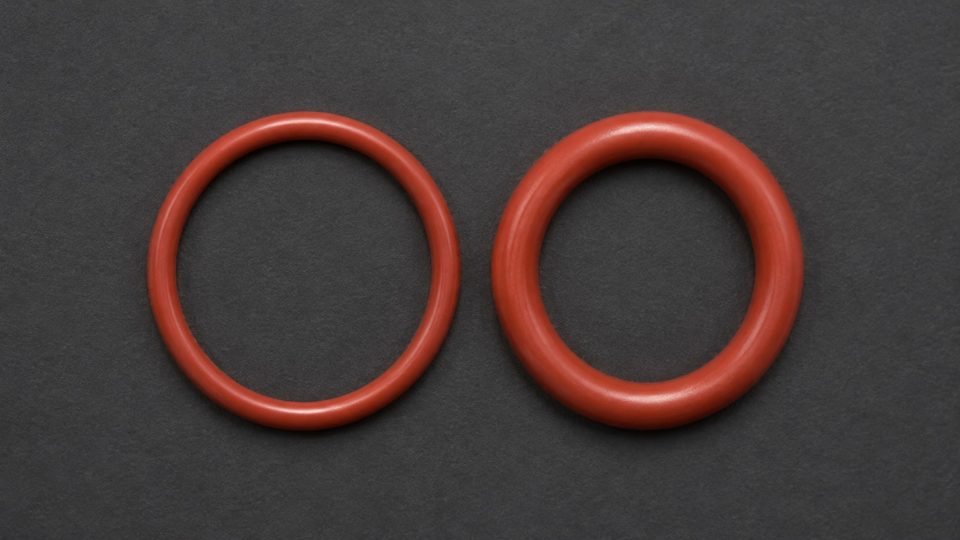
O-ring 24 mm na zewnątrz — jak odróżnić 20 × 2 od 18 × 3?
Jeśli O-ring ma około 24 mm średnicy zewnętrznej, zmierz jeszcze jego otwór i grubość przekroju. Nominalnie zarówno 20 × 2 mm, jak i 18 × 3 mm dają 24 mm na zewnątrz. ...
Read article · 3 min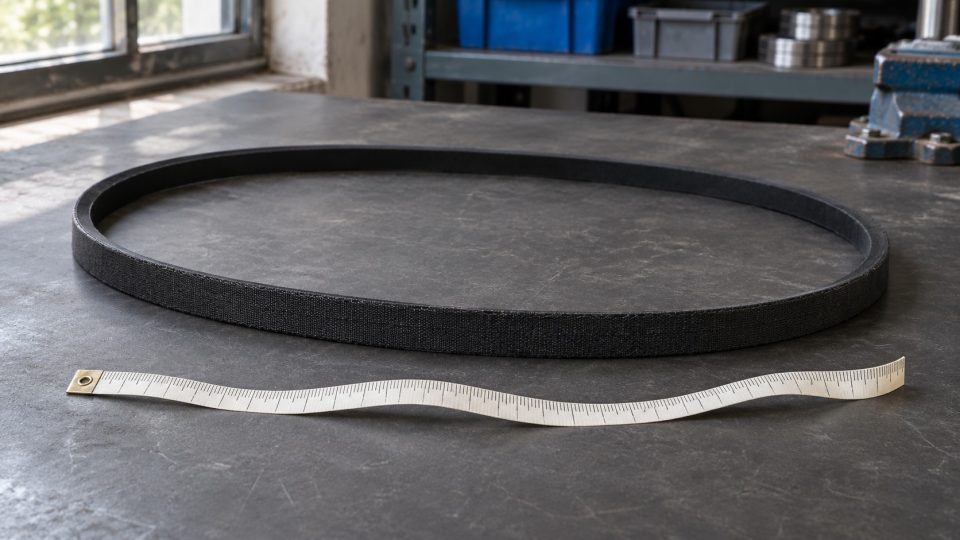
Pasek klinowy Li, Ld czy La — którą długość podać przy zakupie?
W zamówieniu paska klinowego podaj profil, liczbę określającą długość i jej symbol. Sam zapis „1000 mm” pozostawia pytanie: chodzi o obwód wewnętrzny, zewnętrzny czy d...
Read article · 3 min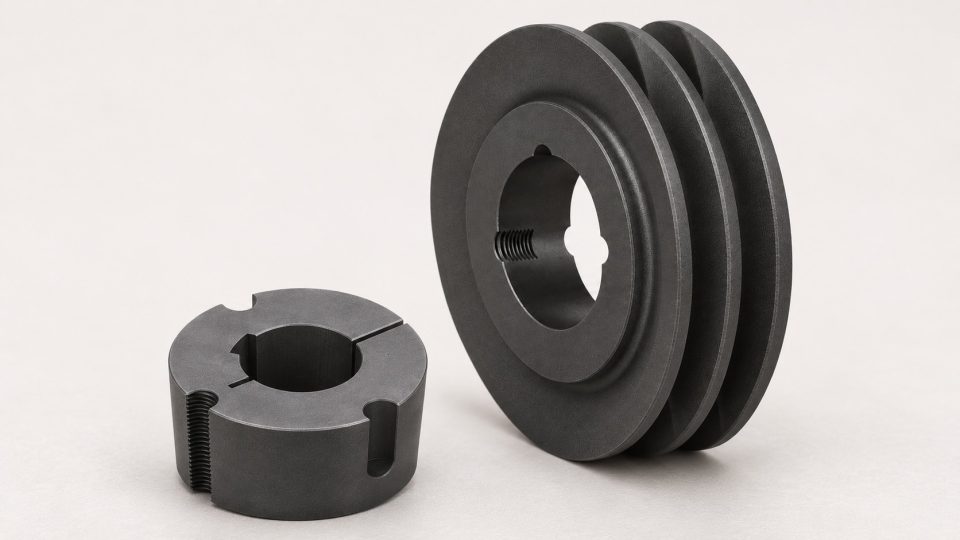
Tuleja Taper Lock 1610/25 — jak dobrać ją do wału i koła pasowego?
Masz wał o średnicy 25 mm i szukasz tulei do koła pasowego? Zacznij od sprawdzenia gniazda w piaście koła. Jeżeli koło jest przewidziane pod tuleję 1610, a wał ma nomi...
Read article · 3 min