
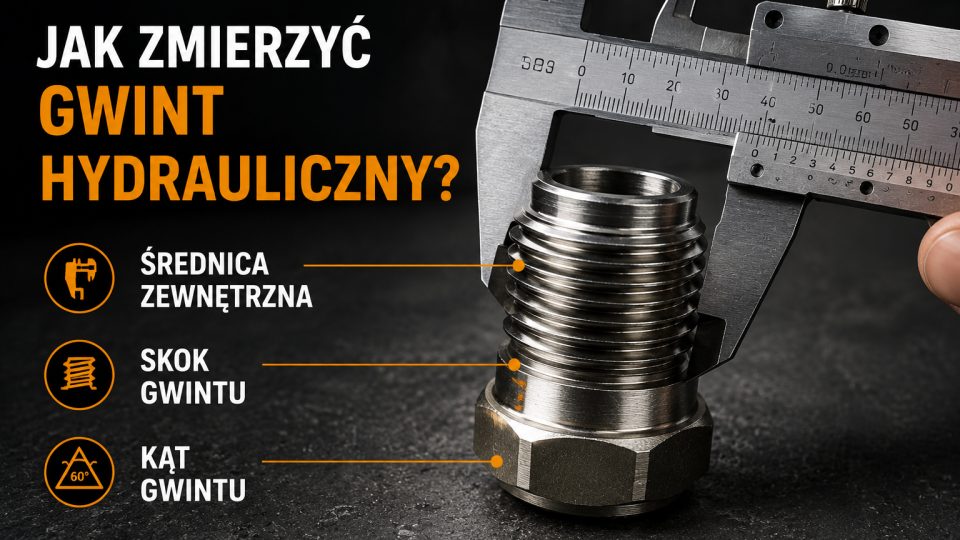
Correct measurement of a hydraulic thread is essential when selecting fittings, adapters, quick couplings and hydraulic hoses. Incorrect measurement can lead to purcha...
Correct measurement of a hydraulic thread is essential when selecting fittings, adapters, quick couplings and hydraulic hoses. Incorrect measurement can lead to purchasing unsuitable components and problems with assembly and hydraulic system sealing.
To measure a hydraulic thread correctly, determine the following.
- thread diameter,
- thread pitch,
- thread type,
- sealing method.
Which tools should be used to measure a hydraulic thread?
For correct measurement, prepare
- a calliper,
- a thread pitch gauge,
- a thread gauge,
- a hydraulic thread table.
How do you measure the thread diameter?
The first step is to measure the thread diameter using a calliper.
For a male thread, initially measure the diameter over the thread crests. For a female thread, the calliper jaw reading relates to a different surface and cannot be compared directly with the outside diameter column. For a tapered thread, the measuring location must be established.
The measurement alone narrows down the choice. It does not yet uniquely identify the size or standard. Also compare pitch/TPI, thread shape and sealing surfaces.
The most common hydraulic thread diameters
The following approximate values apply to the BSP family. They are neither a universal conversion from inches to mm nor thread manufacturing dimensions. For BSPT, account for the measuring location on the taper. Pitch/TPI and sealing must be confirmed separately.
BSP size | Outside diameter ≈ mm | TPI — threads/inch |
|---|---|---|
1/4 | 13,2 | 19 |
3/8 | 16,7 | 19 |
1/2 | 20,9 | 14 |
3/4 | 26,4 | 14 |
1 | 33,2 | 11 |
1 1/4 | 41,9 | 11 |
1 1/2 | 47,8 | 11 |
2 | 59,6 | 11 |
Approximate values for identification, not manufacturing tolerances. For BSPT, account for the measuring location on the taper.
The designation 1/2 in the BSP family describes a nominal size. It is not an outside diameter measurement of 12,7 mm.
How do you measure thread pitch?
After measuring the diameter, determine the thread pitch. The easiest way is to use a thread pitch gauge.
Thread pitch specifies the distance between consecutive thread turns and is one of the most important identification parameters.
Two threads can have very similar diameters but completely different pitches.
How do you identify the hydraulic thread type?
After taking measurements, check the connection's sealing method.
- BSPP — parallel thread, with sealing outside the thread according to the fitting design, for example on a cone or at the port. Related NERON materials BSP.
- BSPT — sealing in the thread,
- NPT — tapered thread,
- JIC — 37° cone,
- ORFS — sealing with an O-ring.
Sealing geometry is an important clue, but confirm identification together with the profile, diameter and pitch or TPI.
Common mistakes when measuring threads
- measuring without a calliper,
- omitting thread pitch,
- assessing a thread solely by appearance,
- confusing BSP with NPT,
- failing to check the sealing method.
Why is the diameter in mm not equal to the inch designation?
For BSP pipe threads, the nominal size is not a simple conversion of the measured outside diameter to inches. Do not extend this rule to every inch thread system.
For example, in a BSP identification table, size 1/2 has an approximate outside diameter of about 20,9 mm and 14 threads per inch. Do not apply this example to any 1/2 thread, such as NPT or UN/UNF.
Therefore, always use hydraulic thread tables.
Frequently asked questions
Is a calliper sufficient to measure a thread?
No. A calliper measures diameter, but full identification also requires checking the thread pitch.
How do you distinguish BSP from NPT?
Check the thread profile, pitch and sealing method. Despite their similar appearance, these are different standards.
How do you identify an ORFS thread?
An ORFS thread has a characteristic O-ring on the fitting's face.
Why do two threads with similar diameters not fit together?
Most often, they differ in pitch, profile or sealing method.
Summary
Correctly measuring a hydraulic thread requires determining diameter, pitch and sealing method. This helps avoid mistakes when selecting fittings, adapters and hydraulic hoses.
Related articles
- How to identify a hydraulic thread
- Types of hydraulic threads
- BSP vs NPT — how do the threads differ?
- ORFS vs BSP — hydraulic thread differences
- How to seal hydraulic threads
Related products
- Hydraulic adapters
- BSP fittings
- ORFS fittings
- Hydraulic quick couplings
- Hydraulic hoses
Related articles
Common mistakes when selecting hydraulics
A matching connection size is not enough when selecting power hydraulic components. Before purchasing, confirm the requirements of the entire connection, including pre...
Read article · 4 min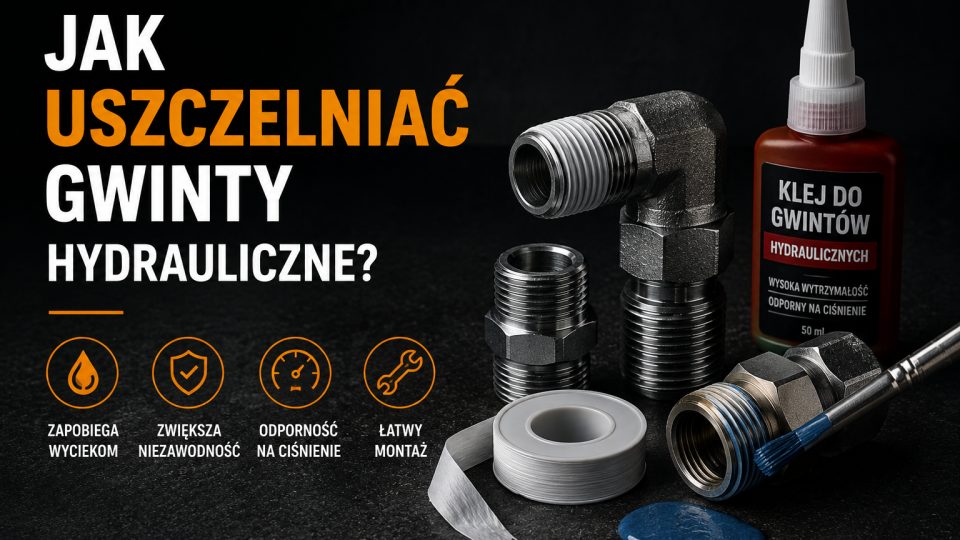
How to seal hydraulic threads?
Correct sealing of hydraulic threads is essential to the leak-tightness and safety of the entire hydraulic system. Inadequate sealing can lead to oil leaks, pressure d...
Read article · 3 min
What does DN12 mean?
DN12 is a nominal size designation used in hydraulics. It does not automatically mean that every bore, thread or hose measures exactly 12 mm. Check how the designation...
Read article · 3 min