
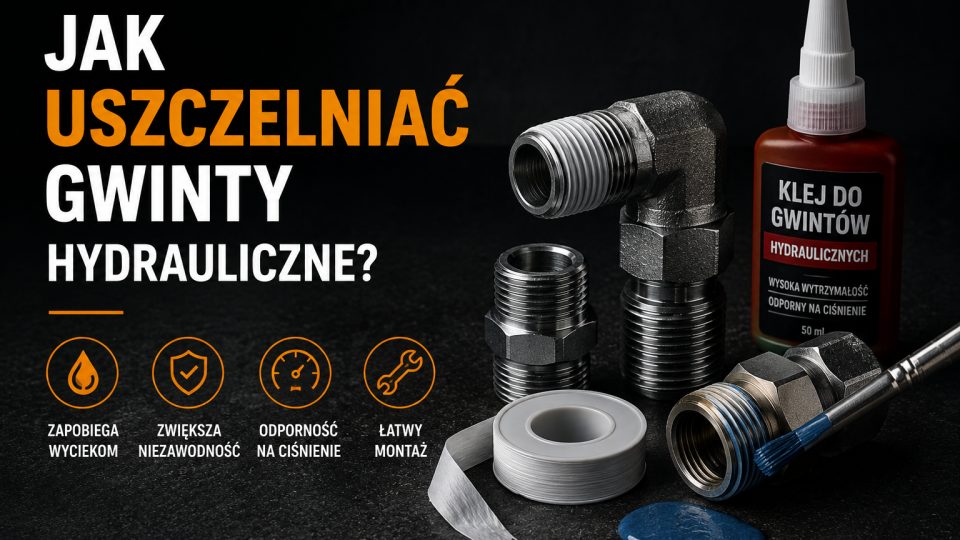
Correct sealing of hydraulic threads is essential to the leak-tightness and safety of the entire hydraulic system. Inadequate sealing can lead to oil leaks, pressure d...
Correct sealing of hydraulic threads is essential to the leak-tightness and safety of the entire hydraulic system. Inadequate sealing can lead to oil leaks, pressure drops and damage to hydraulic components.
The following are most commonly used in hydraulics
- PTFE (Teflon) tape,
- hydraulic thread sealants,
- O-rings,
- flat gaskets,
- conical seals.
Why is correct sealing so important?
Hydraulic systems operate at very high pressure, so even a small leak can cause
- hydraulic oil leaks,
- pressure drops,
- air entering the system,
- damage to pumps and valves,
- reduced system performance.
The most common methods of sealing hydraulic threads
PTFE (Teflon) tape
PTFE tape is one of the most common methods of thread sealing. It is used mainly with tapered threads such as NPT or BSPT.
During assembly, you should
- wrap the thread in the tightening direction,
- avoid using too much tape,
- leave the start of the thread uncovered.
Hydraulic thread sealant
Anaerobic adhesives provide very high leak-tightness and resistance to pressure and vibration. They are often used in power hydraulics and industrial installations.
O-ring sealing
In ORFS systems and some metric connectors, sealing is provided by an O-ring on the connector's end face.
A damaged or incorrectly selected O-ring very often causes hydraulic leaks.
Conical sealing
Some hydraulic threaded connections seal through a suitable cone and do not require additional sealing materials.
Common mistakes when sealing hydraulic systems
- too much PTFE tape,
- using an unsuitable sealant,
- a damaged O-ring,
- overtightening the thread,
- connecting incompatible threads.
The most common seal types
Hydraulics uses different types of seals depending on the thread type and application
- BSP – sealing with a washer or flat gasket,
- BSPT – sealing at the thread,
- NPT – conical sealing,
- ORFS – O-ring sealing,
- JIC – 37° conical sealing.
Frequently asked questions
Does every hydraulic thread require Teflon tape?
No. Some systems, such as ORFS or JIC, have their own sealing surfaces and do not require additional sealing.
Why does a hydraulic system leak despite using PTFE tape?
The most common causes are
- the wrong thread type,
- a damaged thread,
- incorrect tape application,
- overtightening the connection.
Does ORFS require Teflon tape?
No. In ORFS connectors, sealing is provided by an O-ring on the connector's end face.
Which is better — PTFE tape or thread sealant?
Thread sealant provides higher resistance to vibration and very good leak-tightness, while PTFE tape is quicker and easier to apply.
Summary
Correct sealing of hydraulic threads has a major impact on the safety and reliability of the complete hydraulic system. Pay particular attention to thread type, the appropriate sealing method and the quality of the components used.
Related articles
- How to identify a hydraulic thread?
- Types of hydraulic threads
- ORFS vs BSP — differences between hydraulic threads
- How to select a hydraulic hose?
Related articles
Common mistakes when selecting hydraulics
A matching connection size is not enough when selecting power hydraulic components. Before purchasing, confirm the requirements of the entire connection, including pre...
Read article · 4 min
What does DN12 mean?
DN12 is a nominal size designation used in hydraulics. It does not automatically mean that every bore, thread or hose measures exactly 12 mm. Check how the designation...
Read article · 3 min
How to select a hydraulic hose
Selecting the right hydraulic hose is crucial to the safety, efficiency and service life of the entire hydraulic system. An incorrectly selected hose can cause pressur...
Read article · 4 min