
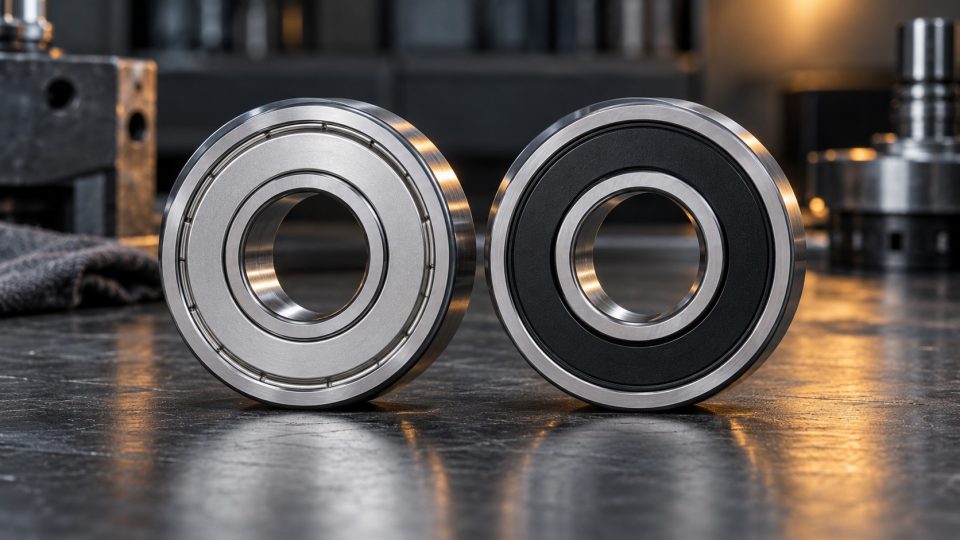
ZZ vs 2RS bearings — which seal should you choose? ZZ and 2RS are most commonly seen on deep groove ball bearings. Both versions are closed on both sides and generally...
ZZ vs 2RS bearings — which seal should you choose?
ZZ and 2RS are most commonly seen on deep groove ball bearings. Both versions are closed on both sides and generally factory-greased, but protect the interior differently. ZZ means two metal shields, usually without contact with the inner ring. 2RS means two elastomer seals, most often contacting the appropriate ring surface.
The difference affects dust and moisture protection, frictional torque, permissible speed, temperature and grease life. Neither version is always better. ZZ suits high speeds and cleaner surroundings, while 2RS provides a stronger barrier against dirt, splashing and frequent washing. The final choice should follow the specific manufacturer's catalogue and actual operating conditions.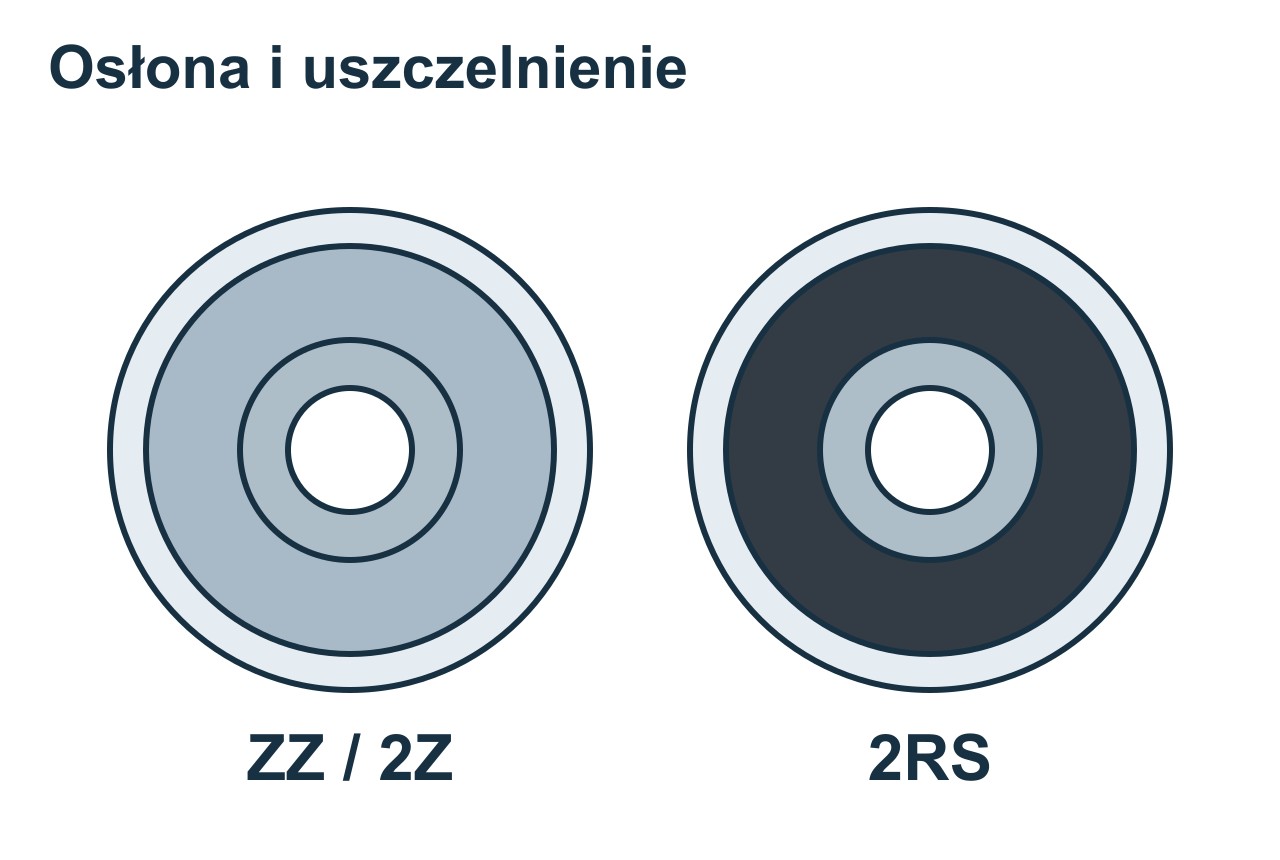 Illustrative view, metal shield on the left and elastomer seal on the right. Suffixes, lip contact and permissible parameters depend on manufacturer and specific design. Appearance alone does not identify the variant.
Key information at a glance
Criterion ZZ / 2Z 2RS Practical conclusion |
Criterion ZZ / 2Z 2RS Practical conclusion |
Criterion ZZ / 2Z 2RS Practical conclusion |
Criterion ZZ / 2Z 2RS Practical conclusion |
Criterion ZZ / 2Z 2RS Practical conclusion |
Criterion ZZ / 2Z 2RS Practical conclusion |
What exactly do ZZ and 2RS mean?
Z traditionally means a shield on one side, while ZZ or 2Z means shields on both sides. A shield is usually fixed in the outer ring and forms a narrow gap to the inner ring. Without rubbing against the ring, it adds very little frictional torque. It retains grease and limits larger contaminants, but the gap does not effectively block water, steam or fine dust.
RS means a seal on one side and 2RS seals on both sides. A typical seal has an elastomer lip with metal reinforcement. The lip contacts the ring surface to form a more effective barrier. Contact also increases friction, heat generation and lip wear.
Designations are not entirely universal. SKF uses 2RS1, 2RSH and 2RSL among others, FAG may use 2RSR or 2HRS, while NSK uses DDU for contact seals and VV for non-contact seals. ZZ can be equivalent to 2Z. When changing brands, compare not just the bearing number but contact type, seal material, grease, clearance and limiting speed.
How does a metal ZZ shield work?
The steel shield covers the entrance gap and hinders direct particle entry to the raceways. Its main advantage is non-contact operation or very little influence on torque. Speed remains close to an open design, though exact values depend on grease, cage, clearance and manufacturer.
ZZ works well in electric motors, fans, rollers, office equipment, light gearboxes and mechanisms within dry, relatively clean housings. Metal shields tolerate many temperatures at which standard elastomers may deteriorate, but grease, cage and ring stabilisation still determine the entire bearing limit.
The gap is the weakness. Fine dust, pressurised liquid and steam can pass through. Do not treat ZZ as protection against water washing. With a housing labyrinth, shaft seal or other effective protection, a metal shield may suffice as a second stage.
How does a rubber 2RS seal work?
A 2RS seal has a lip usually contacting the inner ring. It hinders dust and moisture entry and retains grease better. In agriculture, conveyors, power tools, woodworking, outdoor equipment and heavily dusty halls, it is often safer than ZZ.
Lip contact produces frictional torque, especially noticeable in small low-power drives, cold starts and high-speed applications. Lip heat affects grease and elastomer, so the limiting speed of 2RS is generally lower than 2Z for the same bearing.
2RS does not automatically mean complete waterproofing. The seal primarily protects the bearing rather than acting as the main pressure barrier. Immersion, pressure washing, chemicals and hot steam may need special materials and extra shaft and housing seals.
ZZ vs 2RS bearings — technical comparison
Parameter ZZ / 2Z Contact 2RS Meaning for the user |
Parameter ZZ / 2Z Contact 2RS Meaning for the user |
Parameter ZZ / 2Z Contact 2RS Meaning for the user |
Parameter ZZ / 2Z Contact 2RS Meaning for the user |
Parameter ZZ / 2Z Contact 2RS Meaning for the user |
Parameter ZZ / 2Z Contact 2RS Meaning for the user |
Parameter ZZ / 2Z Contact 2RS Meaning for the user |
Parameter ZZ / 2Z Contact 2RS Meaning for the user |
When should you choose ZZ?
- High rotational speed. A non-contact shield limits additional friction and heat.
- Clean, dry environment. The motor or fan operates in a housing without water or fine dust contact.
- Low available drive torque. Low resistance matters in small motors, rollers and precision equipment.
- Higher ambient temperature. Metal does not age like rubber, but grease and cage limits need checking.
- Additional external sealing. The housing has an effective labyrinth or seal, with the shield providing secondary protection.
Do not choose ZZ merely because it looks stronger. A thin steel shield protects the interior mechanically and retains grease, but its main functional feature is low friction. In water-washed or fine-dust-ingesting machinery, speed advantages may not offset rapid raceway contamination.
When should you choose 2RS?
- Dust and dirt. Including woodworking, agriculture, conveyors, construction and many workshops.
- Moisture and splashing. The lip hinders water entry better than a shield gap.
- Difficult service access. Better grease retention and dirt exclusion support long maintenance-free operation.
- Low or moderate speed. Additional frictional torque fits within the power and temperature balance.
- Risk of grease loss. The seal limits leakage under vibration and changing orientation within its design limits.
Check temperature before selection. Standard nitrile rubber has a defined operating range, and hot, cold or chemically aggressive conditions may need another design. Also account for speed. Even if the seal excludes dirt, excessive speed can overheat the lip and grease.
Selecting sealing for operating conditions
Conditions Most common choice Why Additional checks |
Conditions Most common choice Why Additional checks |
Conditions Most common choice Why Additional checks |
Conditions Most common choice Why Additional checks |
Conditions Most common choice Why Additional checks |
Conditions Most common choice Why Additional checks |
Conditions Most common choice Why Additional checks |
Conditions Most common choice Why Additional checks |
Do closures change bearing load capacity and clearance?
For the same basic type, main dimensions and catalogue dynamic load rating are generally the same with ZZ or 2RS. The closure does not strengthen steel or enlarge balls. It does affect service life by determining how long grease stays clean and in suitable condition.
The sealing symbol does not define clearance class. A 6204-2RS/C3 has 2RS seals and C3 clearance, while 6204-2Z may have normal clearance without another marking. Read the entire designation when buying, including type, size, sealing, clearance, cage, grease and any accuracy class.
A contact seal may make a new bearing feel harder to turn by hand than ZZ. This is not automatically a defect. Assess smoothness, product specification and starting conditions. Jamming, roughness or metallic noise are not normal seal characteristics.
Temperature, speed and seal material
In a 2RS bearing, heat arises at both rolling contacts and the sealing lip. At high speed, temperature may shorten grease life and harden the elastomer. Comparing only maximum rubber temperature is insufficient. Check limiting speed, ring temperatures and expected grease life.
Common NBR elastomer works well in many industrial applications but has limits with very high temperature, ozone, aggressive chemicals and some oils. The manufacturer may offer FKM or another material for these conditions. Select special variants deliberately. Dark seal colour alone does not identify material.
ZZ has steel shields but does not automatically become a high-temperature bearing. Factory grease, polyamide cage and ring dimensional stabilisation may limit the range. Above standard operating temperatures, select a complete temperature-rated design rather than just replacing 2RS with ZZ.
Common ZZ and 2RS selection mistakes
- Assuming ZZ is watertight. A non-contact gap does not block a water jet.
- Assuming 2RS can be immersed. A standard bearing seal does not replace pressure sealing for the entire arrangement.
- Ignoring limiting speed. Versions of the same dimensions may have different permissible speeds.
- Ignoring elastomer temperature. The seal may harden, shrink or wear before the bearing itself is damaged.
- Selecting by photograph alone. Manufacturers use different symbols and contact designs.
- Removing closures for relubrication. This can deform the shield, damage the lip and introduce dirt.
- Confusing sealing and clearance. 2RS and C3 describe different product properties.
- No external sealing. In harsh environments, the bearing seal alone may be insufficient.
Can ZZ be replaced with 2RS?
With matching dimensions and basic designation, replacement is often mechanically possible but requires checking speed, torque, temperature and clearance. 2RS may protect better against dirt but raise temperature in a fast motor. In low-power equipment, extra resistance may change starting behaviour.
Replacing 2RS with ZZ reduces friction but may shorten life in dusty or damp conditions. If the designer specified 2RS, establish what the seal was intended to protect against. Retain the machine manufacturer's full specification unless an upgrade is supported by an operating-condition analysis.
Do not assume identical grease in all bearings with the same number. For quiet, high-speed or high-temperature applications, factory grease type and quantity may matter as much as sealing. Compare product data sheets for substitutes.
How to mount closed bearings correctly
- Keep the bearing in its original packaging until mounting and work at a clean station.
- Check the full designation, including ZZ, 2Z, 2RS, clearance class and any special design.
- Measure shaft and housing seat. A seal will not compensate an incorrect fit.
- Apply mounting force through the ring being interference-fitted, never through the balls.
- Do not press a sleeve against a metal shield or rubber seal.
- For thermal mounting, follow grease and seal material temperature limits.
- Do not wash factory-greased bearings in solvent or remove closures without instructions.
- After start-up, monitor temperature, noise and torque. New 2RS may resist more than ZZ, but motion should be smooth.
FAQ — ZZ and 2RS bearings
Do ZZ and 2Z mean the same thing?
Both most often mean metal shields on both sides. 2Z is common catalogue notation among European manufacturers, while ZZ is widespread in trade. Always check the manufacturer's key.
Is 2RS always a contact seal?
Usually, but low-friction and non-contact variants with other symbols also exist. Detailed geometry differs between brands, requiring the catalogue sheet.
Which bearing is faster, ZZ or 2RS?
Usually ZZ because the shield does not contact the ring and generates less friction. Check the exact limiting speed for size, grease and manufacturer.
Which design protects better against dust?
2RS generally excludes fine dust better. ZZ can suffice for larger dry particles with extra housing protection, but its gap admits fine contaminants more easily.
Is a 2RS bearing waterproof?
It protects better against moisture and splashing than ZZ, but should not automatically be considered watertight under immersion or pressure washing. Harsh conditions require extra sealing.
Can 2RS seals be removed?
Sometimes technically possible, but lip damage and contamination are easy. It also changes factory construction. For open running or periodic lubrication, choose the appropriate variant from the outset.
Do ZZ or 2RS need lubrication?
Bearings closed on both sides are generally factory-greased for their expected service life. Grease does not last indefinitely. Once it degrades, the whole bearing is often replaced.
Does 2RS have lower load capacity than ZZ?
Within the same construction, catalogue load capacity may be identical because it depends mainly on rolling component geometry and material. 2RS may have a lower limiting speed and different grease life under the conditions present.
What should you choose for an electric motor?
Retain the motor manufacturer's specification. ZZ is common in clean high-speed motors, but 2RS may be required for dust or moisture. Clearance, quiet running and grease type also matter.
Can 2RS be used at high temperature?
Only if seal material, grease, cage and rings are designed for that temperature. Standard elastomer may age faster. Sometimes ZZ is better, sometimes a special high-temperature seal.
Need help choosing a bearing?
Before buying, prepare the old bearing's full designation, speed, temperature and information on dust, water and machine washing. See ball bearings in the NERON store or browse the full bearing range. If unsure whether to choose ZZ or 2RS, send sales a photograph of the marking and operating conditions to select without guessing.
Summary
ZZ and 2RS protect bearing interiors differently. Metal ZZ shields provide low friction and generally higher permissible speed, suiting dry, clean, high-speed applications. 2RS seals exclude dust and moisture better but increase torque and temperature, with their range depending on the elastomer.
Selection should primarily consider contaminant type, water, speed, temperature and available torque. Check the full designation too, as manufacturer symbols differ and sealing defines neither clearance nor grease. Even 2RS may need extra housing sealing in harsh environments.
Related categories
Related articles
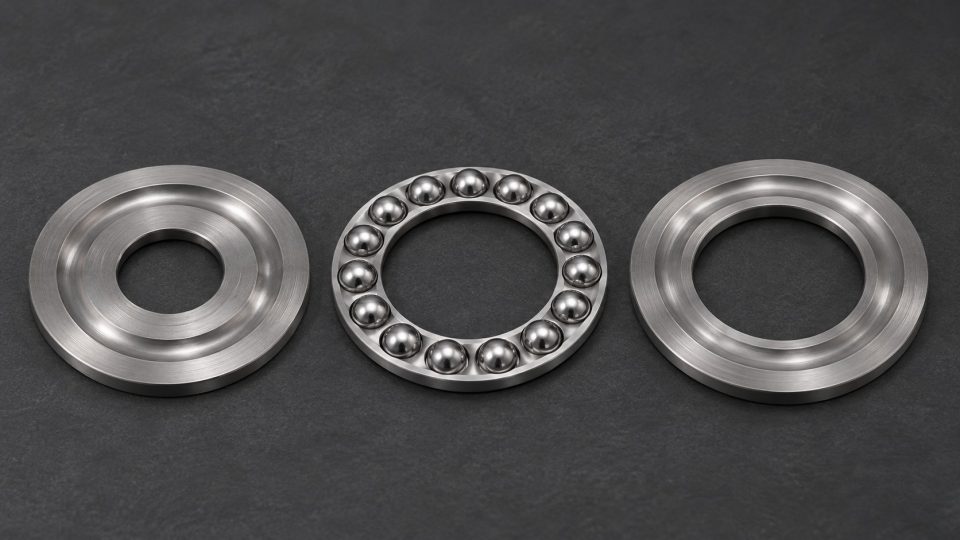
Łożysko oporowe 51105 czy 51205? Co zmierzyć przed wymianą
Okładka pokazuje rozłożone części poglądowo. Wymiary odczytaj z karty danego wykonania. Łożysko 51105 ma wymiary 25 × 42 × 11 mm, a 51205 ma 25 × 47 × 15 mm. Oba mają ...
Read article · 3 min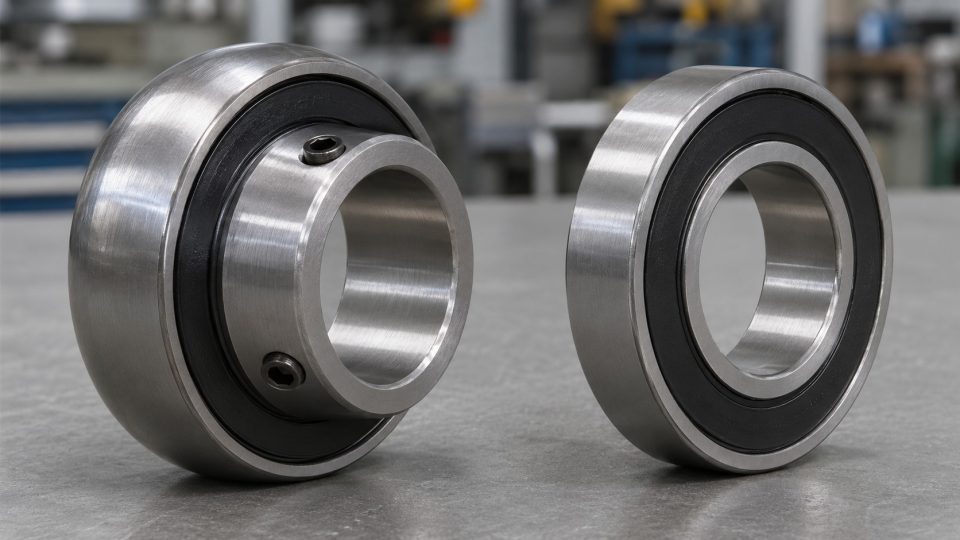
UC205 a 6205 — dlaczego wymiary 25 i 52 mm nie wystarczą?
UC205 i 6205 nie są bezpośrednimi zamiennikami tylko dlatego, że mają otwór 25 mm i średnicę zewnętrzną 52 mm. Przy zakupie sprawdź również kształt powierzchni zewnętr...
Read article · 3 min
causes of premature bearing wear
Causes of premature bearing wear – mounting errors, lubrication and contamination The most common causes of premature bearing wear are inadequate lubrication, lubrican...
Read article · 12 min