
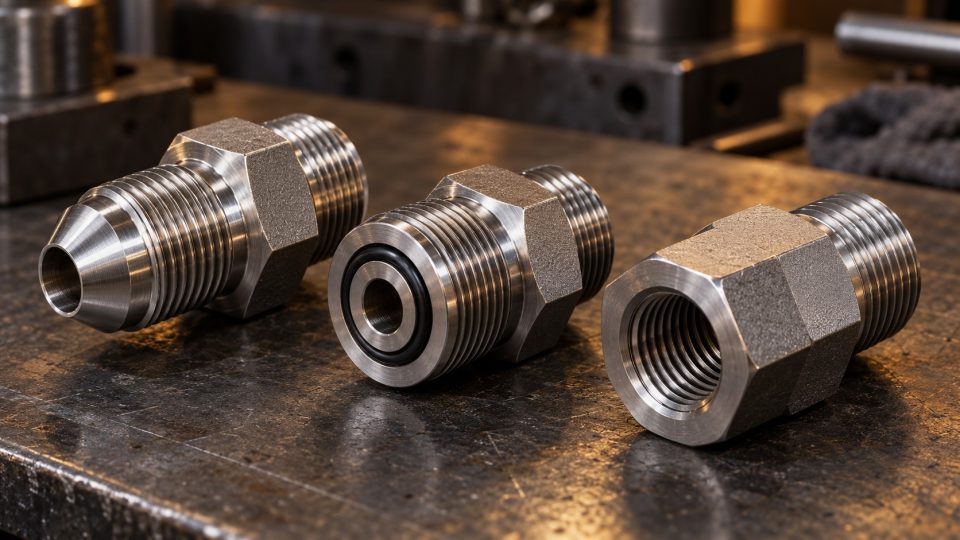
Hydraulic threads are among the most important components of connections used in power hydraulics. They ensure proper connection of hoses, quick couplings, adapters an...
Hydraulic threads are among the most important components of connections used in power hydraulics. They ensure proper connection of hoses, quick couplings, adapters and other hydraulic components. Knowing the types of hydraulic threads helps avoid leaks and incorrect selection of system components.
The most common hydraulic thread types are
- BSP,
- BSPT,
- NPT,
- JIC,
- ORFS,
- metric threads.
Why does the hydraulic thread type matter?
Despite their similar appearance, individual threads differ in profile, thread angle and sealing method. Using the wrong thread can lead to
- hydraulic oil leaks,
- connection damage,
- working pressure drops,
- hydraulic system failure.
BSP thread
BSP (British Standard Pipe) is the most popular thread used in Europe. It is available in both parallel and tapered versions. Sealing is most often achieved with a washer or seal.
BSP threads are widely used in
- power hydraulics,
- agriculture,
- construction machinery,
- industrial installations.
BSPT thread
BSPT is a tapered variant of the BSP thread. Sealing takes place directly on the thread, often using PTFE tape or thread sealant.
NPT thread
NPT (National Pipe Thread) is an American standard for tapered threads. NPT threads are not compatible with BSP despite their similar appearance.
They are most commonly found in
- machinery imported from the USA,
- industrial systems,
- mobile hydraulics.
JIC thread
JIC (Joint Industry Council) uses a characteristic 37° cone seal. Its high leak-tightness makes it common in high-pressure systems.
ORFS thread
ORFS (O-Ring Face Seal) is among the most leak-tight hydraulic connection systems. Sealing is provided by an O-ring on the fitting's face.
This solution is particularly popular in
- construction machinery,
- mobile hydraulics,
- systems operating at high pressure.
Metric threads
Metric threads are widely used in European industrial machinery and hydraulic systems. Their sizes are specified in millimetres, for example M18x1,5 or M22x1,5.
Comparison of the most popular hydraulic threads
The table below provides a quick comparison of the most common hydraulic thread standards.
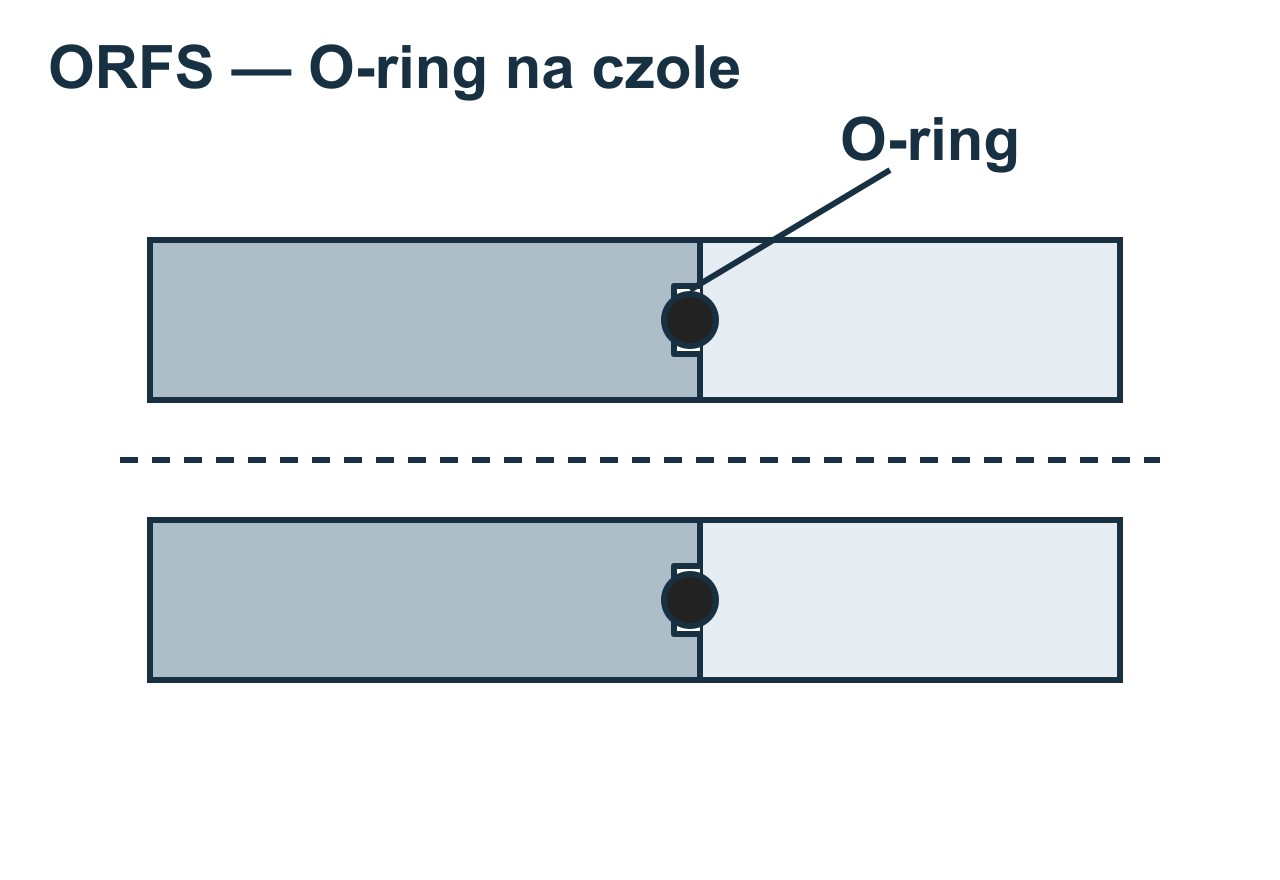 The O-ring lies in a groove on the male fitting's flat face and presses against the mating fitting's flat surface. The thread pulls the parts together. The drawing omits the nut and thread details to show the sealing location.
Common mistakes when selecting hydraulic threads
- confusing BSP with NPT,
- failing to check the sealing method,
- selecting a thread solely by diameter,
- using unsuitable adapters,
- connecting components of different standards.
Frequently asked questions
Which hydraulic thread is most popular in Europe?
BSP is the most commonly used standard.
Are BSP and NPT compatible?
No. Despite their similar appearance, they differ in profile and thread angle.
Which thread provides the highest leak-tightness?
ORFS, which uses an O-ring seal, is considered one of the most leak-tight systems.
How do you identify a hydraulic thread type?
Measure the diameter, determine the thread pitch and check the connection's sealing method.
Summary
Knowing hydraulic thread types helps avoid costly mistakes when repairing and upgrading power hydraulic systems. Pay particular attention to the thread standard, sealing method and component compatibility.
Related articles
- How to identify a hydraulic thread?
- BSP vs NPT — how do the threads differ?
- ORFS vs BSP — hydraulic thread differences
- How to seal hydraulic threads?
- How to select a hydraulic hose?
Related products
- Hydraulic adapters
- BSP fittings
- ORFS fittings
- Hydraulic quick couplings
- Hydraulic hoses
BSPP and BSPT are different designs. BSPP has a parallel thread and requires the seal outside the thread specified by the design. BSPT has a tapered thread and seals in the thread area. JIC denotes sealing on a 37° cone, and ORFS on a flat face with an O-ring. The JIC cone angle is not the thread profile angle.
Related articles
Common mistakes when selecting hydraulics
A matching connection size is not enough when selecting power hydraulic components. Before purchasing, confirm the requirements of the entire connection, including pre...
Read article · 4 min
How to seal hydraulic threads?
Correct sealing of hydraulic threads is essential to the leak-tightness and safety of the entire hydraulic system. Inadequate sealing can lead to oil leaks, pressure d...
Read article · 3 min
What does DN12 mean?
DN12 is a nominal size designation used in hydraulics. It does not automatically mean that every bore, thread or hose measures exactly 12 mm. Check how the designation...
Read article · 3 min