
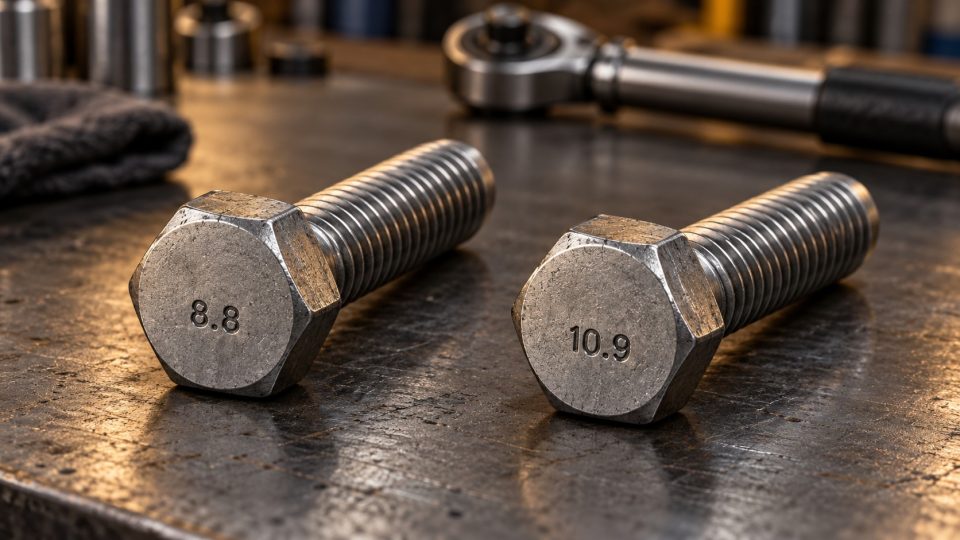
A class 10.9 bolt has higher nominal strength parameters than an 8.8 bolt. However, this does not mean they can be freely interchanged. Selection also requires checkin...
A class 10.9 bolt has higher nominal strength parameters than an 8.8 bolt. However, this does not mean they can be freely interchanged. Selection also requires checking bolt type, thread, length, coating and the requirements of the entire joint. Below we show how to read markings and what information to prepare before purchasing.
What do 8.8 and 10.9 on a bolt mean?
The two numbers separated by a dot describe the mechanical property class of a carbon or alloy steel bolt. The first number multiplied by 100 gives nominal tensile strength Rm in MPa. The second number divided by 10 indicates the nominal ratio of yield strength to tensile strength.
For class 8.8, the calculation is 8 × 100 = 800 MPa and 800 × 0,8 = 640 MPa. For class 10.9, we obtain 10 × 100 = 1000 MPa and 1000 × 0,9 = 900 MPa. MPa is a unit of stress. 1 MPa = 1 N/mm². It is not a mass that can safely be suspended from any bolt.
Bolt classes 8.8 and 10.9 — comparing nominal values
Tensile strength Rm
- Class 8.8 800 MPa
- Class 10.9 1000 MPa
Ratio of yield strength to Rm
- Class 8.8 0,8
- Class 10.9 0,9
Yield strength
- Class 8.8 640 MPa
- Class 10.9 900 MPa
The comparison explains how to read the class. It does not replace the full standard requirements or documentation for a specific product. Nominal values should not automatically be entered as the minimum values required in testing that bolt. Technical acceptance requires the requirements applicable to the specific product and appropriate documentation.
Tensile strength and yield strength describe different properties. The former relates to maximum stress in a tensile test, the latter to permanent material deformation. The class alone does not determine the permissible load of the finished joint.
Can an 8.8 bolt be replaced with a 10.9 bolt?
Class 10.9 should not be treated as an automatic substitute for 8.8. Start replacement with the equipment or joint documentation. If it specifies a particular class and assembly method, select a matching component. A class change should be approved by the equipment manufacturer or the person responsible for its design.
Before accepting a substitute, compare the following information.
- standard or drawing defining the design and head shape,
- diameter, thread pitch, length and threaded extent,
- bolt class and requirements for the mating nut, washer or thread in the part,
- coating, surface condition and lubrication conditions,
- tightening procedure and any requirement to use a new bolt.
Higher specifications for the bolt alone do not confirm compatibility of the entire assembly. Nor should you replace a 10.9 bolt with an 8.8 solely because the dimensions and head look identical. The joint requirements must be checked in both directions.
What tightening torque is needed for an 8.8 or 10.9 bolt?
The designation 8.8 or 10.9 alone cannot provide one correct tightening torque. Data on the specific joint are needed, including thread size and pitch, friction conditions, coating and lubrication. Use the equipment manufacturer's instructions or an approved assembly procedure.
If you use a torque table, check its assumptions. A row labelled “M10, 8.8” is not sufficient instruction if its assumed surface and lubrication conditions are unknown. Do not transfer torque from another bolt based solely on spanner size.
Does the same rule apply to every screw?
The comparison relates to mechanical property classes covered by ISO 898-1. It should not be applied to all threaded components. Set screws and similar elements not subjected to tensile loading fall within a different set of requirements, specified in ISO 898-5. A designation containing H is not equivalent to class 8.8 or 10.9.
Geometry also matters. Some screws with low or countersunk heads have reduced loadability due to head design. Material class does not allow this limitation to be ignored. Nor does it alone determine corrosion resistance or joint behaviour at every temperature.
How should you describe a bolt before purchasing?
Start with documentation and markings, and use measurement to check dimensions. Prepare the bolt type or standard, diameter and thread pitch, length, class and required surface finish. If the length is uncertain, use the guide how to select bolt length.
An example enquiry data list might read “M10 × 60, class 8.8, head type, manufacturing standard, thread pitch and coating according to the attached specification”. This illustrates wording, not the selection of a ready-made product or approval of an application. Without the missing information, it is not a complete order.
See bolts in the NERON range and compare the selected variant's data with the requirements. If anything is unclear, send the specification or a photograph of markings via NERON contact page. A photograph helps identify the component, but does not replace the documentation required to assess its properties.
Questions before selecting a bolt
Does 10.9 mean the bolt is stainless steel?
No. Class 10.9 relates to mechanical properties, not the description “stainless”. Designations such as A2-70 belong to a different material and property description system. Do not treat A2-70 and 8.8 as automatically equivalent substitutes.
Can colour or an absent marking establish the class?
Coating colour is not proof of strength class. If you cannot read the marking, check the delivery documentation and product identification. The absence of a legible number alone does not justify assigning class 8.8, 10.9 or any lower class to the component.
Related articles
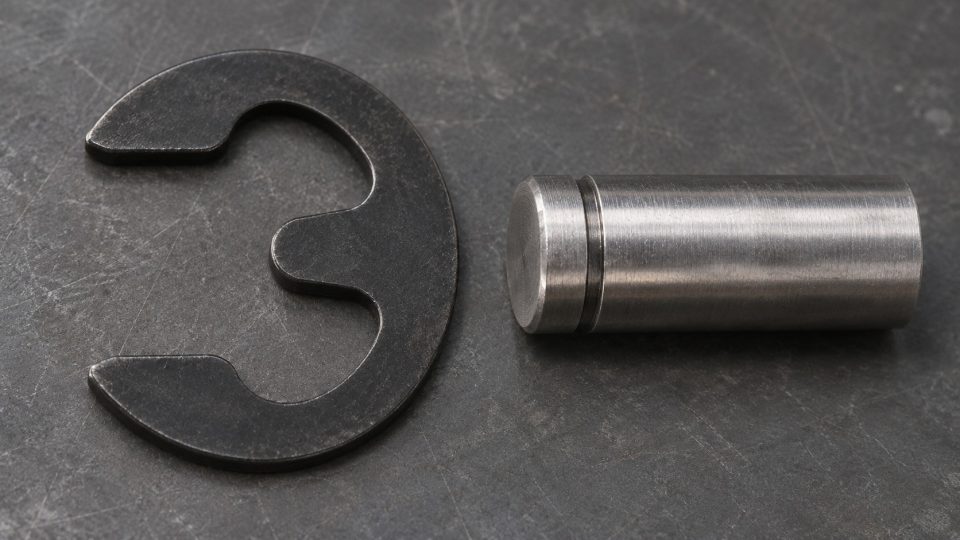
Płytka osadcza DIN 6799 — co oznacza rozmiar 8 mm?
Jeśli wymieniasz płytkę osadczą DIN 6799, sprawdź najpierw średnicę na dnie rowka. W oznaczeniu DIN 6799–8 liczba 8 odnosi się do nominalnej średnicy rowka d₂. Średnic...
Read article · 3 min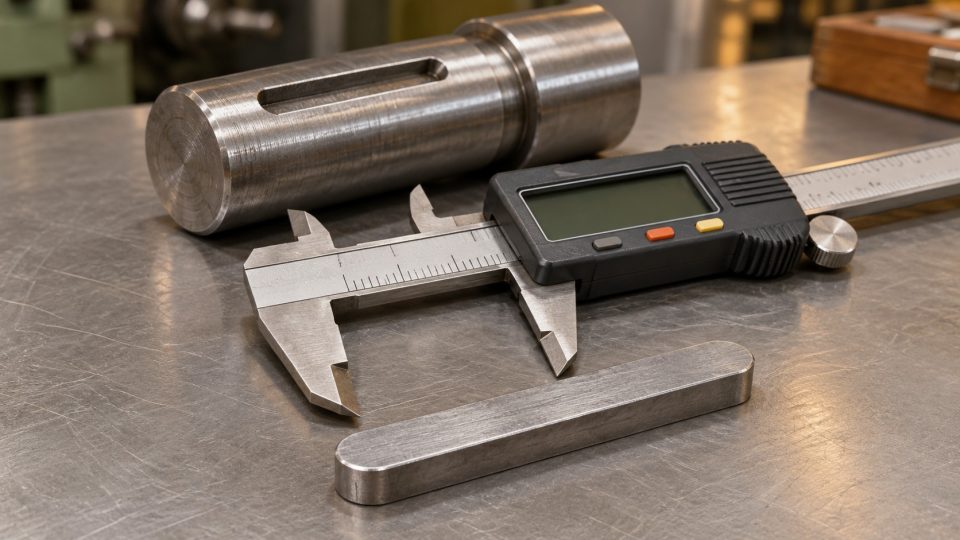
DIN 6885 parallel key — how to measure it and select a replacement?
A DIN 6885 parallel key is selected to suit the shaft and hub keyways, not solely the shaft diameter. Before purchasing, establish the width b, height h, length l, end...
Read article · 4 min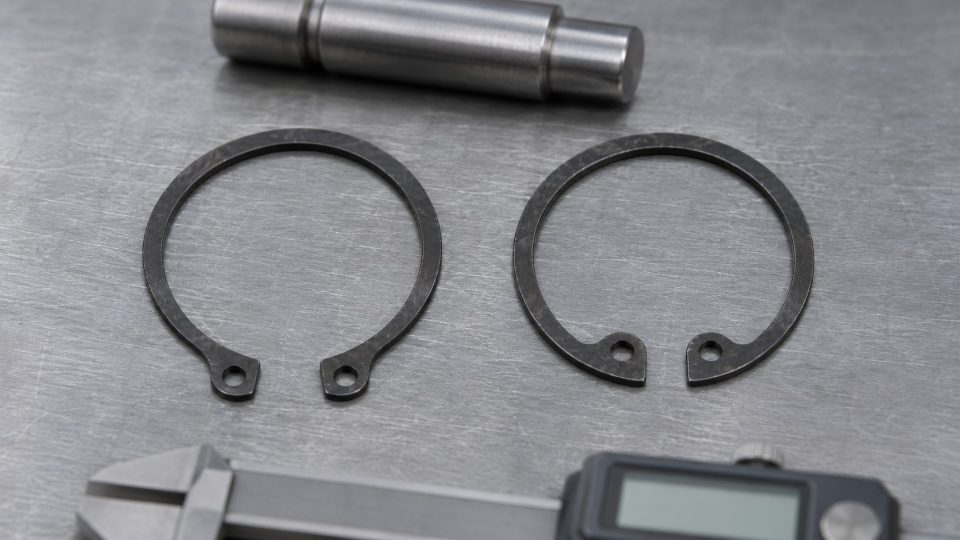
DIN 471 or DIN 472 circlip? How to select the size
DIN 471 denotes a retaining ring for a shaft, while DIN 472 denotes a ring for a bore. Before purchasing, establish the installation location, nominal shaft or bore di...
Read article · 5 min