
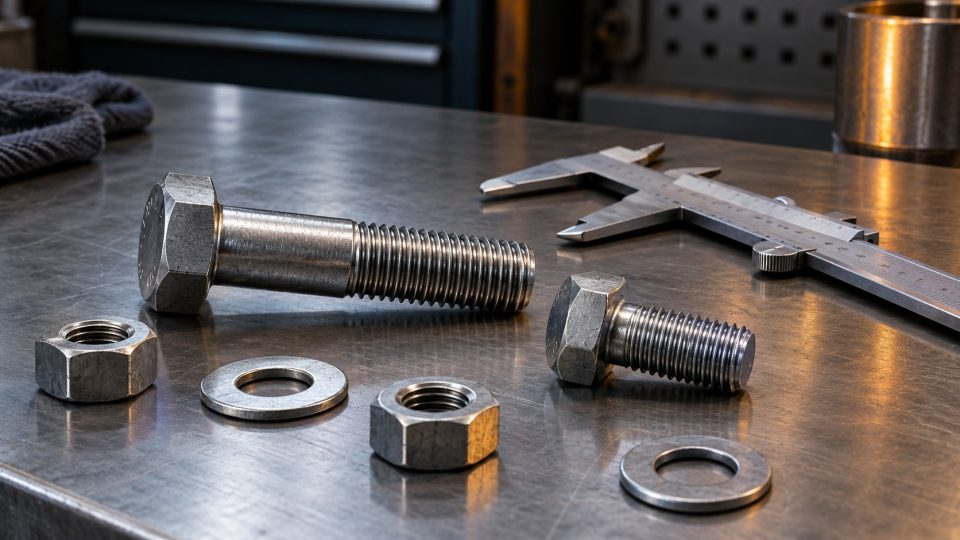
A correctly selected bolt should clamp the joined parts and provide the required thread engagement. A bolt that is too short may not span the entire joint; one that is...
A correctly selected bolt should clamp the joined parts and provide the required thread engagement. A bolt that is too short may not span the entire joint; one that is too long may bottom out in the hole or interfere with another machine component.
To select bolt length, establish how it is measured, measure the thickness of the parts being joined and allow for washers. Then check the space needed for the nut or the permissible insertion depth in a tapped hole. Finally, verify thread length, tolerances and available assembly clearance.
This guide covers metric-thread bolts and screws used with a nut or a prepared internal thread. Wood screws, self-tapping screws and anchors require separate selection rules.
Contents
- Where is bolt length measured from?
- What should you consider before calculating length?
- How to choose bolt length for a nut
- How to choose a screw for a blind hole
- Why does thread length matter?
- Common selection mistakes
- What information should you prepare for an order?
Where is bolt length measured from?
Check the head type before using a calliper. The nominal bolt length is not always its overall end-to-end dimension.
Head type: Hexagonal
- How nominal length is measured: From the bearing surface under the head to the end of the bolt.
Head type: Cylindrical, e.g. with a hexagon socket
- How nominal length is measured: From the surface under the head to the end of the screw.
Head type: Flat countersunk, intended to sit fully flush
- How nominal length is measured: Including the head, from its top surface to the end of the screw.
Head type: Raised countersunk
- How nominal length is measured: Excluding the projecting, domed part of the head; check the product drawing for exact dimensioning.
Head type: Special design, e.g. a shoulder screw
- How nominal length is measured: According to the dimensional drawing of the component.
For example, a hexagon-head bolt with a nominal length of 30 mm has a greater overall length because the head height is excluded. For a flat countersunk screw, a length of 30 mm includes the head.
When replacing a component, record not only the measurement but also the head type and bolt designation.
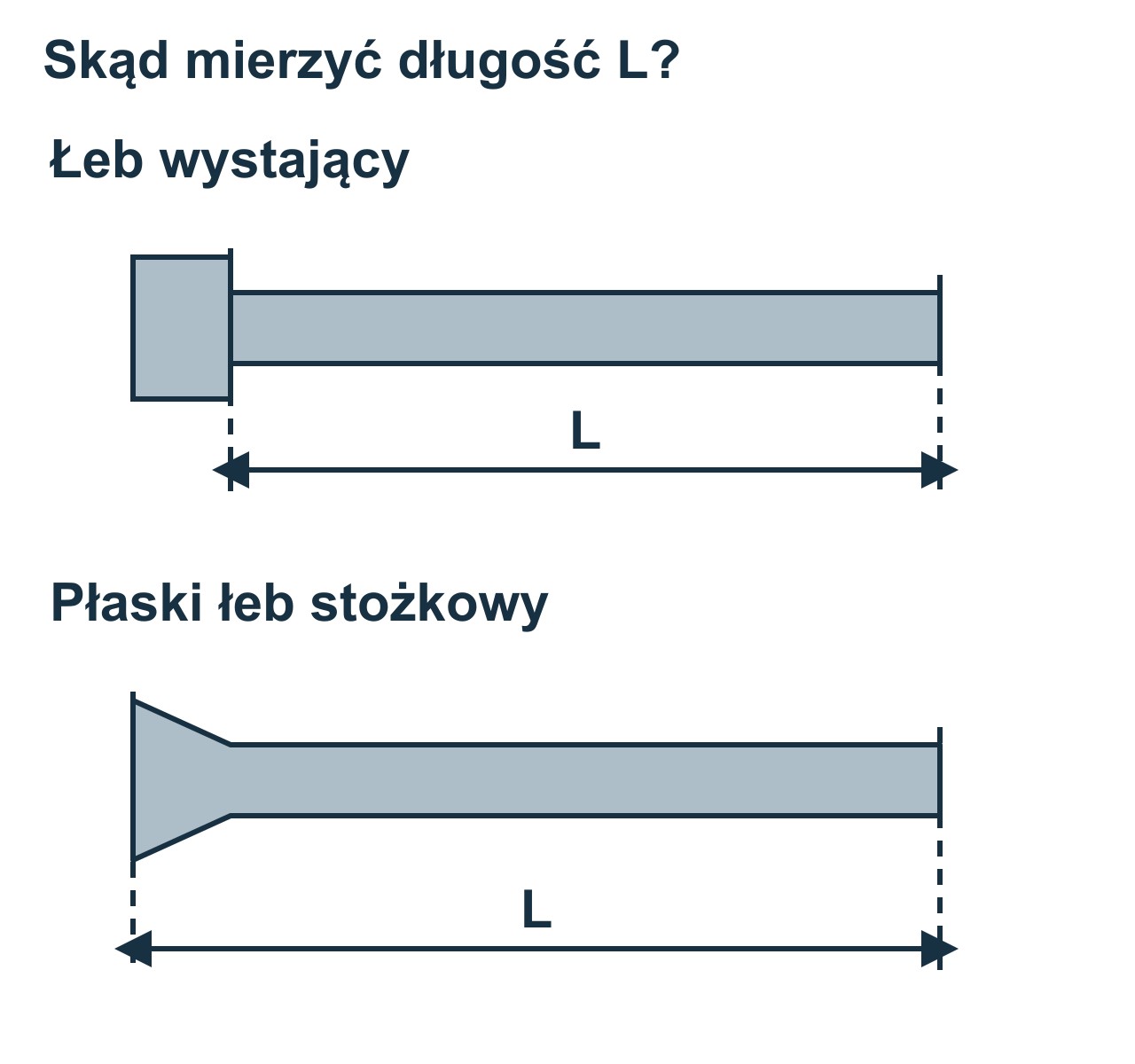 Length L is measured from under a projecting head; for the flat countersunk head shown, it includes the entire head. For unusual designs, check the drawing of the specific screw.
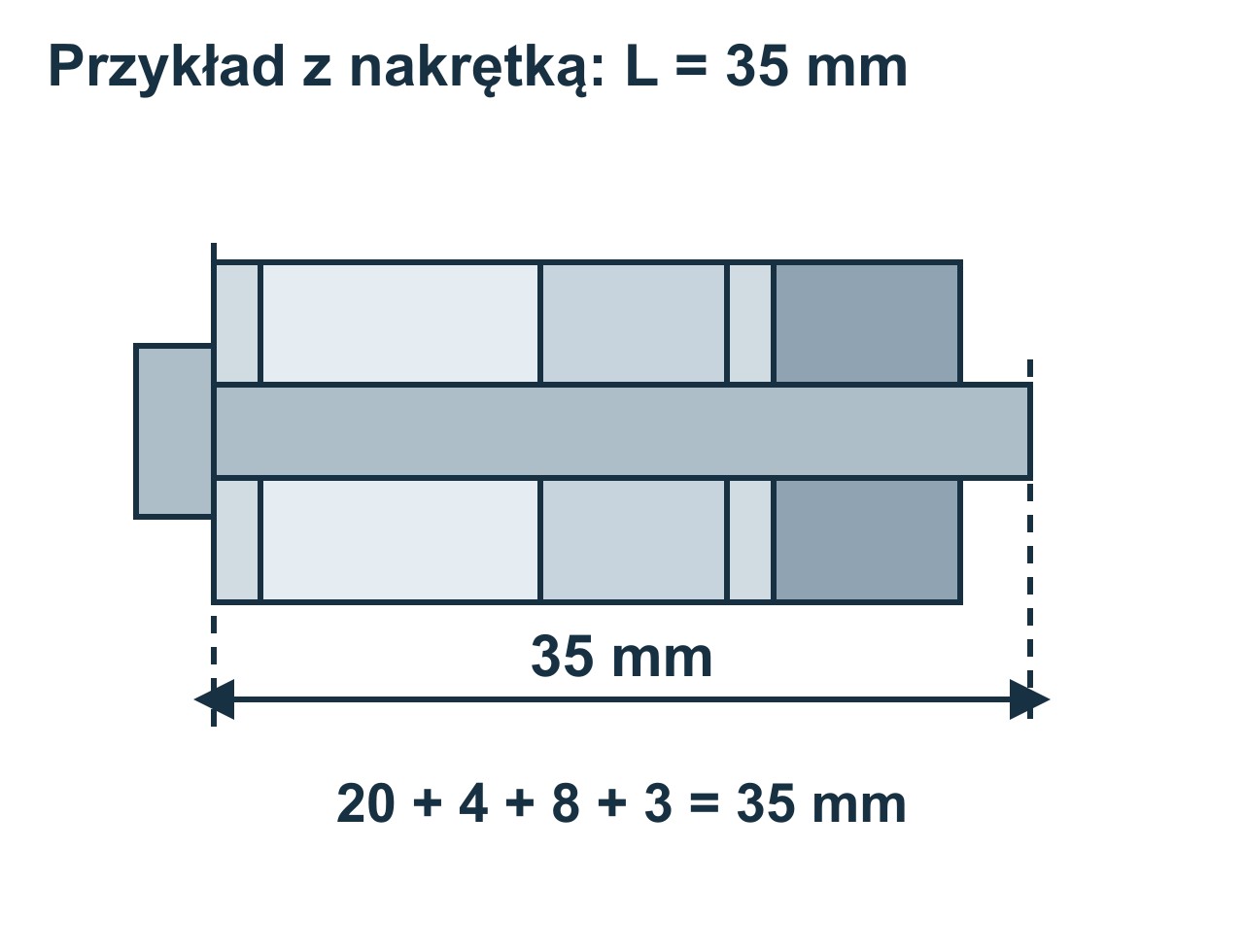 Explicit example assumptions: plates 12 + 8 = 20 mm, washers 2 + 2 = 4 mm, nut 8 mm and protrusion 3 mm. The total of 35 mm is a geometric example, not a standard dimension for every nut or a recommendation for every joint.
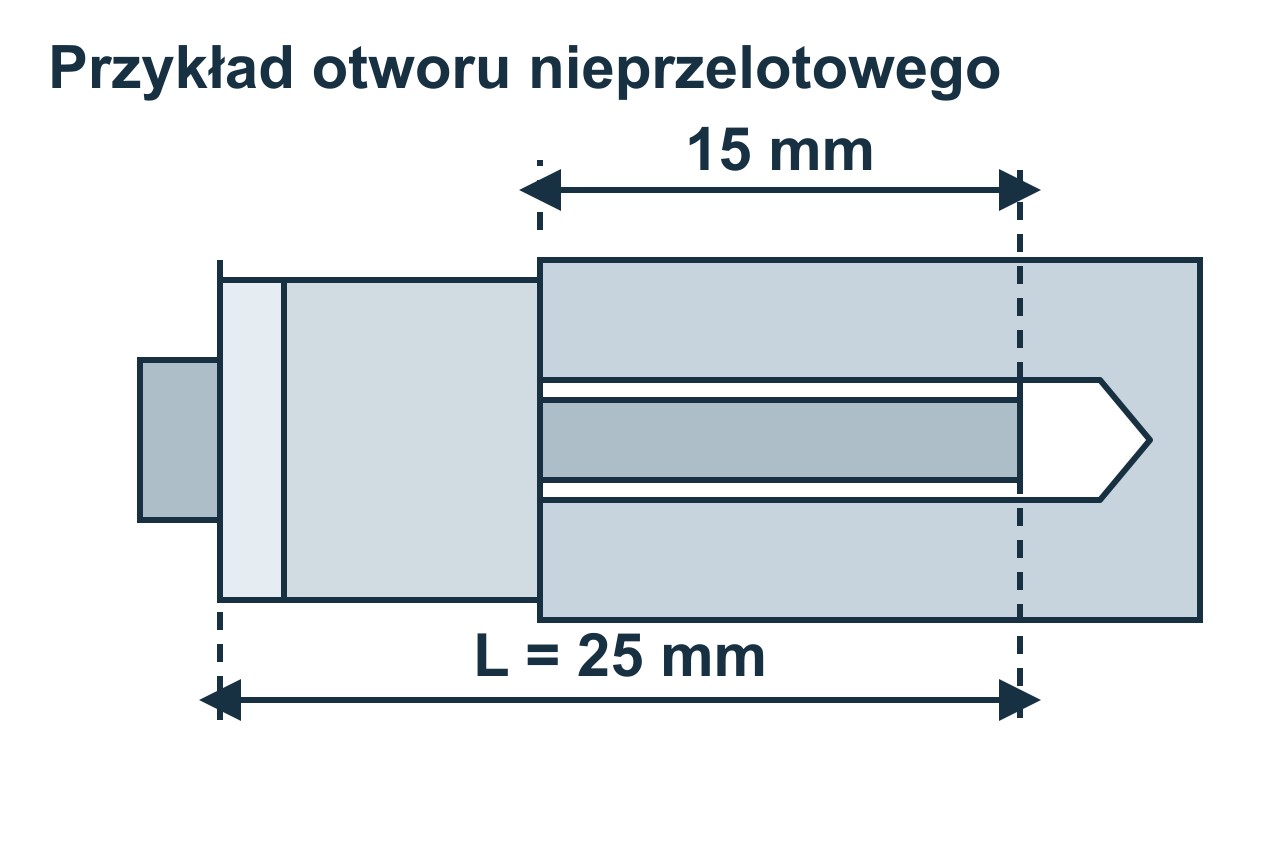 Assumptions as in the current example: component 8 mm + washer 2 mm + insertion 15 mm = L 25 mm. The drawing does not specify the required engagement length or drilling depth; clearance must remain above the hole bottom.
What should you consider before calculating length?
Start by examining the entire joint. Check:
- the thickness of all parts being joined;
- the number and thickness of washers;
- whether spacer sleeves are present;
- how the head is seated, including any recess;
- the nut type or tapped-hole parameters;
- the clearance behind the joint.
Dimensions should refer to the assembled joint. This is especially important where gaskets or other components change thickness under clamping.
The examples below concern bolts measured from under the head. A countersunk screw also requires allowance for its seating geometry.
How to choose bolt length for a nut
In a through joint, the bolt passes through holes in the components and engages with a nut on the other side.
For a preliminary calculation, use:
L = G + P + N + W
where:
- L — bolt length measured from under the head;
- G — total thickness of clamped parts and spacers;
- P — total washer thickness;
- N — nut height;
- W — required bolt-end protrusion beyond the nut.
The value of W must be taken from the joint documentation or the recommendations for the nut used. No single number of protruding threads is suitable for every design and application.
Example: joining two plates
Assume the following design dimensions:
Joint component | Dimension |
|---|---|
First plate | 12 mm |
Second plate | 8 mm |
Two washers | Total 4 mm |
Nut | 8 mm |
Required end protrusion | 3 mm |
Total | 35 mm |
Calculation:
L = 12 + 8 + 4 + 8 + 3 = 35 mm
A bolt with a nominal length of 35 mm is the starting point for checking this joint.
The nut and protrusion dimensions are assumptions for this example. Before purchasing, also consider tolerances, actual thread length and available space. If tolerances could reduce the required end protrusion, the nominal result alone is insufficient to approve the selection.
How to choose a screw for a blind hole
A blind hole has no nut on the other side. The screw engages with a thread formed directly in the housing or another component.
Two conditions must be checked together:
- Will the screw achieve the required thread engagement length?
- Will the tip avoid bottoming out or contacting incomplete threads before the part is clamped?
Drilling depth is not the same as usable thread length. The entry chamfer, thread runout and screw-tip geometry affect how much of the joint actually carries load.
For a simple arrangement with a screw measured from under the head:
screw insertion depth = screw length − thickness of parts clamped above the housing − washer thickness
Example: bracket screwed to a housing
Assume that:
- the bracket thickness is 8 mm;
- the washer thickness is 2 mm;
- the documentation permits insertion into the housing by 12–16 mm, after allowing for required thread engagement and bottom clearance.
The permissible screw length range is:
minimum: 8 + 2 + 12 = 22 mm
maximum: 8 + 2 + 16 = 26 mm
A screw with a length of 25 mm falls nominally within this range. Its tip will enter the housing by:
25 − 8 − 2 = 15 mm
This is a candidate for further verification of tolerances and thread geometry. A 30 mm screw would exceed the assumed maximum insertion depth.
How much thread should engage?
The required engagement length depends on factors including bolt properties, the internally threaded material and the required load capacity. A joint in a steel housing may have different requirements from one in aluminium.
Do not assume without checking that an engagement length equal to one bolt diameter is always sufficient.
These examples calculate joint geometry. They do not replace strength verification or machine-manufacturer requirements.
Why does thread length matter?
Two bolts with the same diameter and nominal length may have different threaded lengths. A partially threaded bolt has an unthreaded section below its head.
Before ordering, check the product drawing for:
- whether the thread reaches the nut's intended position;
- whether the nut can reach the clamping surface;
- whether the unthreaded section prevents the screw from entering the housing;
- whether the documentation specifies a particular position of the plain shank relative to the joined parts.
Replacing a partially threaded bolt with a fully threaded one also requires checking the joint requirements.
Common selection mistakes
Mistake: Measuring a hexagon bolt including its head
- What to check before assembly: Measure from the bearing surface under the head.
Mistake: Ignoring washers or spacers
- What to check before assembly: Add up the thickness of the entire stack.
Mistake: Selecting by drilling depth alone
- What to check before assembly: Establish usable thread length and permissible tip insertion.
Mistake: Choosing a longer bolt “just in case”
- What to check before assembly: Check the hole bottom, interference and ability to clamp.
Mistake: Checking only diameter and length
- What to check before assembly: Verify thread pitch, head type, design and property class.
Mistake: Copying the old bolt's dimension
- What to check before assembly: Confirm that the previous part was correct and the design has not changed.
What information should you prepare for an order?
A complete description simplifies selection and reduces follow-up questions. Prepare:
- Thread diameter and pitch.
- Nominal length and how it is measured.
- Head and drive type.
- Component standard or drawing.
- Full or partial thread.
- Property class, material and coating.
- For selection for a specific application: joint dimensions and an available equipment drawing.
Read more about a complete technical description in the guide DIN ISO fasteners — what to check.
Can you choose the next longer bolt?
Consider that size only after checking the whole joint. In particular, a longer screw in a blind hole may prevent proper clamping.
Does M8 × 30 mean 30 mm of thread?
No. The number 30 specifies nominal length according to the dimensioning convention for that design. The threaded length may differ.
Is the correct length alone enough?
No. Other parameters must also match, including diameter, thread pitch, head geometry and required mechanical properties.
Select a complete set of components at NERON
When selecting a bolt, also allow for suitable nuts, washers and the other joint components. Explore fasteners in the NERON shop.
If you need help identifying the right design, contact NERON. Prepare the component designation, joint dimensions and available documentation to help identify more precisely which part you need.
Related articles
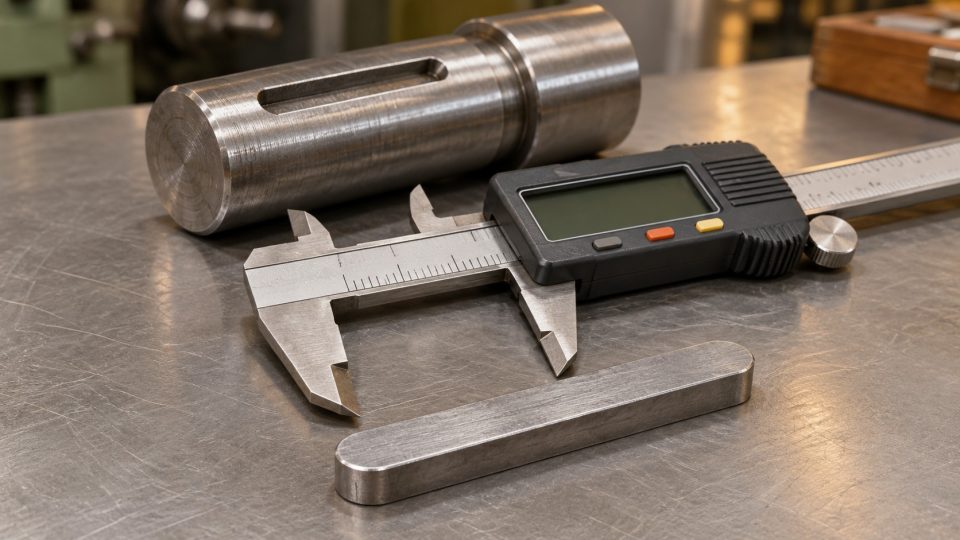
DIN 6885 parallel key — how to measure it and select a replacement?
A DIN 6885 parallel key is selected to suit the shaft and hub keyways, not solely the shaft diameter. Before purchasing, establish the width b, height h, length l, end...
Read article · 4 min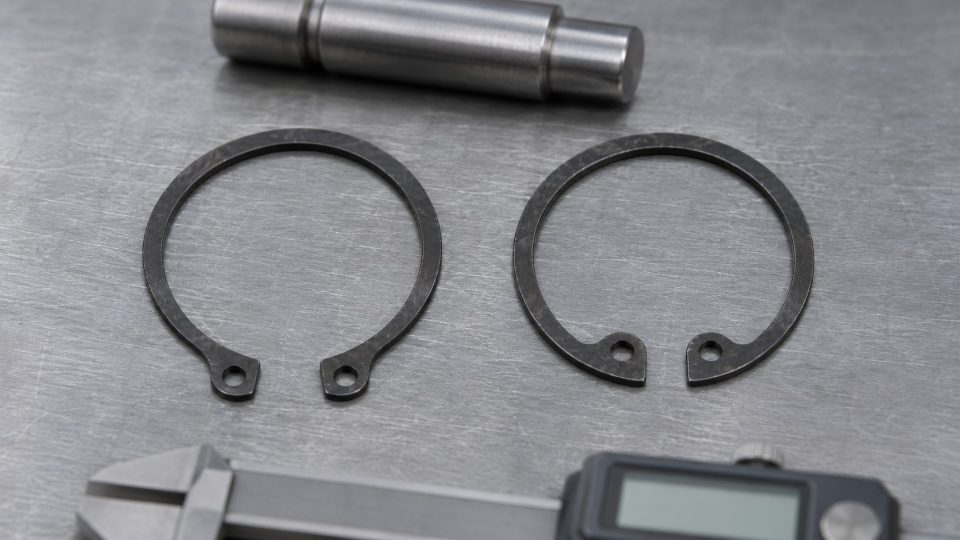
DIN 471 or DIN 472 circlip? How to select the size
DIN 471 denotes a retaining ring for a shaft, while DIN 472 denotes a ring for a bore. Before purchasing, establish the installation location, nominal shaft or bore di...
Read article · 5 min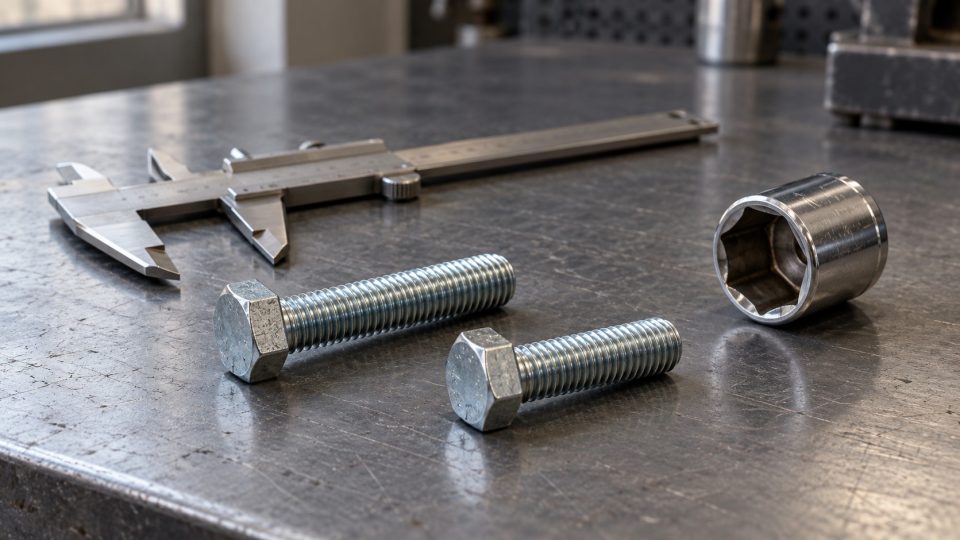
DIN 933 and ISO 4017 — which wrench and what to check before replacement?
An M10 bolt does not always require a 17 mm wrench. For DIN 933, the nominal width across flats is 17 mm, while for ISO 4017 it is 16 mm. The same thread therefore doe...
Read article · 4 min