
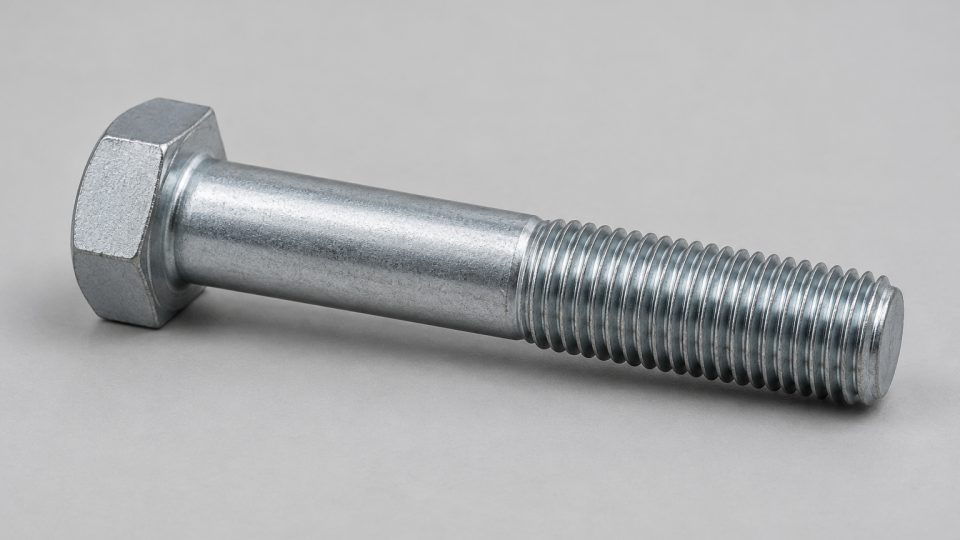
DIN 931 designates a hexagon-head bolt with a partial thread. There is an unthreaded shank section between the head and the threaded end. When purchasing, check not on...
DIN 931 designates a hexagon-head bolt with a partial thread. There is an unthreaded shank section between the head and the threaded end. When purchasing, check not only the bolt diameter and length but also the thread length and where its full profile begins. This information helps determine whether the bolt can clamp the parts correctly.
How can you identify a DIN 931 bolt?
Look at the bolt from the side. The head has an external hexagon, with a smooth shank section beneath it. The thread is at the end. A hexagon head alone is not enough for identification: fully threaded bolts and other designs have a similar appearance.
Head markings do not replace the standard number in the documentation. The number describing the mechanical property class answers a different question from DIN 931. The standard, size, material, property class and coating must be checked separately.
DIN 931 versus DIN 933 — what is the difference?
What to check DIN 931 DIN 933 |
What to check DIN 931 DIN 933 |
What to check DIN 931 DIN 933 |
What to check DIN 931 DIN 933 |
The term “fully threaded” does not mean that the transition below the head and the thread end can be ignored. The product drawing shows the exact design. DIN 933 is not an automatic substitute for DIN 931 just because both bolts have the same M size and length.
Do not choose the threading type solely by a rule such as “for thin sheet” or “for structures”. The joint should comply with the design documentation. The appearance of a smooth shank alone does not confirm the permissible load or replace joint calculations.
Are DIN 931 and ISO 4014 identical?
ISO 4014 is a standard for partially threaded hexagon-head bolts, related to the former DIN 931 designation. The current published edition is ISO 4014:2022. Both numbers are still used commercially, sometimes alongside each other.
Related standards do not guarantee that all dimensions are identical. For example, for M10 the nominal width across flats under DIN 931 is 17 mm, and under ISO 4014 it is 16 mm. For M12 it is 19 and 18 mm respectively. When substituting, check the drawing of the specific variant and the space for the tool instead of relying only on the word “equivalent”.
How do you measure a partially threaded bolt?
- Determine length l: for a hexagon head, measure from the bearing surface beneath the head to the end of the bolt; do not include the head height.
- Identify the thread diameter and pitch: compare the measurement with the documentation. Thread diameter and spanner size are different dimensions.
- Check dimension b: this denotes the thread length on the drawing. Do not assume that all bolts with the same diameter have the same threaded length regardless of their overall length.
- Check the transitions: take account of the thread run-out at the smooth shank and the termination at the bolt end. A suitable threaded section is needed to engage the nut.
- Compare with the joint: mark the thicknesses of the parts and washers, and the position of the nut or the start of the thread in the hole. Only then assess the fit.
Detailed guidance on choosing the length is provided in the guide how to choose bolt length. Here, the key additional check is where the unthreaded shank ends.
M10 × 60 example — why is length alone not enough?
Suppose we are examining a DIN 931 M10 × 60 bolt with a coarse thread. In the dimensional sheet consulted, for M10 and lengths up to 125 mm, b = 26 mm and pitch P = 1,5 mm are specified. The difference l − b is therefore 60 − 26 = 34 mm.
This is an example of reading dimensional data, not a ready-made bolt selection for a machine or a declaration of the specifications of a particular NERON product. Do not treat 34 mm as a guaranteed length of a perfectly smooth section: the thread transition and the tolerances specified in the documentation must be taken into account.
A practical check involves marking these sections on a sketch of the joint. If the nut would be positioned on the unthreaded section, the bolt will not provide the required clamping force. Changing the overall length without rechecking the threaded length may leave this problem unresolved.
What information is needed when ordering DIN 931 bolts?
Prepare the standard number required by the documentation, thread diameter and pitch, length l, required threaded length, material, property class and coating. For a substitute, also specify the head dimensions and installation-space restrictions. If you are using an old part as a reference, include a side-view photograph and legible markings.
Compare DIN 931 hexagon-head bolts at NERON with the requirements of your joint. Variants described as fully threaded can be found in the category of DIN 933 bolts. Each selected variant requires its product sheet to be checked; a shared category name does not confirm that products are interchangeable.
If the documentation does not clearly specify the design, send the details via NERON's contact page. Do not assume compatibility based solely on the spanner size or a photograph.
Related articles
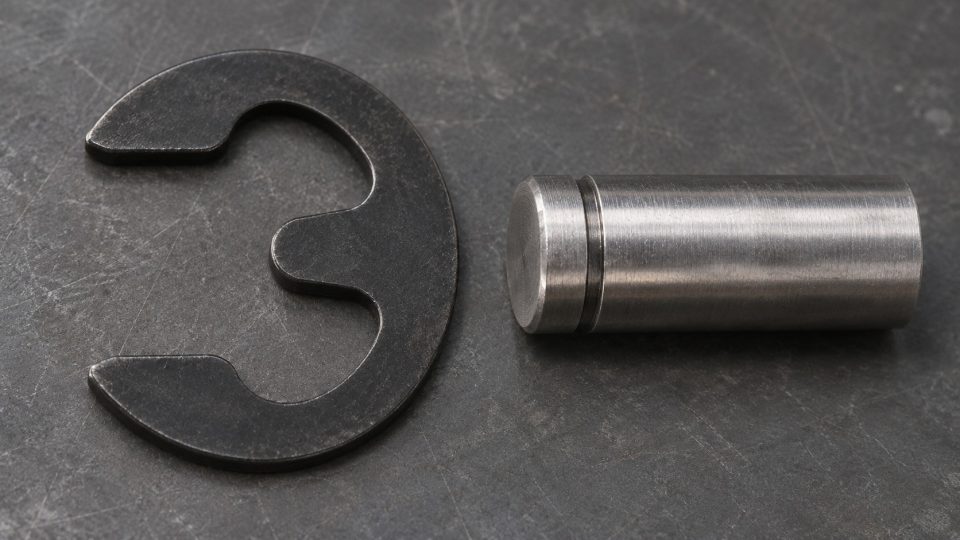
Płytka osadcza DIN 6799 — co oznacza rozmiar 8 mm?
Jeśli wymieniasz płytkę osadczą DIN 6799, sprawdź najpierw średnicę na dnie rowka. W oznaczeniu DIN 6799–8 liczba 8 odnosi się do nominalnej średnicy rowka d₂. Średnic...
Read article · 3 min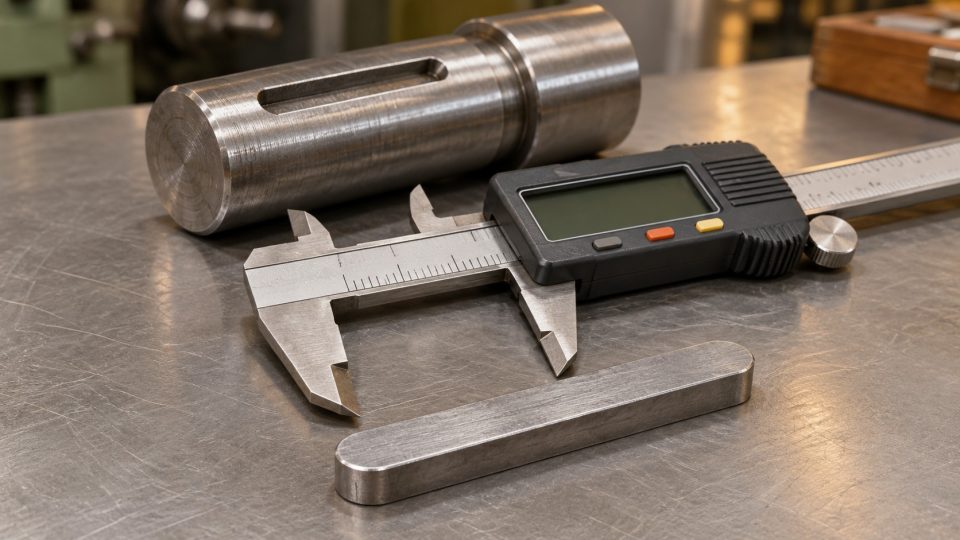
DIN 6885 parallel key — how to measure it and select a replacement?
A DIN 6885 parallel key is selected to suit the shaft and hub keyways, not solely the shaft diameter. Before purchasing, establish the width b, height h, length l, end...
Read article · 4 min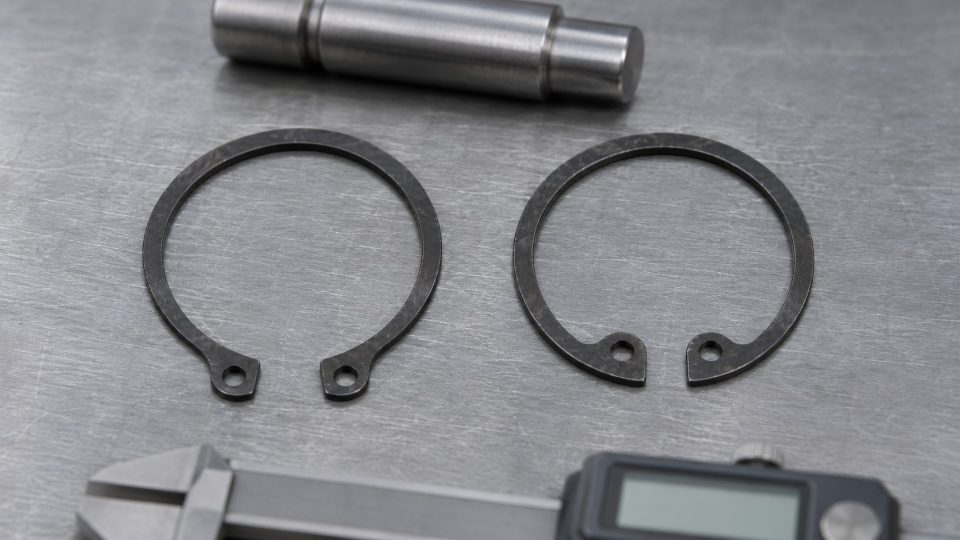
DIN 471 or DIN 472 circlip? How to select the size
DIN 471 denotes a retaining ring for a shaft, while DIN 472 denotes a ring for a bore. Before purchasing, establish the installation location, nominal shaft or bore di...
Read article · 5 min