
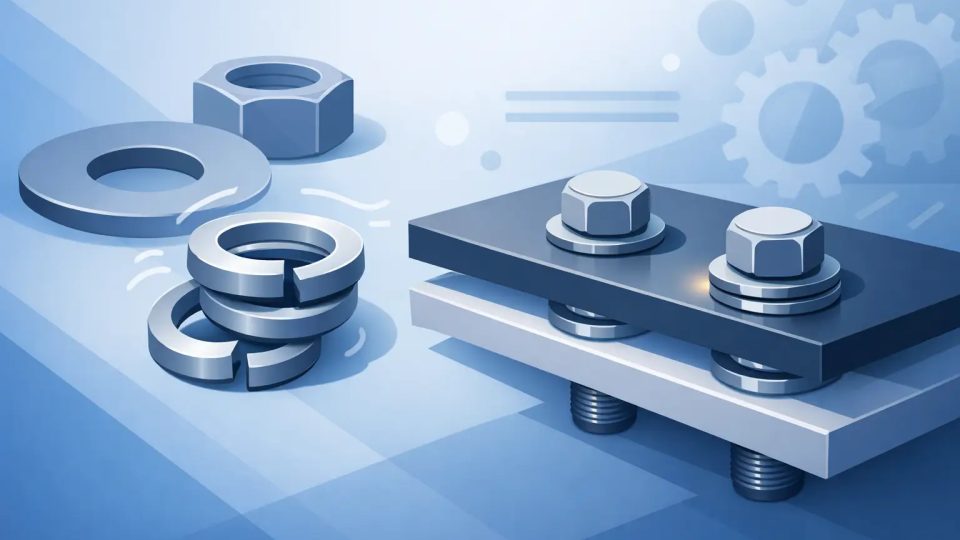
A loose bolted joint rarely starts with a major failure. Play, lost clamping force, vibration or difficulty holding a setting generally appear first. Selecting spring ...
A loose bolted joint rarely starts with a major failure. Play, lost clamping force, vibration or difficulty holding a setting generally appear first. Selecting spring washers therefore concerns the stability of the entire mounting joint, not just a small part.
How to select spring washers for a specific application
A spring washer is intended to counter self-loosening and help maintain clamping force. It works correctly only when suited to fastener diameter, operating conditions and the materials of the whole joint. Selection “by eye” often leaves the washer working incorrectly or even worsening assembly stability.
First establish the joint type. A light enclosure, a vibration-exposed joint and an assembly under high humidity, aggressive media or changing temperatures need different washer selection. For dynamic operation, a spring washer alone is not always sufficient. Consider the whole set, bolt, nut, strength class, tightening torque and any additional thread locking.
Start with nominal bolt diameter
The basic rule is simple. Select the washer for the nominal bolt or screw diameter. An M6 bolt takes a washer intended for M6, an M8 takes one for M8, and so on. The washer bore must fit freely over the shank without excessive play. Too large a bore gives poorer guidance and less predictable tightening behaviour.
In industry, check dimensions against a specific standard immediately. “For M8” alone is not always enough. Washer thickness, split height and elastic range also matter. If the documentation specifies a DIN standard or equivalent, follow it consistently throughout the order.
Check washer material and operating environment
Material directly affects joint durability and resistance. Spring steel washers, zinc-coated or uncoated, and stainless versions are most common. Selection depends on the operating environment.
Dry workshop conditions and standard machine applications generally need spring steel with suitable surface protection. Outdoors, in damp areas, during installation washing or where corrosion risk is elevated, stainless steel is a better choice. However, stainless steel does not always provide the same mechanical properties as carbon spring steel. Heavily loaded joints cannot be selected by corrosion resistance alone.
In chemically aggressive environments, also check material compatibility with other joint components. Combining different metals can accelerate electrochemical corrosion. Maintenance should select washer material as part of the entire mounting system, not separately.
When a spring washer makes sense and when it does not
Spring washers are popular but not universal. They work well in many standard bolted joints, especially where simple, fast protection against loosening is needed. Modern systems with high dynamic requirements often use other locking methods, such as self-locking nuts, threadlockers or wedge-locking washers.
If the joint experiences severe vibration, shocks or cyclic load changes, a spring washer alone may be insufficient. Treat it as an auxiliary component or replace it entirely with a more effective solution for the system. This matters particularly in production machines, transport equipment and rotating assemblies.
For less demanding service joints, a spring washer remains practical. Its advantages are simplicity, widespread availability and fast assembly without changing the standard bolting process.
Why the hardness of joined components matters
A common mistake is using a spring washer on soft materials such as aluminium, thin sheet or some plastics. Its edge can bite locally into the surface, changing pressure distribution and reducing joint consistency. Instead of improved locking, this can cause material damage or loss of proper clamping force after some operating time.
For soft or deformation-prone surfaces, consider an additional flat washer or another locking method. This matters especially for enclosures, guards, cabinets and lightweight mounting structures.
Which parameters to check during selection
Check several parameters together when buying and assembling joints. Diameter alone is insufficient for long, uninterrupted operation.
The manufacturing standard, material, protective coating, bolt-size compatibility and expected service conditions are crucial. Industrial use also requires consistent deliveries. Similar-sized washer variants in one machine make servicing mistakes easy. Standardise selection wherever possible.
Assembly method also matters. A spring washer must sit correctly between the clamping component and joined surface. Incorrect tightening torque prevents even a well-selected washer from working. Too little torque fails to provide stable clamping, while too much may flatten the washer excessively and remove its spring effect.
Standards and consistency in purchasing
Production should rely on standardised components. This simplifies identification, stock planning and reordering without mismatch risk. Procurement gains fewer exceptions in item records and fewer shop-floor questions during emergency replacement.
Once the technical team verifies the correct washer type for a joint, retain that standard for subsequent batches. This shortens servicing and reduces assembly errors.
Selecting spring washers in workshop practice
In practice, a simple sequence is safest. First identify bolt diameter and type. Then check the joined component materials and operating environment. Finally verify that a spring washer is genuinely the appropriate locking solution for the application.
A simple example. A standard M10 bolted joint in a steel guard structure inside a hall generally needs only a spring washer to the appropriate standard in corrosion-protected steel. But if the same joint experiences strong vibration on a power unit or transport system, consider more effective anti-loosening protection.
Likewise for installations exposed to moisture. The M10 size stays the same, but washer material changes. Stainless steel may extend joint life if compatible with the rest of the mounting set.
Customers buying different fastener groups together benefit from selection by diameter, standard and material. This organisation reduces mistakes, particularly when orders include bolts, nuts, flat and spring washers together.
Common selection mistakes
Most problems arise from incorrect application rather than washer quality. Common mistakes are selecting by diameter alone without operating-condition checks, using a spring washer where stronger locking is needed, and mixing materials without corrosion and strength analysis.
A washer is sometimes treated as compensation for poor assembly. If threads are damaged, surfaces uneven and torque arbitrary, a spring component alone will not repair the joint. First remove the cause, then choose suitable locking.
For batch purchasing, beware apparently similar products lacking a clear standard and material. Fastener details matter because they affect assembly consistency and service durability.
For efficient replenishment of standard mounting components, select a supplier with broad technical category availability who allows a complete joint set to be assembled quickly. This reduces downtime and simplifies workshop and procurement work. A correctly selected spring washer is small, but such details often decide whether a connection holds in practice as well as on paper.
Related articles
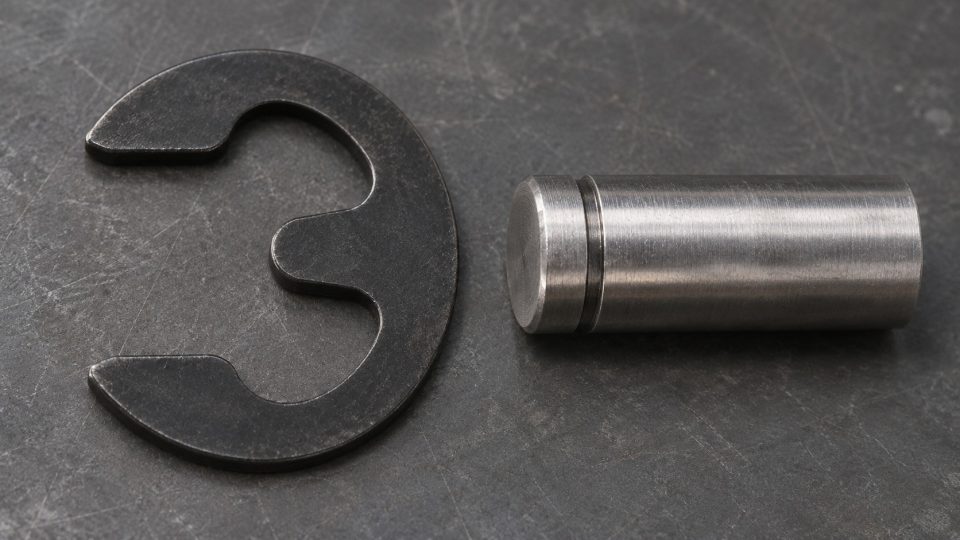
Płytka osadcza DIN 6799 — co oznacza rozmiar 8 mm?
Jeśli wymieniasz płytkę osadczą DIN 6799, sprawdź najpierw średnicę na dnie rowka. W oznaczeniu DIN 6799–8 liczba 8 odnosi się do nominalnej średnicy rowka d₂. Średnic...
Read article · 3 min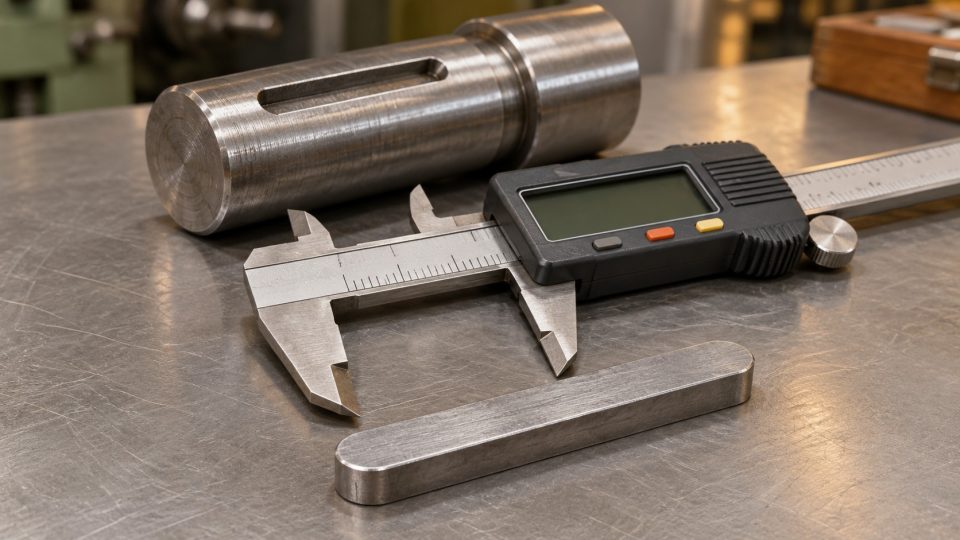
DIN 6885 parallel key — how to measure it and select a replacement?
A DIN 6885 parallel key is selected to suit the shaft and hub keyways, not solely the shaft diameter. Before purchasing, establish the width b, height h, length l, end...
Read article · 4 min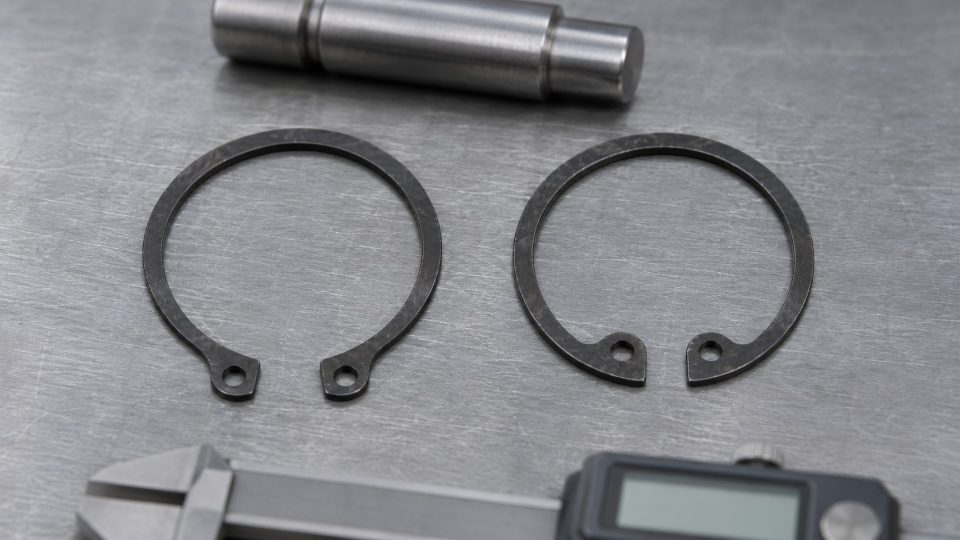
DIN 471 or DIN 472 circlip? How to select the size
DIN 471 denotes a retaining ring for a shaft, while DIN 472 denotes a ring for a bore. Before purchasing, establish the installation location, nominal shaft or bore di...
Read article · 5 min