
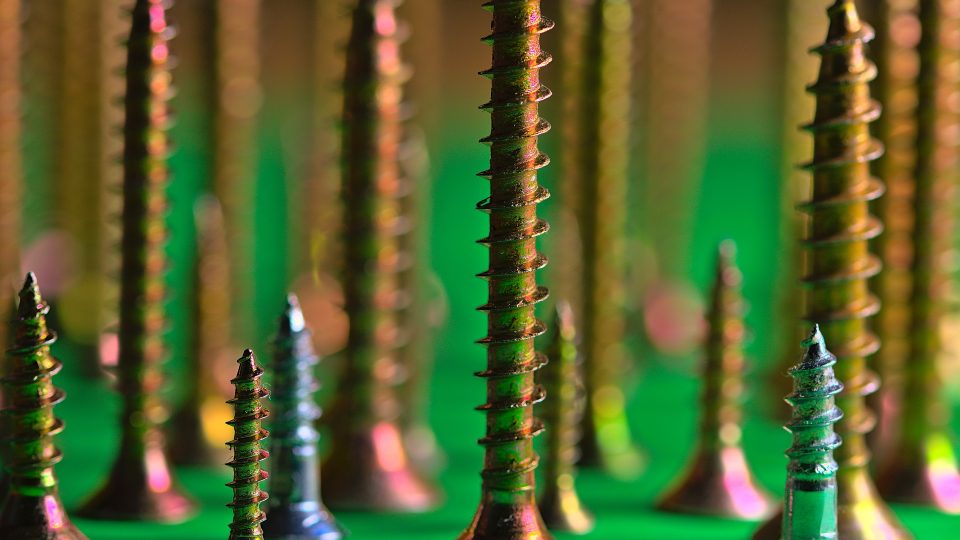
What are the main differences when comparing wood screws with metal screws, and how do they affect correct installation? The main difference lies in thread geometry an...
What are the main differences when comparing wood screws with metal screws, and how do they affect correct installation? The main difference lies in thread geometry and shank construction. Wood screws have a coarse, deep thread and a sharp point for cutting flexible fibres, while metal versions have a fine, shallow thread designed to grip hard materials.
Using a fastener for the wrong purpose causes stripped threads, damage to the substrate or a drastic reduction in joint strength. In professional installation, correct component selection determines the structure's durability and safety. Understanding how both fastener types work helps avoid costly workmanship errors and speeds up the process.
Contents
- Characteristics of wood screws
- Thread geometry and profile
- Shank construction and milling features
- Head and drive shape
- Point and self-drilling properties
- Characteristics of metal screws
- Thread geometry and profile
- Tip design and installation
- Head shape and clamping
- Material and strength
- Differences at a glance
- What happens if you interchange them?
- How to select the right screw
- Step 1: identify the base material
- Step 2: determine the optimum dimensions
- Step 3: select the protective coating and drive
- Choose professional fasteners for your project!
Characteristics of wood screws
What characterises professional wood screws, and which design features determine their reliability? These fasteners are designed for flexible, fibrous substrates, requiring deep penetration without forcing the material apart. Their main features are a coarse thread, sharp point and special shank construction that helps draw components together.
Thread geometry and profile
Joinery and carpentry screws have a deep thread with a wide pitch, meaning a large distance between turns. This design allows the screw to cut smoothly between natural fibres without damaging the wood structure. The large thread surface provides maximum pull-out resistance in solid wood and wood-based panels such as MDF and chipboard.
Shank construction and milling features
Partial threads dominate professional work: the smooth shank section beneath the head allows the attached component to be drawn tightly against the substrate. Premium versions also have a reaming feature above the thread that enlarges the upper hole and reduces resistance and friction during driving.
Head and drive shape
Head construction depends on the intended application:
- countersunk – sits fully flush with the wood surface, while special milling ribs under the head produce a neat countersink in the material,
- washer head – the wide head maximises clamping force, preventing pull-through in roof and timber-frame structures.
Drive transmission most often uses deep Torx (TX) or Pozidriv (PZ) recesses that eliminate the risk of bit slippage (cam-out).
Point and self-drilling properties
A very sharp tip allows immediate, precisely positioned starting without the fastener slipping. A special cutting notch at the point, such as a crown-type tip, cuts fibres during installation, reducing internal stresses and allowing safe driving near edges without the risk of splitting the wood.
Characteristics of metal screws
What characterises professional metal screws and what determines their reliability? These fasteners are intended for hard, dense substrates, requiring fine thread pitch and hardened, shear-resistant steel. Their purpose is to plastically form a thread in metal, cut one themselves or engage with an existing metric tapped hole.
Thread geometry and profile
Screws for metal substrates fall into two main categories:
- self-tapping sheet-metal screws – have a sharp, closely spaced thread along the full shank length, providing maximum grip in thin sheets and profiles,
- metric screws (bolts) – have a standardised ISO thread, such as M4 or M6. They are screwed only into a previously tapped hole or secured with a nut.
Tip design and installation
The screw tip determines the installation method and whether predrilling is required:
- self-drilling screws – have a miniature drill-shaped tip, such as short framing screws or roofing screws, allowing drilling, thread formation and fastening in one operation,
- self-tapping screws – require a hole in which they form their own thread without producing chips during driving,
- blunt tip – typical of metric versions, making insertion into a tapped hole easier.
Head shape and clamping
Metal screws rarely sit flush with the substrate: heads increasing the clamping surface predominate:
- cylindrical and pan heads – project above the material and distribute stresses evenly around the hole,
- flanged heads (with a washer) – the integrated flange prevents deformation and pull-through of thin sheets,
- hexagonal heads – ideal for installation with a socket wrench or impact driver under heavy loads.
Material and strength
These fasteners are hardened so that their hardness exceeds that of the material being drilled. Industry uses zinc-plated carbon steel and stainless (A2) or acid-resistant (A4) steel, which guarantee extreme resistance to shear and head breakage under high driving resistance.
Differences at a glance
What are the technical differences between the two fastener groups? A direct comparison quickly identifies differences in their construction and operating mechanics:
Technical parameter Wood screws Metal screws |
Technical parameter Wood screws Metal screws |
Technical parameter Wood screws Metal screws |
Technical parameter Wood screws Metal screws |
Technical parameter Wood screws Metal screws |
Technical parameter Wood screws Metal screws |
Technical parameter Wood screws Metal screws |
What happens if you interchange them?
What are the direct technical consequences of ignoring a fastener's intended purpose? Substituting one type for the other leads to immediate mechanical failure at the material interface:
- a metal screw driven into wood – generates too little surface friction. The fastener meets no resistance and spins in place, pulling loose chips from the hole instead of permanently clamping the structure;
- a wood screw driven into metal – jams at the first layer encountered. The threads flatten, and forcing the screw further breaks the hardened shank, leaving the damaged core stuck in the hole.
How to select the right screw
A correct technical specification requires analysis of the substrate, the thickness of the joined layers and the environmental conditions in which the structure will operate.
Step 1: identify the base material
Before visiting a supplier, define the project's working requirements precisely. For steel structures or aluminium profiles, it is important to determine which metal screws best suit the wall thickness, such as self-drilling Tex screws for thin sheets or metric versions for thick, tapped components. For roof framing, pergolas or furniture panels, success depends on knowing which wood screw , whether structural, hardened or countersunk, provides suitable ductility and drawing force without splitting the material.
Step 2: determine the optimum dimensions
The second stage is calculating fastener geometry. Many installers wonder how to choose wood screw lengthto ensure maximum load capacity. The engineering rule states that a partially threaded screw should penetrate the base component to a depth of at least twice the thickness of the attached part. For metal structures, length is selected so that the threaded section projects at least 3–5 mm beyond the lower edge of the profile.
Step 3: select the protective coating and drive
- Outdoor conditions – require stainless steel A2/A4 or anticorrosion coatings such as zinc flake.
- Indoor conditions – allow standard electroplated zinc coatings, white or yellow.
- Working convenience – for fast repetitive assembly, choose Torx (TX) drives, which guarantee optimum power transfer without damaging the bit.
Choose professional fasteners for your project!
What conclusions follow from comparing the technical specifications? Successful installation ultimately depends on precisely matching component geometry to how the substrate behaves. Informed component selection eliminates installation downtime, reduces material losses and guarantees that structural joints remain stable for decades of service.
Preparing a new project and looking for reliable fastening solutions? Do not risk the durability of your structures: choose proven components. Explore the Neron Shop's range! We offer a wide selection of certified carpentry, joinery and sheet-metal screws and metric bolts that meet stringent construction standards.
Related articles
Everything worth knowing about grease nipples
Modern machinery and equipment depend not only on their design but, above all, on how they are maintained. Correct servicing of lubrication points is one of the most i...
Read article · 6 min
Kluber greases – why does choosing the right lubricant matter?
In precision engineering and heavy industry, there is no room for half measures. Every machine, whatever its purpose, needs proper protection to operate reliably for m...
Read article · 5 min
Dog couplings – reliable solutions for industrial drives
In industrial machinery and precision engineering, a coupling is one of the key components enabling efficient power transmission. Although many people associate it mai...
Read article · 5 min