
Modern machinery and equipment depend not only on their design but, above all, on how they are maintained. Correct servicing of lubrication points is one of the most i...
Modern machinery and equipment depend not only on their design but, above all, on how they are maintained. Correct servicing of lubrication points is one of the most important factors in reliable operation. These are locations of intense friction, loads and material wear, which quickly degrade components without adequate protection. Grease nipples, though small and often overlooked by operators, are an important part of maintenance systems. They allow controlled lubricant delivery precisely where needed, without dismantling components or interrupting machine operation.
Correct lubrication becomes increasingly important as operating costs and reliability requirements rise. Machine downtime, bearing failures and joint wear generate repair costs and production losses. In practice, even a component as small as a grease nipple can materially affect the efficiency of the entire process. This article covers the main aspects of grease nipples, from function and construction through selecting suitable solutions to practical lubrication and operating principles.
Contents
- What is a grease nipple and how does it work?
- Types of grease nipples
- Grease nipple threads
- Lubrication – essential information
- How to lubricate correctly through a grease nipple
- Summary
What is a grease nipple and how does it work?
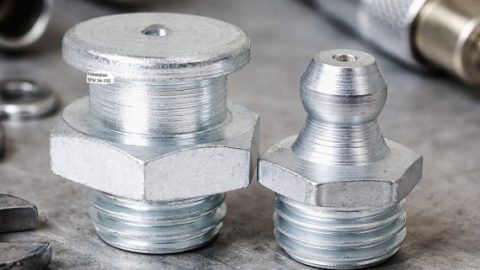
A grease nipple, also known as a grease fitting, is a small component installed at machine and equipment lubrication points to deliver grease accurately into the system. Although simple in construction, it plays a very important role in ensuring the durability and reliability of interacting parts. A typical grease nipple consists of several basic components:
- body – a threaded metal housing for installation in the assembly,
- ball (non-return valve) – a small component closing the lubrication passage,
- spring – pressing the ball against its seat to keep the system sealed.
Together they form a simple but effective mechanism for one-way grease flow.
Operating principle
For a grease nipple and the question of how it works, the mechanism is simple yet highly effective. It relies on a pressure difference: once the grease gun is connected and pumping begins, pressure pushes the ball into the body, opening the passage and allowing lubricant to enter the component, such as a bearing or joint. After lubrication, the spring presses the ball back into its seat, closing the opening. As a result:
- grease does not flow back out,
- contaminants such as dust or water cannot enter,
- the lubrication point remains sealed between maintenance cycles.
In practice, the grease nipple acts both as a protective valve and a service port for the lubrication system, supplying grease at the appropriate pressure exactly where needed without altering the machine's construction. This simplicity and effectiveness make it a standard component in almost every industry, from automotive and agriculture to heavy construction machinery.
Types of grease nipples
Grease nipples come in various designs, selected according to lubrication-point accessibility and operating conditions.
By shape
- Straight – for easily accessible locations.
- Angled (45°, 90°) – make lubrication easier in confined spaces.
- Flush – do not project beyond the surface and resist damage.
By application
- Standard – for most machines.
- High-pressure – for demanding systems.
- Specialist – for example, for hard-to-reach points.
By material
- Zinc-plated steel – the most commonly used material.
- Stainless steel – for damp and aggressive environments.
- Brass – good corrosion resistance and easy installation.
Grease nipple threads
For a grease fitting, the type of thread matters because it determines correct installation and a leak-tight connection to the machine component. It is one of the key parameters to select correctly, both for initial installation and when replacing a worn fitting. Several thread standards are used in practice:
- metric (M) – the most common in Europe (e.g. M6, M8, M10),
- BSP (G) – parallel pipe threads, common in installations and machinery (e.g. G1/8"),
- NPT – tapered, self-sealing threads used mainly in American systems,
- UNF – fine-pitch imperial threads used, among other areas, in automotive applications.
They differ not only in diameter but also in pitch and geometry. It is particularly important to distinguish between:
- parallel threads (e.g. metric, BSP), which require additional sealing,
- tapered threads (e.g. NPT), which seal themselves when tightened.
How to identify the thread standard
A common servicing question is: what thread does the grease nipple havethat needs replacing? The safest approach is to:
- check the machine's technical documentation,
- measure the thread diameter and pitch (e.g. with a calliper and thread gauge),
- compare with the old grease nipple.
Remember that an incorrect choice can damage the mounting hole or cause leakage, making lubrication more difficult.
Lubrication – essential information
Lubrication is an important part of keeping machinery operational, and its effectiveness depends primarily on selecting the right lubricant.
Common types of grease
- Lithium greases – versatile, for most applications.
- High-temperature greases – for operation at elevated temperatures.
- EP (Extreme Pressure) greases – for heavy loads and high contact pressures.
- Water-resistant greases – for damp environments exposed to water.
Grease selection should consider
- Operating temperature.
- Mechanical loads.
- Environmental conditions (dust, moisture, chemicals).
- Machine manufacturer's recommendations.
The wrong grease can accelerate component wear even when lubrication is carried out regularly.
How to lubricate correctly through a grease nipple
In everyday machine maintenance, even a small detail such as selecting the right grease and checking its path can determine the durability of the entire system. This is why the grease nipple matters. How should you lubricateso that lubricant reaches exactly where needed rather than spilling outside the lubrication point? First clean dirt and old grease from the nipple and check that it is neither damaged nor blocked.
Then inject grease slowly and evenly, watching for it to appear at the outlet. Excessive pressure can damage seals, while insufficient pressure will not achieve complete lubrication. The process requires care, monitoring resistance during pumping and avoiding excessive grease injection. Only then can the nipple fully perform its function, ensuring effective and safe lubrication of moving components.
Summary
Although small, grease nipples play an important role in correct machine and equipment lubrication. Proper selection and an understanding of threads, types and lubrication principles help extend component life, reduce failures and keep equipment ready for use. Regular maintenance with suitable greases and correct techniques significantly affects safety and efficiency. If you are looking for high-quality grease nipples and lubrication accessories, explore the Neron shop's range. You will find a wide selection of components for professional machine maintenance.Discover types, threads and tips to make lubrication easier and extend equipment life
Explore our range!Related articles
Wood screws vs metal screws – understand the differences and avoid installation mistakes
What are the main differences when comparing wood screws with metal screws, and how do they affect correct installation? The main difference lies in thread geometry an...
Read article · 7 min
Kluber greases – why does choosing the right lubricant matter?
In precision engineering and heavy industry, there is no room for half measures. Every machine, whatever its purpose, needs proper protection to operate reliably for m...
Read article · 5 min
Dog couplings – reliable solutions for industrial drives
In industrial machinery and precision engineering, a coupling is one of the key components enabling efficient power transmission. Although many people associate it mai...
Read article · 5 min