
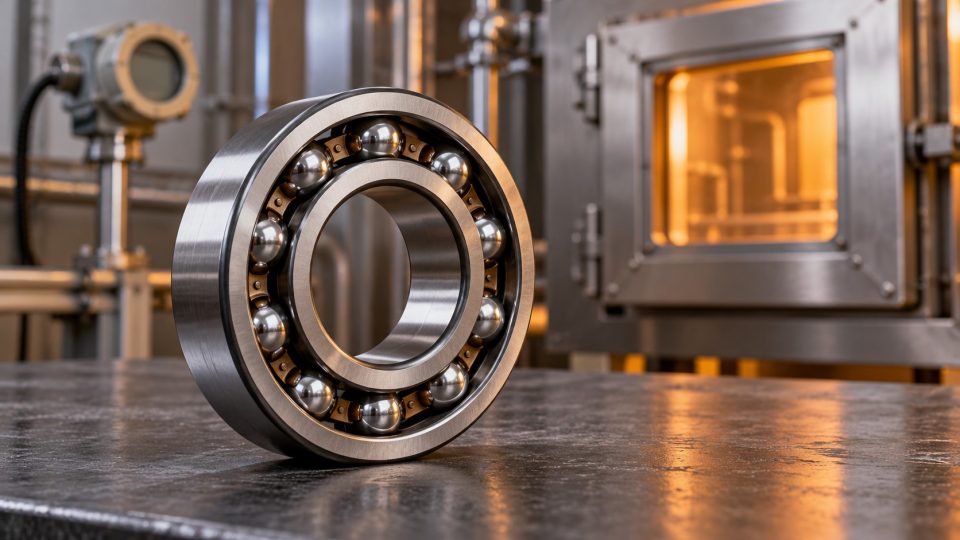
Which bearing should you choose for high temperatures? Selecting a bearing for elevated temperatures involves more than comparing machine temperature with a number in ...
Which bearing should you choose for high temperatures?
Selecting a bearing for elevated temperatures involves more than comparing machine temperature with a number in the product name. Establish the actual temperature of the bearing rings, its duration, rotational speed, load, lubrication method and the effects of dust, moisture and chemicals. A standard bearing may work correctly in a moderately warm arrangement, but its life falls rapidly once the capabilities of the grease, seals or heat-stabilised steel are exceeded. Conversely, using an expensive high-temperature bearing in a slowly heating mechanism where a C3 variant would suffice increases cost unnecessarily.
This guide helps distinguish three situations: operation suitable for a standard bearing, operation requiring greater C3 or C4 clearance, and applications requiring a complete high-temperature design. We also discuss the BRL ENC150, ENC200, ENC250, ENC270, ENC270CL and ENC330 series. In the manufacturer's documentation, the variant commonly called ENC270 may appear as ENC270C, so confirm the full designation and design before ordering.
Key information at a glance
Situation Usually appropriate selection approach Essential checks |
Situation Usually appropriate selection approach Essential checks |
Situation Usually appropriate selection approach Essential checks |
Situation Usually appropriate selection approach Essential checks |
Situation Usually appropriate selection approach Essential checks |
Situation Usually appropriate selection approach Essential checks |
Where should high-temperature bearing selection begin?
The first parameter is the temperature measured as close as possible to the outer ring, rather than the air temperature in the furnace, dryer or chamber. The bearing may be cooler than its surroundings because heat is conducted through the shaft and housing, but it may also be hotter when friction, excessive interference or too much grease generate additional heat. Measurements should cover steady operation, startup and the most heavily loaded part of the cycle.
Distinguish continuous temperature from a temporary maximum. A seal or grease may withstand a brief peak without necessarily retaining its properties for thousands of hours at that temperature. Every temperature rise accelerates base oil ageing, oxidation and loss of grease consistency. The lubricant's temperature range is therefore as important as the steel rings' temperature resistance.
The second parameter is speed. High speeds increase heat generation and require a stable lubricant film. Bearings intended for 270–330°C are often designed for slower operation than standard versions. Do not assume that a bearing with a higher permissible temperature will automatically handle the same speed as a standard bearing of identical dimensions.
The third element is load. Consider radial and axial forces, impacts, misalignment and housing stiffness. Load affects contact stresses and heat generation. In furnaces, trolleys, conveyors and fans, movement may be slow but loads change abruptly. In such cases, a load-rating margin is needed in addition to an appropriate catalogue temperature.
The fourth area is the environment: dust, ash, fibres, steam, moisture, aggressive vapours and frequent washing. The shield or seal type must limit contaminant ingress without becoming the assembly's weakest thermal element. Conventional elastomers are unsuitable at very high temperatures. Appropriately selected metal shields, open designs or special material solutions are used instead.
When is a standard bearing sufficient?
A standard bearing is a reasonable choice when its actual operating temperature remains within the combined limits for steel, cage, grease and seals, and operating clearance does not fall below a safe value after warming up. In a typical motor, gearbox or fan, housing temperature may be distinctly elevated while still remaining within the capabilities of a correctly lubricated catalogue bearing.
However, do not decide on the basis of touch alone. A housing that feels hot may be at 60–80°C, and that temperature does not always justify a high-temperature design. Measurement and manufacturer data for the specific bearing and lubricant are needed. Seal type also matters: an open design or one with metal shields may have different limits from a bearing with rubber seals.
A standard design is suitable if temperature is stable, speed does not exceed the catalogue value after allowing for lubrication, and mounting does not clamp the rings excessively. If a large temperature gradient, frequent starts after cooling or operation near the grease limit is expected, a more detailed analysis of clearance and thermal design is needed.
When should greater C3 or C4 clearance be selected?
C3 and C4 denote internal clearance greater than normal. They are not synonyms for high-temperature resistance. The greater clearance compensates for its reduction after mounting on the shaft and in the housing, and during uneven expansion of the rings. If the inner ring is hotter than the outer ring, it expands more and operating clearance decreases. Insufficient clearance increases friction, temperature and the risk of seizure.
C3 is often used in motors, fans, pumps and other arrangements with an interference fit or elevated temperature. C4 provides even greater initial clearance and may be required with a larger thermal gradient, strong interference fits or specific conditions identified in calculations. Do not choose C4 just in case. After warming up, operating clearance should be within the recommended range. Excessive clearance can increase vibration, noise, shaft movement and uneven loading of rolling elements.
The decision must consider fits, diameters, shaft and housing materials, both ring temperatures and load. C3 or C4 will not solve the problem if ordinary grease chars at the temperature involved, a seal loses elasticity or steel does not retain dimensional stability. A complete high-temperature version is then required.
When is a high-temperature bearing needed?
A high-temperature bearing is needed when the continuous temperature exceeds the capabilities of a standard assembly or when the required life cannot be achieved merely by changing clearance and grease. Such a bearing is selected as a system: rings and balls, clearance, cage, surface protection, shields and factory lubrication must work together within a defined temperature and speed range.
Typical applications include furnace conveyors, dryers, paint ovens, furnace trolleys, ceramic equipment, industrial bakeries, rollers and hot-air fans. High temperature often occurs together with dust, oxidation, long standstills and slow movement. Selection based solely on bore diameter and maximum temperature is therefore insufficient.
Consult the product range only after gathering the data: existing bearing designation, shaft diameter, speed, load, continuous and peak temperature, cycle time, shaft orientation and contamination information. This helps distinguish thermal failure from a mounting problem or incorrect fit.
BRL high-temperature series: ENC150–ENC330
BRL offers high-temperature ball bearings in popular dimension series, including 6000, 6200 and 6300. The individual ENC series differ in nominal temperature, protection, lubrication and recommended speed range. The table below is for preliminary selection. Final parameters must be confirmed for the specific size and current manufacturer data sheet.
BRL series Temperature / design characteristics Lubrication and protection Typical application direction |
BRL series Temperature / design characteristics Lubrication and protection Typical application direction |
BRL series Temperature / design characteristics Lubrication and protection Typical application direction |
BRL series Temperature / design characteristics Lubrication and protection Typical application direction |
BRL series Temperature / design characteristics Lubrication and protection Typical application direction |
BRL series Temperature / design characteristics Lubrication and protection Typical application direction |
The numbers in series names help organise the family but do not replace verification. The temperature limit may depend on size, load, speed, operating time, shield design and the specific lubricant. For ENC270 in particular, establish whether ENC270C or ENC270CL is intended, because the versions have different lubrication and speed capabilities.
How should lubrication be selected for the temperature?
Grease consists of base oil, thickener and additives. High temperature lowers oil viscosity and accelerates oxidation. An excessively thin film does not separate the surfaces, while degraded grease hardens, flows out or forms deposits. Selection should consider minimum startup temperature, continuous and short-term temperatures, speed and load.
Not all greases described as high-temperature are interchangeable. Products may use mineral oil, synthetic oil or PFPE and different thickeners. Mixing incompatible greases may cause loss of consistency. If a BRL bearing is factory-filled with a special grease, do not add an arbitrary lubricant without confirming compatibility.
Grease quantity also matters. Excessive filling at high speed causes lubricant churning and increases resistance and temperature. Too little reduces the film formation time. For relubricated designs, determine the quantity and interval based on size, speed, temperature and contamination. The higher the temperature, the shorter the grease life usually is, but this does not automatically mean frequently pumping in a large quantity.
Very slow furnace mechanisms use solutions able to retain their function at temperatures where typical mineral grease degrades quickly. Friction and surface condition must still be checked. Maintenance-free does not mean resistant to every thermal cycle and any quantity of dust.
Temperature, speed, load and environment — a practical selection matrix
Operating conditions Main risk Recommended action |
Operating conditions Main risk Recommended action |
Operating conditions Main risk Recommended action |
Operating conditions Main risk Recommended action |
Operating conditions Main risk Recommended action |
Operating conditions Main risk Recommended action |
Operating conditions Main risk Recommended action |
Operating conditions Main risk Recommended action |
Selection examples
Hot-air fan
If the temperature at the bearing is moderate and the shaft rotates quickly, a standard bearing with the correct clearance and grease may be better than a low-speed version rated for 330°C. Check both ring temperatures, limiting speed, rotor balance and heat flow through the shaft. If the continuous temperature exceeds the capabilities of standard grease, ENC150 or ENC200 can be considered, but only after verifying speed.
Conveyor in a dryer
A conveyor usually involves moderate speeds, long operating times and dust. Shields and grease resistance to constant temperature are important. Depending on the measurement, ENC200, ENC250 or ENC270C may be suitable. If the mechanism moves very slowly, ENC270CL may be more appropriate, but the shaft load must be checked.
Furnace trolley
The trolley moves slowly, but its bearings may remain in extreme heat for long periods and be exposed to impact loads. ENC330 is considered for temperatures reaching around 330°C. Account for axle expansion, structural thermal movement, the ability of one bearing to move and time spent in the hot zone.
Motor beside heating equipment
If heat reaches the motor from outside, problems may be caused by insufficient operating clearance, inadequate cooling or excessive interference. C3 may suffice if the grease and seals operate within their permissible range. Choosing ENC without analysing motor speed can make the situation worse.
Common errors when choosing a high-temperature bearing
- Selecting by furnace temperature. Bearing temperature throughout the cycle is what matters.
- Treating C3 or C4 as a temperature class. These are internal clearance classes, not complete thermal designs.
- Overlooking speed. The highest temperature resistance often comes with speed restrictions.
- Ignoring shields and seals. The closure component may have lower resistance than the steel.
- Mixing greases. Incompatible lubricants can quickly lose their properties.
- Excessive relubrication. Too much grease raises resistance and temperature.
- No room for expansion. A long shaft and a hot structure require a well-considered locating and non-locating bearing arrangement.
- Buying by dimensions alone. Two bearings of identical dimensions may have completely different greases, clearances and speed limits.
How to prepare the data for a quotation enquiry
- Write down the existing bearing's full designation and dimensions.
- Provide continuous and maximum temperatures measured at the bearing.
- Specify rotational speed and daily operating time.
- Describe the load, impacts and force directions.
- State the types of contamination, moisture, washing and chemical contact.
- Provide shaft and housing fits if known.
- Describe previous failures: overheating, noise, seizure, corrosion or grease leakage.
This information helps select the ENC series as well as the correct shields, clearance and mounting method. It reduces the risk of a new bearing being thermally resistant but unsuitable for the speed or load.
FAQ — high-temperature bearings
1. From what temperature is a high-temperature bearing needed?
There is no single limit for all designs. The weakest element determines the limit: grease, seal, cage, steel or fit. First measure bearing temperature and check the parameters of the specific standard design.
2. Is a C3 bearing a high-temperature bearing?
No. C3 means internal clearance greater than normal. It can compensate for clearance reduction after mounting and warming up, but does not provide special grease, shields or material stabilisation.
3. When should C4 be chosen instead of C3?
C4 is considered when interference or temperature gradients reduce clearance even further. Selection should follow an operating-clearance calculation. Excessive clearance after warming up is also undesirable.
4. Can ENC330 be used in place of ENC200?
Not automatically. ENC330 is intended for very high temperatures and has defined restrictions, particularly on speed. In a faster machine, ENC200 may be more appropriate if the temperature stays within its range.
5. What is the difference between ENC270C and ENC270CL?
Both versions are intended for around 270°C, but differ in lubrication and motion capabilities. ENC270CL is primarily aimed at slower applications. Confirm the full designation when purchasing.
6. Does the number in an ENC name mean an unconditional continuous temperature?
It should not be interpreted that way. It indicates the design class. Actual permissible operation depends on size, grease, shields, speed, load and the duration of temperature exposure.
7. Can a high-temperature bearing be relubricated with ordinary grease?
Generally, this should not be done without confirmation. Ordinary grease may not withstand the temperature, and mixing it with the factory lubricant can impair consistency and lubrication.
8. How should bearing temperature be measured?
Ideally, take repeatable measurements at the housing as close as possible to the outer ring and observe the trend from startup to steady operation. Fixed sensors are used at critical bearing arrangements. Measuring air temperature is insufficient.
9. Why does a new bearing heat up after mounting?
Running-in and grease distribution may be the cause, but so may excessive interference, misalignment, too much grease, lack of operating clearance or incorrect mounting. If temperature continues to rise, stop the machine and diagnose it.
10. Is a ZZ shield always better at high temperatures?
A metal shield withstands temperature well and limits larger contaminants, but does not seal as effectively as a contact seal. Selection depends on temperature, dust, moisture, speed and the specific series.
Select a high-temperature bearing with NERON
Knowing the temperature, speed, load and environmental conditions makes selection considerably safer. Explore the high-temperature ball bearings available in the NERON shop. You can also compare ball bearings and browse the full bearing category. Before ordering, prepare the data from the list above and discuss the BRL series and design with a technical adviser.
Summary
A standard bearing is sufficient when temperature, speed, grease and seals operate within their permissible ranges. C3 or C4 is used when mounting and temperature differences reduce operating clearance, but greater clearance does not replace a high-temperature design. The BRL ENC150, ENC200, ENC250, ENC270C, ENC270CL and ENC330 series enable designs to be selected for increasingly demanding thermal conditions, but each has its own lubrication, protection and speed restrictions. The best choice follows from measuring temperature at the bearing and jointly analysing speed, load, thermal cycle and environment.
Related articles
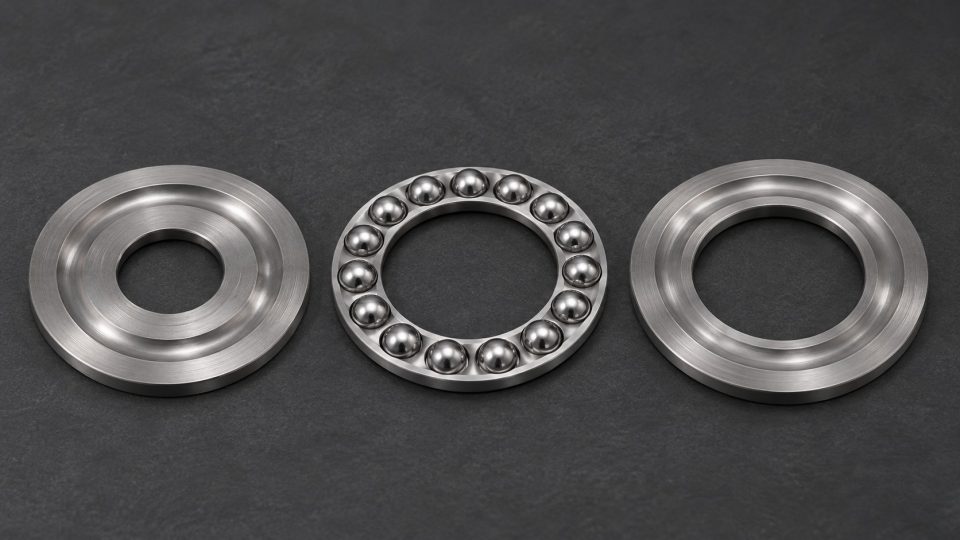
Łożysko oporowe 51105 czy 51205? Co zmierzyć przed wymianą
Okładka pokazuje rozłożone części poglądowo. Wymiary odczytaj z karty danego wykonania. Łożysko 51105 ma wymiary 25 × 42 × 11 mm, a 51205 ma 25 × 47 × 15 mm. Oba mają ...
Read article · 3 min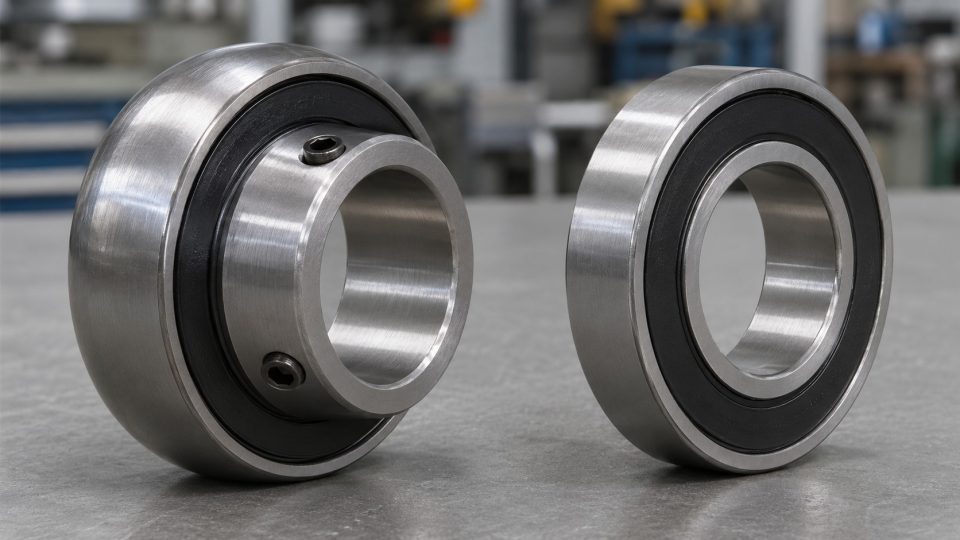
UC205 a 6205 — dlaczego wymiary 25 i 52 mm nie wystarczą?
UC205 i 6205 nie są bezpośrednimi zamiennikami tylko dlatego, że mają otwór 25 mm i średnicę zewnętrzną 52 mm. Przy zakupie sprawdź również kształt powierzchni zewnętr...
Read article · 3 min
causes of premature bearing wear
Causes of premature bearing wear – mounting errors, lubrication and contamination The most common causes of premature bearing wear are inadequate lubrication, lubrican...
Read article · 12 min