
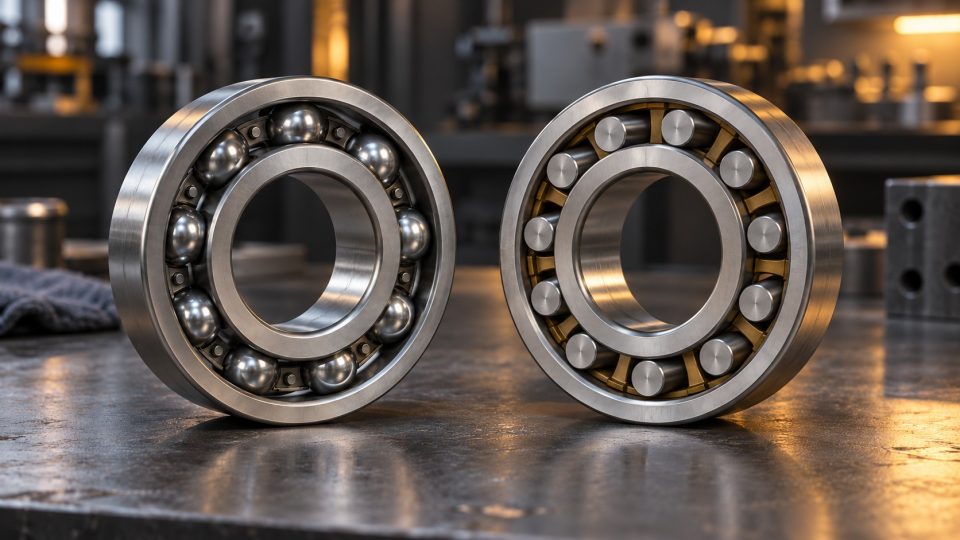
Ball bearings vs roller bearings – differences, applications and selection A ball bearing is worth choosing primarily when low resistance to motion, high rotational sp...
Ball bearings vs roller bearings – differences, applications and selection
A ball bearing is worth choosing primarily when low resistance to motion, high rotational speed, quiet operation and the ability to carry moderate radial and axial loads are priorities. A roller bearing is usually better for heavier loads, required stiffness, impacts or limited radial space, but its exact capabilities depend on roller shape: cylindrical, tapered, spherical or needle.
There is therefore no single winner in the comparison between ball and roller bearings. A high-speed motor will most often use a ball bearing, a heavily loaded gearbox a cylindrical or tapered roller bearing, and applications with misalignment and impacts a spherical roller bearing. The final decision requires comparing radial and axial load, speed, temperature, accuracy, stiffness, life, mounting conditions and operating environment.
Contents
- Key information at a glance
- What are ball bearings?
- What are roller bearings?
- Design differences
- Detailed comparison table
- Load transmission
- Speed and operating temperature
- Life, load rating and stiffness
- When should each type be selected?
- Common selection errors
- FAQ
Key information at a glance
Application condition Most common choice Reason |
Application condition Most common choice Reason |
Application condition Most common choice Reason |
Application condition Most common choice Reason |
Application condition Most common choice Reason |
Application condition Most common choice Reason |
What are ball bearings?
Ball bearings use balls as rolling elements between the inner and outer rings. Ball-to-raceway contact is approximately a point, although a small contact ellipse develops under load. The small contact area limits friction, so ball-bearing designs work well at high speeds and are widely used in electric motors, fans, pumps, power tools, conveyors and precision equipment.
Single-row deep groove ball bearings are the most versatile. They carry radial loads and moderate axial loads in both directions. Where axial forces dominate or greater shaft-location stiffness is required, angular contact ball bearings are used, often mounted in pairs. Self-aligning ball bearings can be considered for misalignment, and thrust versions for exclusively axial loads.
The NERON range lets you compare different ball bearings, but bore diameter alone is insufficient for selection. Check the dimension series, dynamic and static load ratings, limiting speed, clearance, accuracy class, cage type, sealing and grease.
What are roller bearings?
Roller bearings use elongated rolling elements. Depending on the version, these are cylindrical, tapered or spherical rollers, or very slender needle rollers. Contact with the raceway is approximately linear, spreading the load over a larger area than in a ball bearing. The result is usually greater load capacity and stiffness within comparable overall dimensions.
The term roller bearing covers several families with different roles. Cylindrical roller bearings primarily carry heavy radial loads and may allow one ring to move axially. Tapered roller bearings handle combined radial and axial loads but require correct clearance or preload adjustment. Spherical roller bearings are self-aligning and tolerate loads, impacts and angular misalignment well. Needle roller bearings provide high load capacity with a small cross-sectional height.
For demanding industrial applications, explore spherical roller bearings. However, do not automatically substitute them for a ball bearing: higher load capacity may come with greater friction, lower permissible speed, different mounting and a higher cost for the entire bearing arrangement.
Design differences between ball and roller bearings
The key difference is contact geometry. A ball contacts the raceway over a smaller area, reducing rolling resistance but causing higher contact stress under the same force. A roller distributes load along a contact line and can therefore carry greater forces. It requires more accurate guidance, however, and alignment errors can concentrate pressure at the edge unless the design is self-aligning or appropriately profiled.
The second difference concerns axial guidance. A standard deep groove ball bearing can locate the shaft in both directions under moderate axial forces. Some cylindrical roller bearings are primarily designed as non-locating bearings and accommodate shaft thermal expansion through internal displacement. Tapered roller bearings and certain cylindrical designs can carry significant axial forces, but their mounting arrangement must be analysed according to load direction.
Mounting also differs. Deep groove ball bearings are non-separable and relatively simple to install. Many cylindrical and tapered roller bearings are separable, making the rings easier to fit but increasing the requirements for cleanliness, alignment and adjustment. Incorrect clearance in a tapered roller bearing pair can cause overheating or loss of stiffness.
Ball bearings vs roller bearings – a detailed comparison table
Parameter Ball bearings Roller bearings Significance for selection |
Parameter Ball bearings Roller bearings Significance for selection |
Parameter Ball bearings Roller bearings Significance for selection |
Parameter Ball bearings Roller bearings Significance for selection |
Parameter Ball bearings Roller bearings Significance for selection |
Parameter Ball bearings Roller bearings Significance for selection |
Parameter Ball bearings Roller bearings Significance for selection |
Parameter Ball bearings Roller bearings Significance for selection |
Differences in load transmission
Radial load
Radial load acts perpendicular to the shaft axis. Within the same design space, a roller bearing usually achieves a higher load capacity than a ball bearing because the load is distributed over a longer contact zone. Cylindrical and spherical roller bearings are therefore common choices in gearboxes, rolling mills, large motors, conveyors and heavy machinery.
This does not mean that ball bearings are weak. Larger-section series and double-row designs can carry significant loads. However, where the load is high relative to overall dimensions and speed is moderate, rollers usually provide a greater load-capacity and stiffness margin.
Axial load
Axial force acts along the shaft. A deep groove ball bearing can carry it in both directions, but only within the limits of the specific design. An angular contact ball bearing carries greater axial force in one direction and therefore often operates in a pair. Among roller bearings, tapered roller bearings are particularly important for combined loads, while spherical roller bearings can carry axial forces together with heavy radial loads.
Cylindrical roller bearings require accurate interpretation of their designation. Some designs do not locate the shaft axially, while others carry limited forces in one or both directions. The designer should define which bearing is locating and which is non-locating so that shaft thermal expansion does not create additional load.
Impact and variable loads
Impact loading requires consideration of dynamic and static load ratings, housing stiffness, fit, clearance and pressure distribution. Spherical roller bearings work well in screens and crushers because they combine high load capacity with the ability to accommodate misalignment. In a ball-bearing application, a severe impact can permanently deform a raceway despite a low average load.
Effects of speed and operating temperature
Ball bearings usually have a speed advantage. A smaller contact area limits friction, and a light rolling element generates lower inertial forces. In high-speed motors, fans and spindles, this limits temperature and energy losses. The speed limit still depends on cage, lubrication, sealing, clearance, load and heat dissipation.
Roller bearings can operate at high speeds, especially precision cylindrical designs, but values from a ball bearing of the same dimensions must not be transferred. Tapered roller bearings also require correct clearance adjustment. Excessive preload rapidly increases friction and temperature.
Temperature affects lubricant viscosity, operating clearance, cage material, seals and ring dimensional stability. If the inner ring heats up more than the outer ring, clearance decreases. A C3 or C4 design may then be needed, but greater clearance cannot replace appropriate grease or a high-temperature bearing. For hot bearing arrangements, review the high-temperature ball bearing category and check the speed restrictions of the specific design at the same time.
Life, load rating and stiffness
The dynamic load rating C is used to calculate fatigue life, while the static load rating C0 helps assess the risk of permanent deformation under heavy or impact loads. Two designs of identical dimensions may have significantly different C and C0 values. Replacing one type with another by dimensions alone is therefore risky.
Roller bearings usually have greater load capacity and stiffness, but their life falls if misalignment, incorrect fit or edge overload occurs. Spherical roller bearings reduce some of this risk through self-alignment. Ball bearings tolerate high speeds better, but should not be overloaded merely because they run cool and quietly.
Actual life also depends on cleanliness, lubrication, temperature, electrical oscillations, mounting and housing stiffness. Calculated rating life does not guarantee a number of hours if dust or water enters the bearing or a ring rotates in its seat. In B2B purchasing, compare downtime cost and replacement availability as well as unit price.
Main versions and their applications
Bearing type Main advantage Limitation Typical application |
Bearing type Main advantage Limitation Typical application |
Bearing type Main advantage Limitation Typical application |
Bearing type Main advantage Limitation Typical application |
Bearing type Main advantage Limitation Typical application |
Bearing type Main advantage Limitation Typical application |
When should a ball bearing or a roller bearing be selected?
When should a ball bearing be selected?
- when rotational speed is high and load is moderate.
- when low resistance, quiet operation and energy efficiency matter.
- when a simple, non-separable design and easy replacement are needed.
- when moderate radial and axial loads occur.
- when a sealed, factory-lubricated standard design is required.
A good starting point is the catalogue category of NERON ball bearings. Before purchase, compare the full designation, not just dimensions.
When should a roller bearing be selected?
- when radial load is high relative to the available space.
- when the arrangement requires high stiffness and low deflection.
- when impact loads or a heavy industrial duty cycle occur.
- when combined loads justify a tapered roller bearing.
- when misalignment and high forces favour a spherical roller bearing.
- when limited radial space requires a needle roller bearing.
A full overview of the bearing category in the NERON shop makes it easier to compare design families, but specific product parameters must always be related to bearing-arrangement calculations.
Practical selection procedure
- Determine radial and axial forces, their directions, variation and impacts.
- Establish minimum, nominal and maximum speeds throughout the duty cycle.
- Define the required life and reliability factor.
- Check available radial and axial space.
- Assess shaft misalignment, deflection and housing stiffness.
- Select a locating and non-locating bearing arrangement that accounts for thermal expansion.
- Verify temperature, lubrication, sealing and contamination.
- Compare C and C0 load ratings, catalogue speeds, clearance and fits.
- Check mounting, adjustability and the maintenance plan.
- Assess life-cycle cost, availability and downtime risk.
Common bearing selection errors
- Selecting by dimensions alone. Identical d, D and B do not mean the same load rating, speed or axial function.
- Assuming roller bearings are always better. Higher load capacity may be unnecessary, while greater friction may be disadvantageous at high speeds.
- Overlooking axial load. A cylindrical roller bearing may not locate the shaft as the designer expects.
- Ignoring misalignment. A rigid bearing may suffer edge overload despite sufficient catalogue load capacity.
- Incorrect tapered roller bearing adjustment. Insufficient clearance or excessive preload causes heating, while excessive clearance impairs stiffness.
- Comparing purchase price alone. A cheaper component may increase mounting, maintenance and downtime costs.
- Failing to account for temperature. Changes in operating clearance and grease viscosity can completely change the arrangement's behaviour.
- No fit check. A rotating ring with too loose a fit can creep and damage the shaft or housing.
FAQ — ball and roller bearings
1. Which bearing has greater load capacity: ball or roller?
At comparable dimensions, a roller bearing usually has greater radial load capacity because of line contact with the raceway. The exact advantage depends on type, series, material and internal design.
2. Which bearing works better at high speeds?
Most often a ball bearing, because of its lower friction and lighter rolling elements. Check the final value in the catalogue for the specific cage, grease, sealing and load.
3. Can a roller bearing carry axial load?
Yes, but it depends on the version. Tapered and spherical roller bearings carry combined loads, while some cylindrical roller bearings have limited axial load capacity or serve as non-locating bearings.
4. Can a ball bearing be replaced by a cylindrical roller bearing of the same dimensions?
Not without analysis. Check locating function, clearance, load rating, speed, fit, lubrication and the ability to accommodate shaft expansion.
5. Why do spherical roller bearings tolerate misalignment well?
They have a spherical outer-ring raceway that allows the roller assembly to align with a deflected shaft. The permissible angle remains limited by the design.
6. When should a needle roller bearing be used?
When available radial space is small and load is high. Appropriate raceway hardness and quality, accurate alignment and effective lubrication are essential.
7. Are ball bearings always quieter?
They usually favour quiet operation, but noise also depends on accuracy class, clearance, raceway waviness, grease, mounting and housing condition. A poorly mounted ball bearing can run louder than a correctly selected roller bearing.
8. How does temperature affect bearing type selection?
It changes operating clearance and lubricant viscosity and limits cage and seal materials. In a hot bearing arrangement, analyse the entire assembly, not just the ball or roller.
9. What do C3 and C4 mean?
They are internal clearance classes greater than normal. They are used where fits and temperature differences will reduce clearance during operation. They do not designate load capacity or quality.
10. Which bearing is less expensive to operate?
That depends on the application. A standard ball bearing is often cheaper to buy, but a suitable roller bearing in a heavy machine may provide significantly lower downtime and replacement costs.
Select a bearing with NERON
Before ordering, prepare the existing bearing's full designation, dimensions, speed, radial and axial load, temperature and environmental description. In the NERON shop, you can compare ball bearings, explore spherical roller bearings for heavy-duty conditions and view the full range of bearings. For a critical bearing arrangement, discuss load rating, clearance, fit and lubrication before purchase — verification usually costs many times less than a failure.
Summary
Ball bearings usually provide higher speed, lower friction and economical operation in moderately loaded applications. Roller bearings offer greater load capacity and stiffness, and their versions solve different problems: cylindrical designs carry heavy radial forces, tapered designs handle combined loads, spherical designs accommodate misalignment and impacts, and needle designs carry high loads in little space. Correct selection follows from calculations of load capacity, life, speed, temperature and alignment, together with mounting and lubrication conditions, rather than the group name.
Related articles
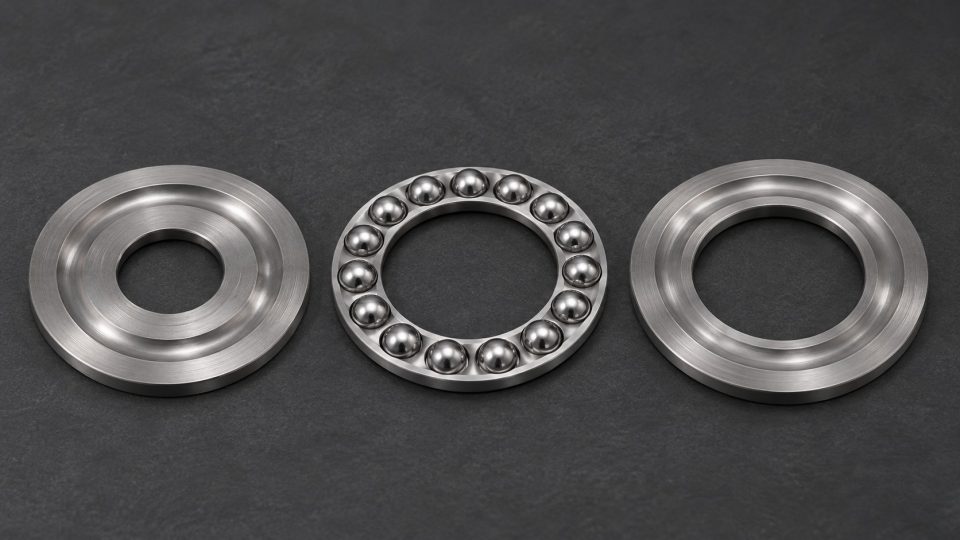
Łożysko oporowe 51105 czy 51205? Co zmierzyć przed wymianą
Okładka pokazuje rozłożone części poglądowo. Wymiary odczytaj z karty danego wykonania. Łożysko 51105 ma wymiary 25 × 42 × 11 mm, a 51205 ma 25 × 47 × 15 mm. Oba mają ...
Read article · 3 min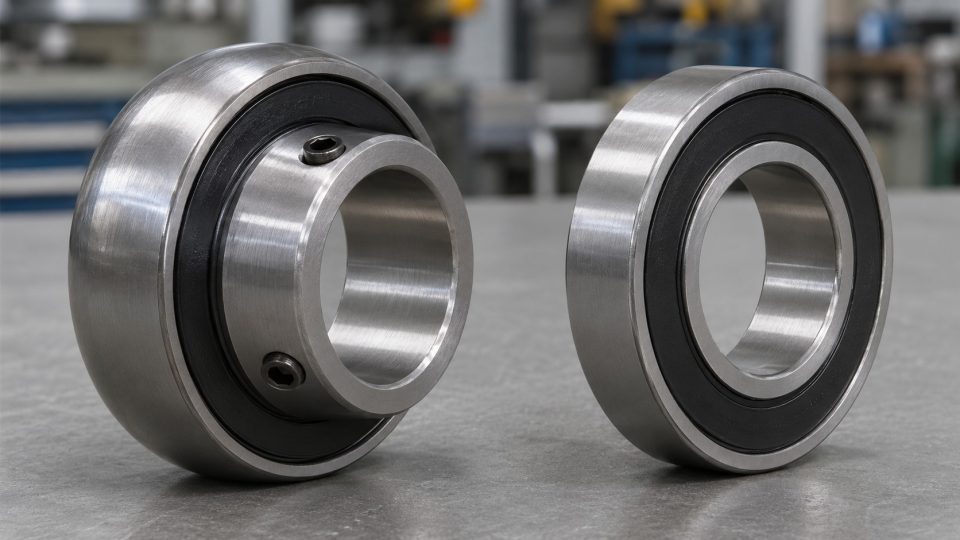
UC205 a 6205 — dlaczego wymiary 25 i 52 mm nie wystarczą?
UC205 i 6205 nie są bezpośrednimi zamiennikami tylko dlatego, że mają otwór 25 mm i średnicę zewnętrzną 52 mm. Przy zakupie sprawdź również kształt powierzchni zewnętr...
Read article · 3 min
causes of premature bearing wear
Causes of premature bearing wear – mounting errors, lubrication and contamination The most common causes of premature bearing wear are inadequate lubrication, lubrican...
Read article · 12 min