
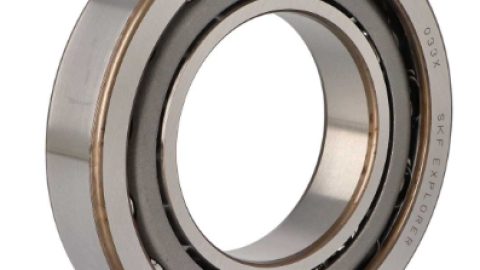
Bearing designations — three basic groups of characters, prefix, suffix and basic number Explaining bearing markings is very important, especially in industry and othe...
Bearing designations — three basic groups of characters, prefix, suffix and basic number
Explaining bearing markings is very important, especially in industry and other technical fields where accuracy and precision are crucial. The above information lets us identify the bearing type from its designation. Bearing technical specifications structure designations to provide precise product information. Conventional designations can be divided into three key segments, prefixes before the basic number, the basic number itself, and suffixes after it. Each supplies critical information on the bearing's construction, dimensions and technical specification. A brief summary follows.
Prefixes
Indicate specific model properties or specific bearing models.
“F” means a flanged outer ring is present.
“SS” or “S” indicates a stainless steel bearing.
Basic number
The first symbol describes the bearing type, for example 0 for a double-row angular contact bearing, 7 for a single-row angular contact ball bearing, and so on.
The second part of the basic number refers to bearing size.
For radial bearings, the first digit describes width and the second outside diameter.
For thrust bearings, the first digit indicates axial bearing height.
The bearing's inside diameter, the inner ring bore, is calculated by multiplying the two digits at this position by five. There are exceptions for diameters below 10 mm or above 500 mm.
Suffixes
Provide specific bearing properties such as materials, seals, cage, retaining ring groove, accuracy class or internal clearance.
The last suffix section describes manufacturing precision, for example P0 for normal class and P4 for precision class.
Bearing types and sizes — bearing designations
Bearing designations are crucial for identifying specific properties and applications. Their three groups of characters give specialists information on bearing type and specification.
The first symbol of the basic number indicates bearing type, crucial when selecting for a specific application. The classification is as follows.
0— double-row angular contact bearing, guided on the outer ring in radial bearings, providing rotational and dimensional accuracy.
1— double-row self-aligning ball bearing with a retaining ring groove in the outer ring, guaranteeing stability on both bearing sides.
2— a spherical roller bearing is a distinctive design carrying radial and axial loads. These properties make it ideal for axial bearing applications.
3— single-row tapered roller bearing whose unique construction provides efficiency in a back-to-back arrangement, with a retaining ring groove in the outer ring.
4— double-row deep groove ball bearing with a characteristic construction in which the outer ring is guided on the inner ring.
5— thrust ball bearings are designed to carry loads in one direction.
6— single-row deep groove ball bearing with a retaining ring groove in the outer ring, making it particularly stable in many applications.
7— single-row angular contact ball bearing whose particular contact angle is optimal for applications requiring precise adjustment.
8— cylindrical roller thrust bearings designed to carry high axial loads.
C— CARB needle roller bearing whose compact construction with an inner ring is ideal for restricted spaces.
N— cylindrical roller bearing with a retaining ring groove in the outer ring, chosen for high-load applications.
QJ— 4-point angular contact ball bearing with a split inner ring, making it versatile for varying loads.
In the two-digit sequence of the basic number, the first digit refers to radial bearing width or thrust bearing height. Note the unusual sequence, which does not increase conventionally. Radial bearing widths use the following values from smallest upwards, 8, 0, 1, 2, 3, 4, 5, 6, 7. Thrust bearing heights use 7, 9, 1, 2.
The second digit applies to both bearing types and refers to outside diameter. Its sequence from the smallest diameter is 7, 8, 9, 0, 1, 2, 3, 4, 5. A higher value indicates wider inner and outer bearing rings.
Bore diameter and its designation
Detailed analysis of bearing bore diameter designations reveals a varied structure intended for specialists.
First consider bore diameters between 20 and 500 mm. Here, multiplying the first two digits of the bearing designation by five gives the inside diameter in millimetres. For example, applying this rule to 6205 gives 25 mm.
For bores below 10 mm and above 500 mm, another convention gives the bore diameter directly in the designation. For example, 230/750 K-MB-T52BW-C3 FAG has a bore diameter of 750 mm.
Also consider bores between 10 and 20 mm. Special codes identify the inside diameter according to the following table.
00 — bearing with a 10 mm bore,
01 — bore diameter 12 mm,
02 — bore diameter 15 mm,
03 — bearing with a 17 mm bore.
Suffixes — characters after the basic number
Suffixes are a key part of bearing designations, providing specialists with valuable component property information. Directly after the basic number, these combinations of letters and digits specify materials, seal type, cage, retaining ring groove, accuracy class or internal clearance.
Manufacturing precision is one of the most important suffix properties. It is generally indicated by P followed by a digit. This system is based on international standard ISO 492 and classifies manufacturing accuracy as follows.
P0 — normal class, very common in standard applications and often omitted from designations because of its prevalence.
P6 — accuracy class 6, a higher precision level.
P5 — accuracy class 5, very accurate bearing manufacture.
P4 — accuracy class 4, precision manufacture.
P2 — accuracy class 2, the highest available precision, reserved for specialist applications requiring extreme accuracy.
Industry also uses P3 and P4s. Although their dimensional accuracy matches P4, their rotational accuracy reaches P2, making them distinctive for running precision.
Bearing external shape
External shape and design details are fundamental to engineering selection. The bore may take different forms, the most typical being tapered. Such bearings are mounted on shafts using sleeves and marked K after the basic number. Without this letter, a cylindrical bore with the same diameter at both ends may be assumed.
Another key external feature is a retaining ring groove. It is often formed in the outer ring to fit a spring retaining ring or for other design purposes. Specific codes quickly identify these features.
N — a retaining ring groove in the outer ring.
NR — retaining ring groove with a spring retaining ring.
Bearing contact angle information
Contact angle is crucial in angular contact ball and tapered roller bearings, defining raceway position relative to the bearing axis. It directly affects axial load capacity and is therefore an important selection criterion where axial loads dominate.
Manufacturers such as FAG and NSK use specific alphanumeric codes to indicate contact angle in the bearing designation.
C (FAG, NSK) denotes bearings with a 15° contact angle. These are angular contact ball bearingsof high precision, ideal where accuracy and minimum friction are priorities.
E (FAG), A5 (NSK) indicate a 25° contact angle. These are also precision angular contact ball bearings, but carry greater axial loads than the 15° version.
B indicates a 40° contact angle in single-row angular contact ball bearings. For double-row angular contact ball bearings it means 25° and 32°. The latter lack ball filling slots, affecting their operation and applications.
Analysing bearing designations
The cage separates rolling elements, preventing mutual friction in operation. Cage material variants can be identified by specific markings.
Pressed steel cage, J or W. Manufacturers often omit this marking.
Pressed brass cage, Y.
Machined brass cage, including M, MP, MPA, MA, MB, CAM.
Polyamide cage, TNG, often glass-fibre reinforced for greater strength.
Full complement of rolling elements, V indicates a cageless bearing.
Cage guidance also matters. It is usually rolling-element guided but can be guided by the outer ring, A, or inner ring, B.
Internal clearance is a key bearing operating parameter, the possible displacement of one ring relative to the other. ISO defines five classes identified by C and a digit. Bearings for specific uses, such as vibrating equipment, have extra designations such as T41, VB, VA405 and W800.
Different sealing options provide different protection. A metal shield, Z, is traditional, while rubber seals such as RS or 2RS offer better protection but may affect maximum speed.
For example, 6004 ZZ NR NSK indicates a bearing ball bearings with a 20 mm bore, metal shield and retaining ring groove in the outer ring. Another example, RNU2206-E-XL-TVP2, is a cylindrical roller bearing without an inner ring and with a plastic cage.
Understanding and interpreting designations lets mechanical specialists select and apply bearings correctly for particular uses.
Related articles
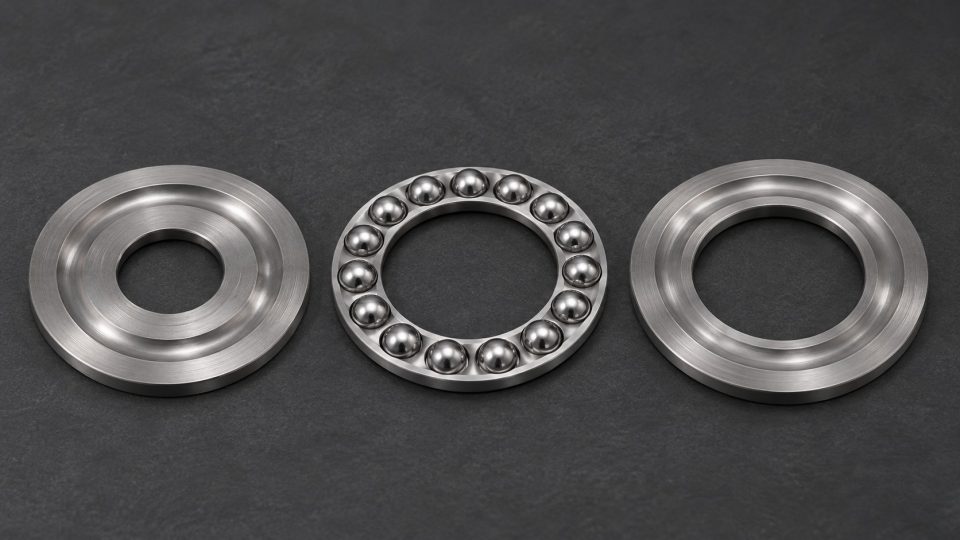
Łożysko oporowe 51105 czy 51205? Co zmierzyć przed wymianą
Okładka pokazuje rozłożone części poglądowo. Wymiary odczytaj z karty danego wykonania. Łożysko 51105 ma wymiary 25 × 42 × 11 mm, a 51205 ma 25 × 47 × 15 mm. Oba mają ...
Read article · 3 min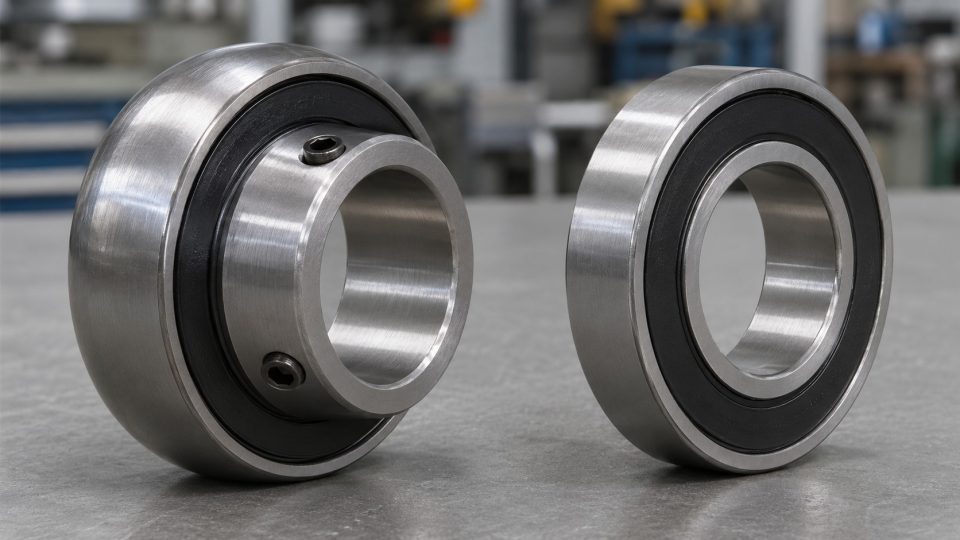
UC205 a 6205 — dlaczego wymiary 25 i 52 mm nie wystarczą?
UC205 i 6205 nie są bezpośrednimi zamiennikami tylko dlatego, że mają otwór 25 mm i średnicę zewnętrzną 52 mm. Przy zakupie sprawdź również kształt powierzchni zewnętr...
Read article · 3 min
causes of premature bearing wear
Causes of premature bearing wear – mounting errors, lubrication and contamination The most common causes of premature bearing wear are inadequate lubrication, lubrican...
Read article · 12 min