

SAE 3000 3/4″ reducing flange / female BSP 1/2″ FG03-12-08U - set
Straight carbon-steel reducing fitting with a 3/4″ SAE 3000 flange and a female 1/2″ BSP port.
Version U includes the flange fitting, UNC mounting screws and an O-ring seal.
SAE 3000 3/4″ reducing flange / female BSP 1/2″ FG03-12-08U - set
Straight carbon-steel reducing fitting with a 3/4″ SAE 3000 flange and a female 1/2″ BSP port.

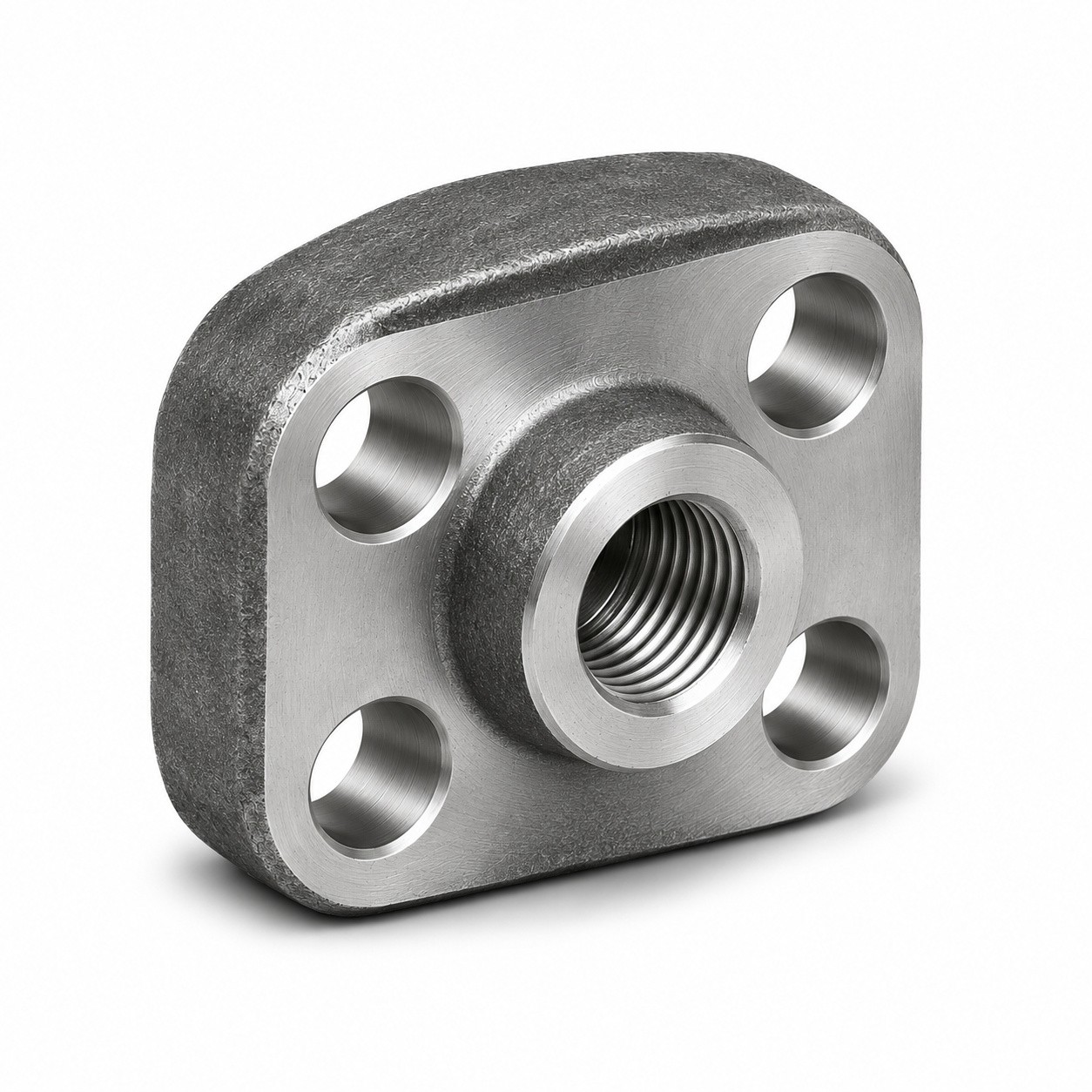
Illustrative view of the body FG03-12-08U
Connections
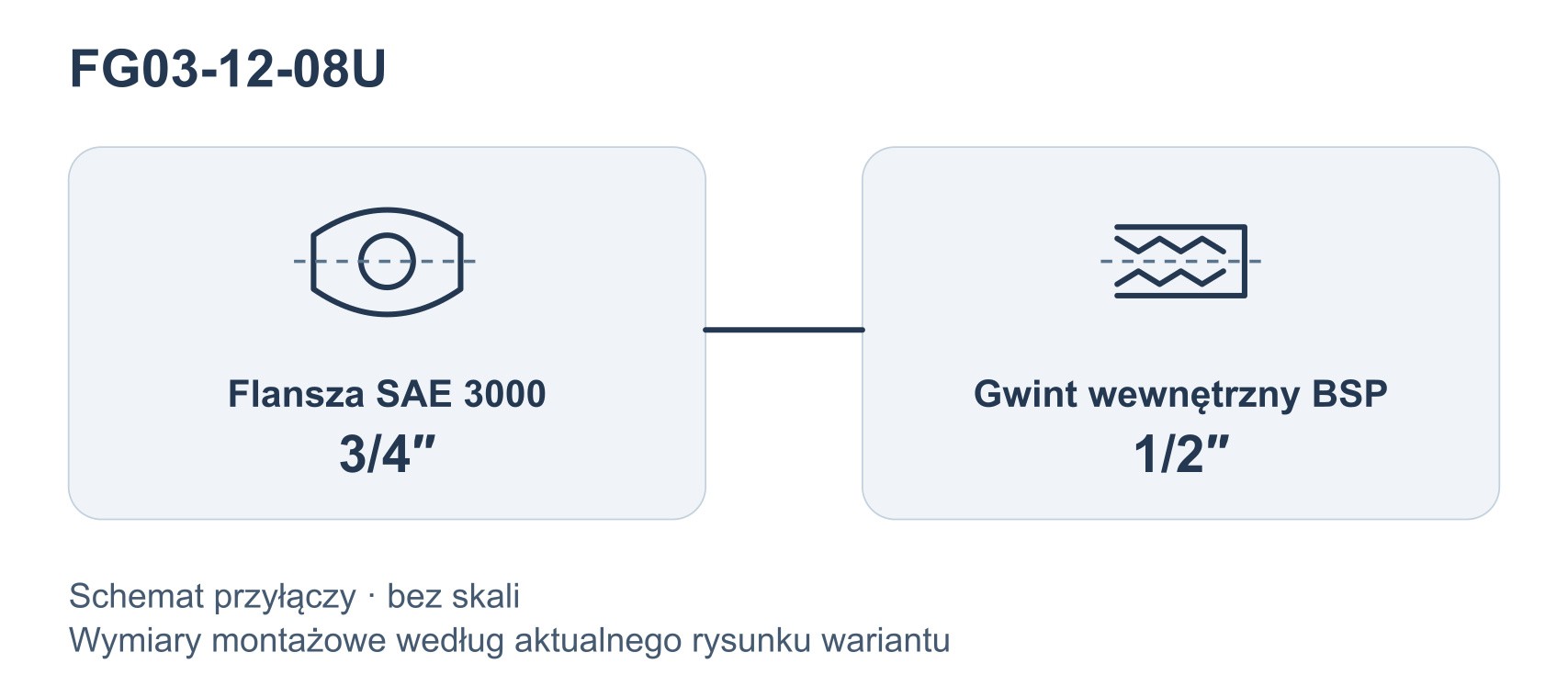
- Flange type and size: SAE 3000, 3/4″.
- Threaded port: female 1/2″ BSP.
- Body: carbon steel.

Connection diagram, not to scale FG03-12-08U

Illustrative view of the body in a carton FG03-12-08U. Mounting hardware is outside the frame.
Set contents
Version U includes the flange fitting, UNC mounting screws and an O-ring seal.
Frequently asked questions
What sizes does this reducing fitting have?
It has a 3/4″ SAE 3000 flange and a female 1/2″ BSP threaded port.
What does version U include?
A flange fitting, UNC mounting screws and an O-ring seal.
How do I identify the variant?
The variant code is FG03-12-08U. Its interfaces are a 3/4″ flange and a 1/2″ BSP female thread.
How do I check the mounting dimensions?
Use the current drawing for FG03-12-08U to confirm the mounting centres and body dimensions.
-
ConditionNew
-
Sales unitset
-
Source referenceFG03-12-08U
-
Internal threadBSP 1/2″
-
Quantity per pack1 kpl.
-
Body materialStal węglowa
-
Product typePrzyłącze flanszowe proste
-
ShapeProste
-
SeriesSAE 3000
-
Connection size3/4″
-
SealO-ring
-
Gwint mocującyUNC
1. Eye protection:
– Always wear safety goggles or a face shield to protect your eyes from sparks, particles and metal fragments.
2. Hearing protection:
– When working in a noisy environment, use ear defenders or earplugs to prevent hearing damage.
3. Respiratory protection:
– When working in dusty surroundings or in the presence of fumes, wear a filtering mask or an appropriate respirator.
– Ensure proper ventilation of the workstation.
4. Hand and skin safety:
– Use protective gloves that protect against mechanical injuries and chemicals.
– Where necessary, use protective creams to prevent irritation and dry skin.
5. Work clothing:
– Work in protective clothing resistant to sparks and splashes.
– Avoid loose clothing, jewellery and loose hair near machinery.
6. Fire risk:
– Keep the workstation free of flammable materials (e.g. paper, fabrics and chemicals).
– Keep a serviceable fire extinguisher close at hand and know how to use it.
7. Electrical hazards:
– Check the condition of cables and electrical equipment before use.
– Do not use electrical devices in damp conditions.
– Disconnect equipment from the power supply during maintenance or repairs.
8. Use of machinery and tools:
– Regularly inspect the technical condition of machines and tools.
– Use equipment in accordance with the manufacturer's instructions.
– Blades and tools should be maintained regularly and kept in good condition.
– Machines should be fitted with appropriate guards and protective devices.
9. Handling materials:
– Use handling equipment to move heavy components.
– Lift and carry using ergonomic practices to avoid injury.
10. Working with chemicals:
– Store chemicals in labelled, safe containers.
– Use substances in accordance with the manufacturer's instructions and occupational health and safety rules.
– Ensure air circulation when using chemicals.
Other important rules:
– Keep the workstation clean and tidy.
– Ensure adequate lighting in the working area.
– Provide occupational health and safety training.
– Carry out regular safety audits and comply with current regulations.

Comments (0)
Your review appreciation cannot be sent
Report comment
Report sent
Your report cannot be sent