Module gear M4 Z60 without hub — Hubber
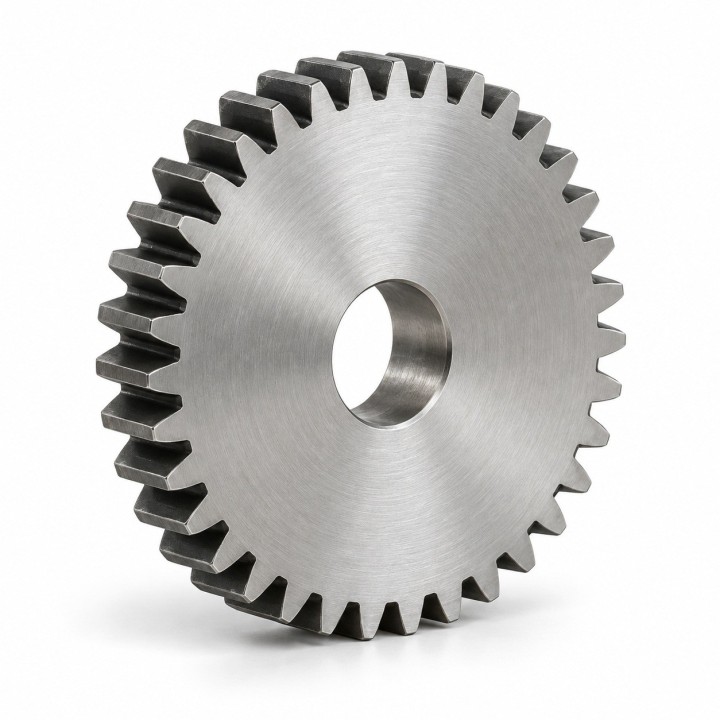
Hubber M4 Z60 gear plate made of carbon steel, with straight hardened teeth. Design without a projecting hub, module 4 and 60 teeth. Product for gear drives and systems with a suitably selected gear rack; it is not a sprocket.
Specifications and dimensions
| Parameter | Value |
|---|
| Manufacturer | Hubber |
| Type | Cylindrical module gear without hub — gear plate |
| Module | 4 |
| Number of teeth z | 60 |
| Teeth | Straight hardened teeth |
| Material | Carbon steel |
| Source item code | M4 Z60 HRC TARCZA |
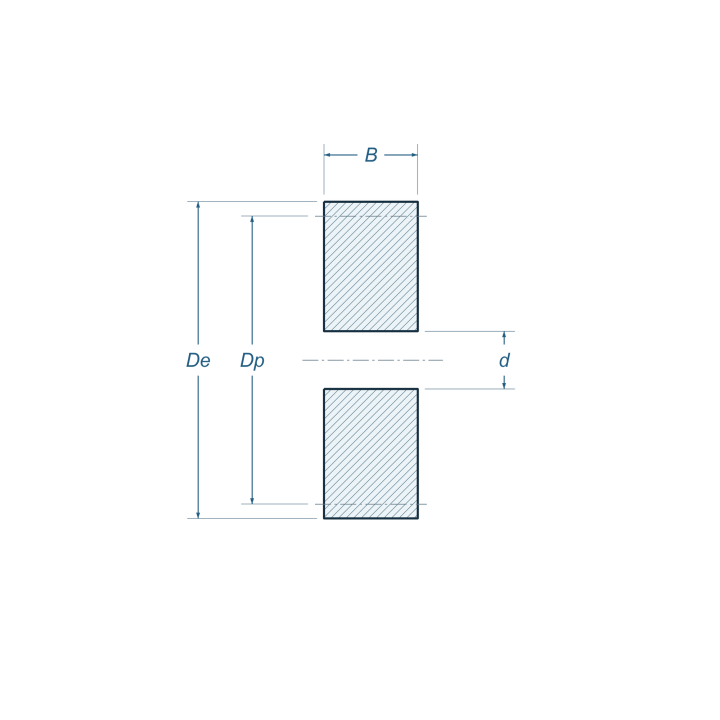
| d — bore diameter | 25 mm |
| Dp — pitch diameter | 240 mm |
| De — outside diameter | 248 mm |
| B — face width | 40 mm |
| Product weight alone | 13,890 kg |
| Sales unit | 1 piece |
The source does not specify dimension A separately; we do not add it based on the design alone.
Selecting a plate without hub
Compare the module, number of teeth, bore d, outside diameter De and face width B. Pitch diameter Dp defines the nominal pitch cylinder. The required shaft mounting method must be confirmed for the specific machine; we do not claim an unspecified keyway, fastening or bore tolerance. The module alone does not confirm full interchangeability — also check the pressure angle, accuracy and operating conditions. The source does not specify the steel grade, numerical hardness, accuracy grade or these tolerances.
Frequently asked questions
What does M4 Z60 mean?
M4 denotes module 4, and Z60 a count of 60 teeth.
How does the plate differ from a hubbed gear?
The plate has no projecting hub. Do not interchange the two designs solely on the basis of module and tooth count; their construction and mounting conditions differ.
How should the diagram be read?
d — bore diameter, Dp — pitch diameter, De — outside diameter, B — face width. The dimensions for this variant are in the table; the drawing only shows measurement locations. It does not include hub diameter D because this product has no hub.
Are the teeth hardened?
Yes, the title of the supplier's own data sheet confirms hardened teeth. However, it specifies neither a numerical hardness nor the heat-treatment technology.
What are the minimum quantity and fulfilment time?
Minimum 1 piece, fulfilment within 48 hours. This is not a guarantee of delivery by the carrier.
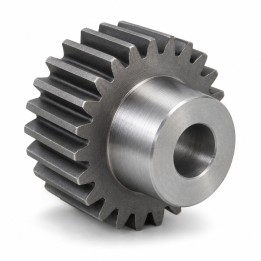
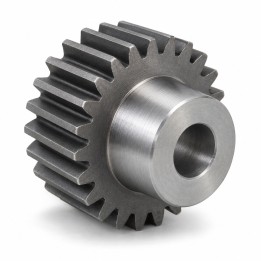
The main image is an original photorealistic visualisation of the common plate design, not a photograph of the specific item supplied. The tooth count and proportions shown do not replace the offer specifications. The diagram is illustrative, not a manufacturing drawing. The supplier's photographs were not copied.




Comments (0)
Your review appreciation cannot be sent
Report comment
Report sent
Your report cannot be sent