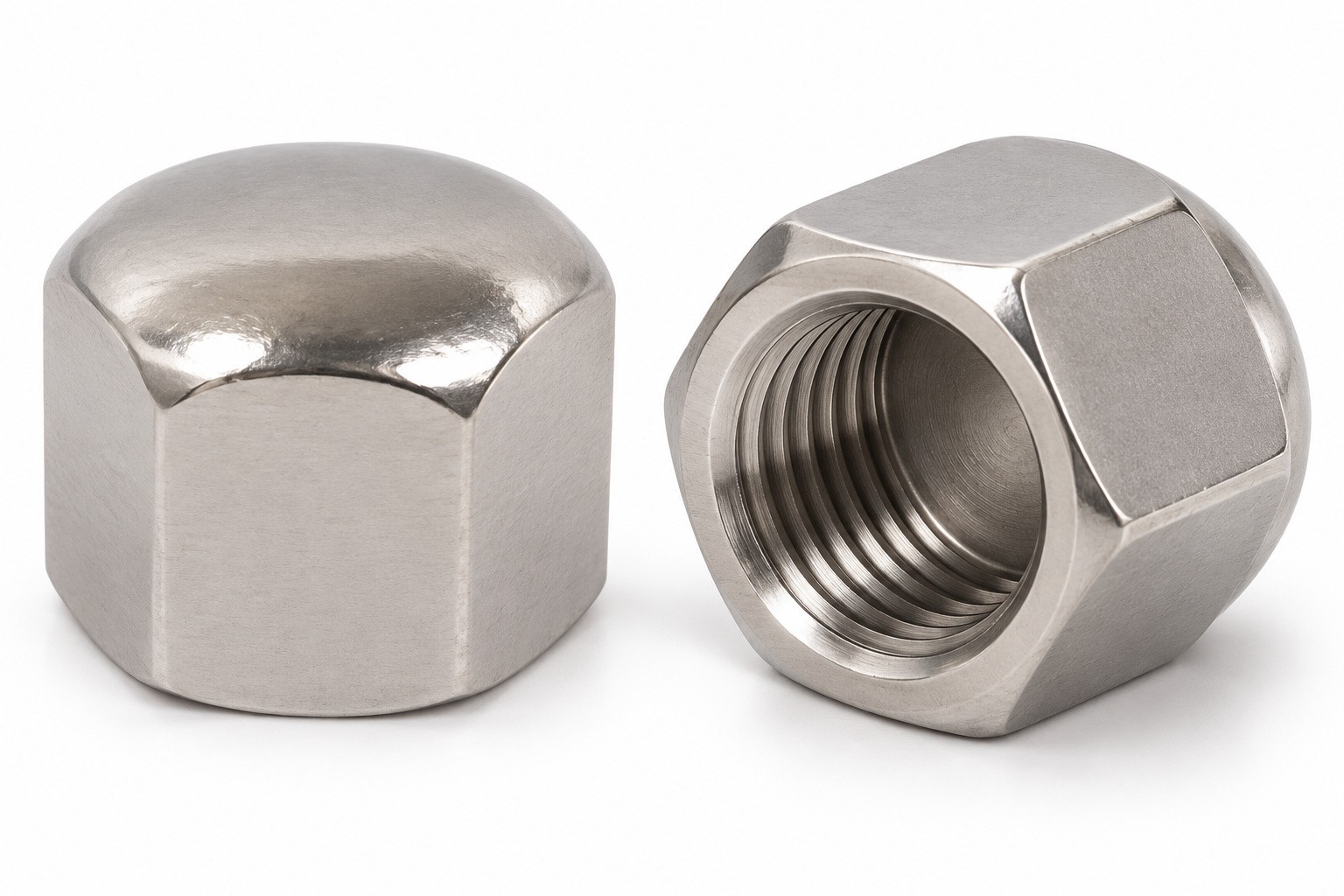
Low blind cap nuts M4 DIN 917 — 10 pieces
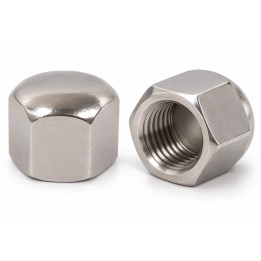
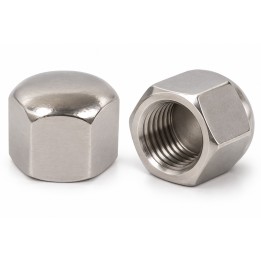
Low hexagon nut with a closed end and blind threaded hole. The rounded top lies directly above the spanner portion. The cap covers the screw tip provided the protruding thread length is selected correctly.
Technical specifications
- Dimensional reference: DIN 917
- Catalogue association: PN 82182
- Nut type: Low hexagon cap nut
- Nut construction: Low closed cap; blind threaded hole
- Female thread d: M4
- Thread pitch P: 0,7 mm
- Thread direction: Right-hand
- Thread tolerance: 6H
- Thread standard according to the catalogue: DIN 13-15
- Overall height h — nominal and maximum: 5,5 mm
- Overall height h — minimum: 5,2 mm
- Hole depth t — minimum according to diagram: 4,16 mm
- Hole depth t — maximum according to diagram: 4,64 mm
- Width across flats s: 7 mm
- Material: Stainless steel
- Material group according to catalogue offer: A1 or A2, depending on delivery
- Property class: 50 (catalogue variant designation)
- Mechanical properties standard: ISO 3506-2 (catalogue reference)
- Coating: Without additional coating
- Product grade according to the catalogue: A
- Tolerance standard according to the catalogue: ISO 4759-1
- Quantity per pack: 10 pcs.
- Sales unit: pack
Dimensions and standard references are catalogue data, without declaring test results for the specific batch. The catalogue design provides for A1 or A2 stainless steel depending on delivery. This offer does not guarantee group A2 exclusively.
Material and design
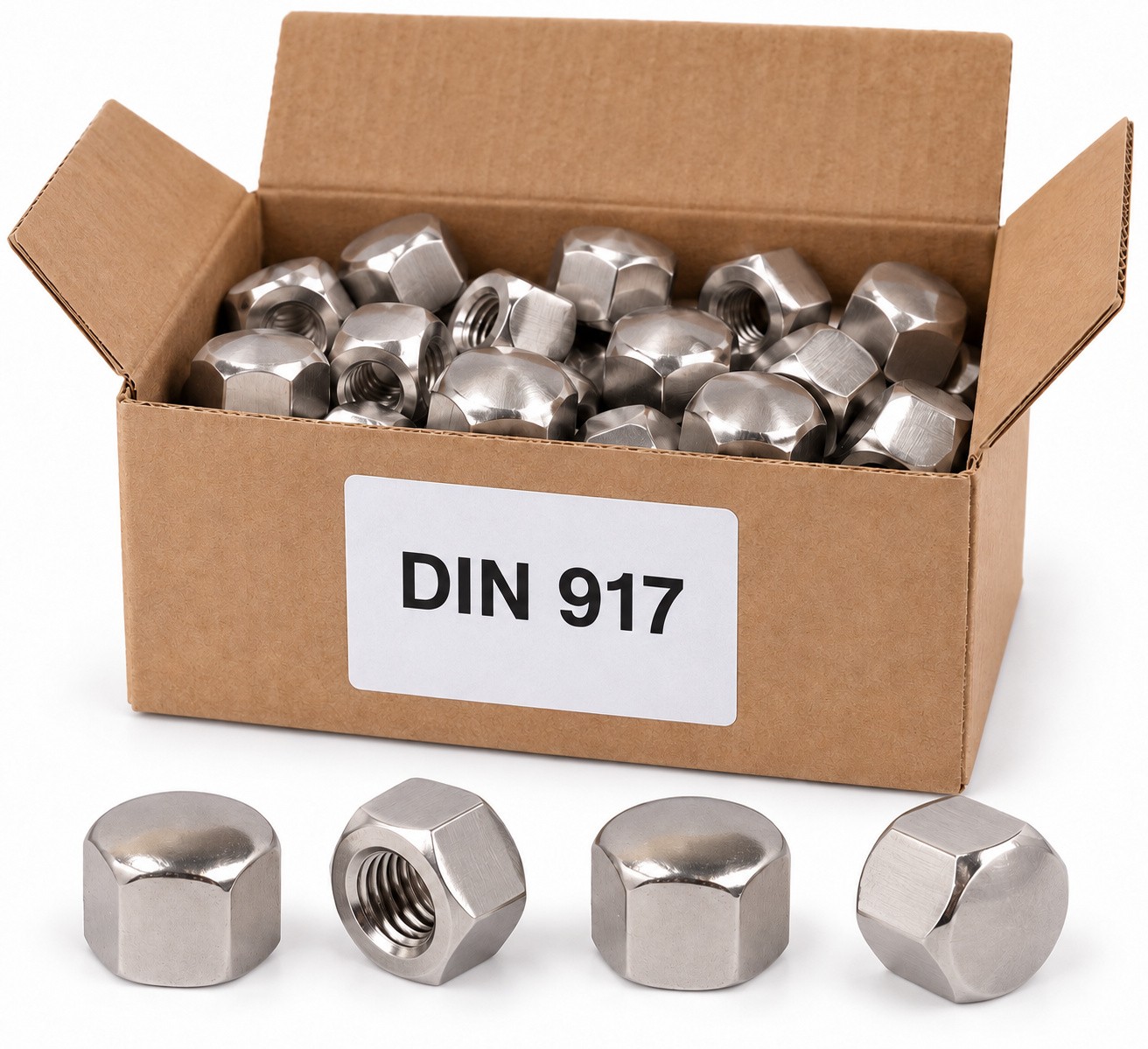
Stainless steel without additional coating, catalogue property class 50. A1 and A2 designate material groups; the number 50 denotes a property class, not a hardness scale. The low closed cap does not declare sealing or self-locking functionality.
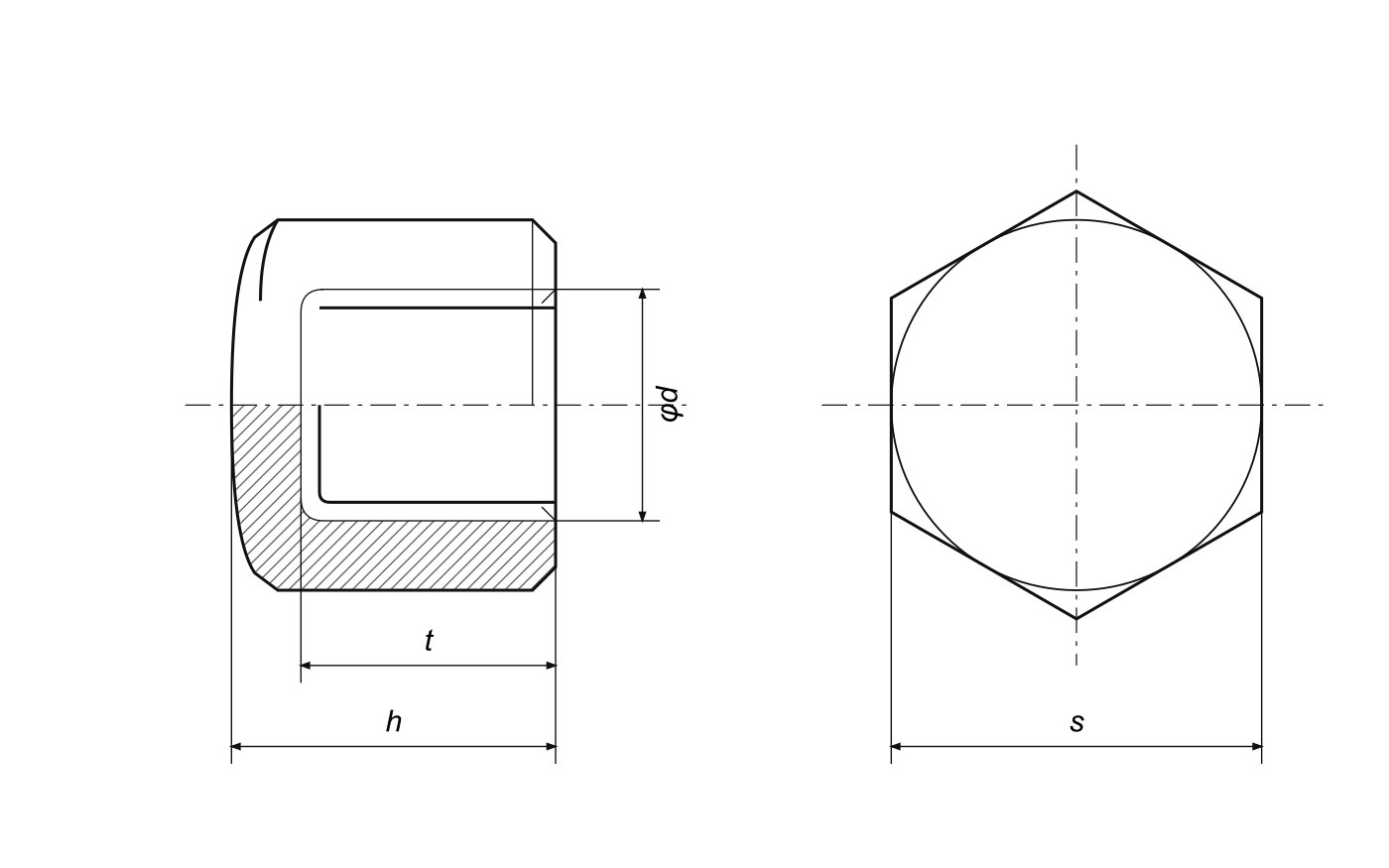
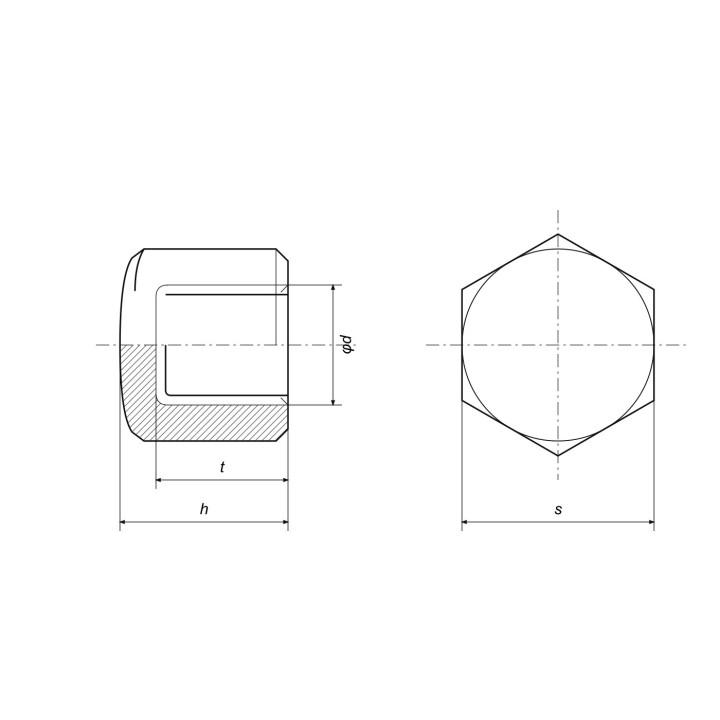
Diagram dimensions and references:
d — female thread M4; pitch P = 0,7 mm, tolerance 6H, right-hand.
h — overall height from 5,2 to 5,5 mm; nominal and maximum value 5,5 mm.
t — hole depth according to diagram: from 4,16 to 4,64 mm.
s — spanner size in the described catalogue variant: 7 mm.
Our own diagram shows a half-section and axial view of the low nut, using only lines and references d, h, t, s. It is a family illustration and catalogue diagram, not production documentation.
Scope of delivery and selection
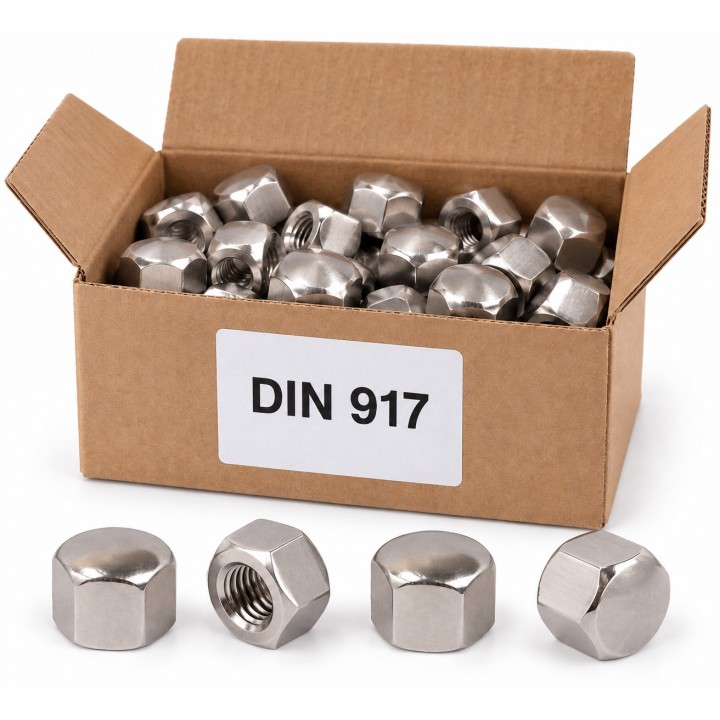
The price includes 10 stainless low blind cap nuts M4 DIN 917. The product and neutral carton illustrations are indicative; the number of items in front of the carton does not specify delivery quantity.
The joint requires thread M4 with 0,7 mm pitch. Select the protruding screw length for the actual hole depth so the screw tip does not bottom against the closure before proper clamping is achieved. Height h and depth t are different dimensions.
Frequently asked questions
How many pieces does the price include?
10 nuts M4 DIN 917.
What thread and spanner size does this variant have?
Thread M4 with 0,7 mm pitch, tolerance 6H, right-hand; catalogue spanner size 7 mm.
Does the screw pass through the nut?
No. The hole is blind. According to the table, depth t is 4,16–4,64 mm and overall height h 5,2–5,5 mm.
Is the material always A2?
No. For this catalogue design, A1 or A2 stainless steel is permitted depending on delivery.




Comments (0)
Your review appreciation cannot be sent
Report comment
Report sent
Your report cannot be sent