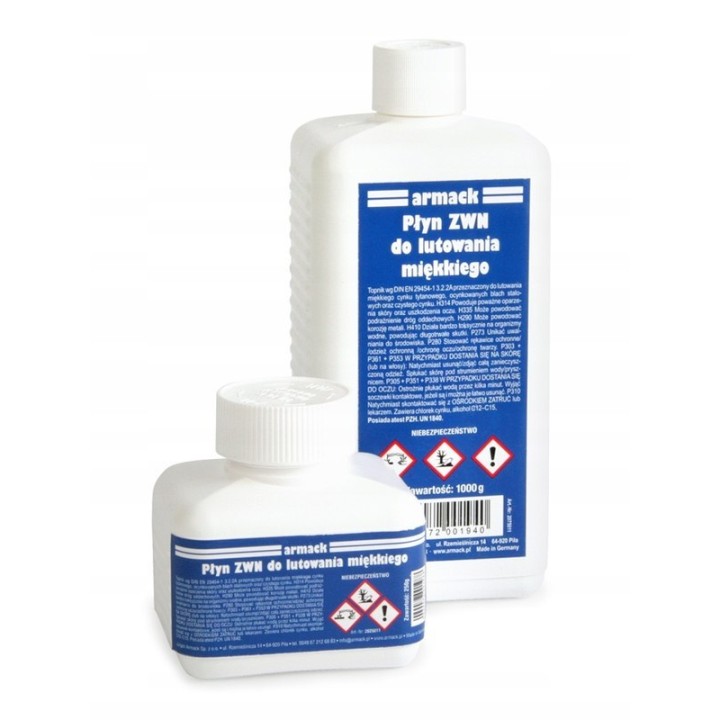
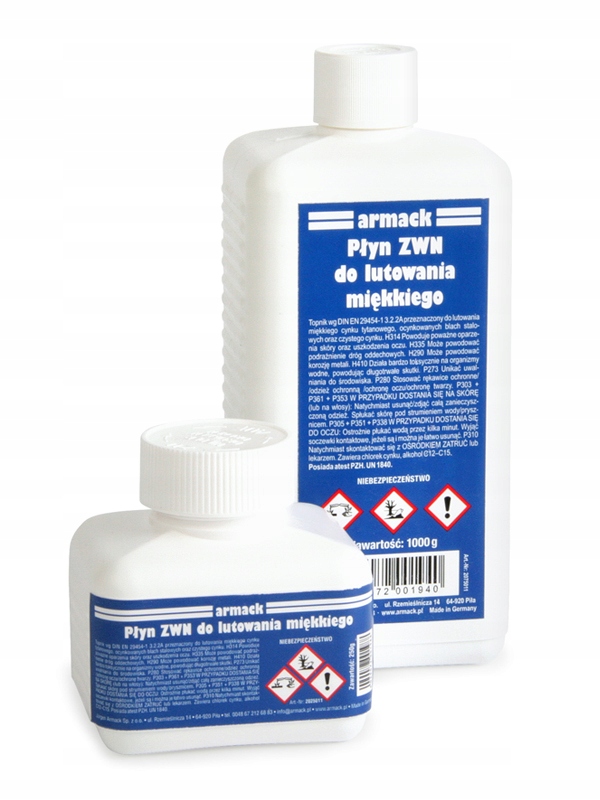

Armack ZWN fluid for zinc and galvanized sheets 250g
Armack ZWN fluid for zinc and galvanized sheets 250g.
Flux for soft soldering titanium zinc, galvanized steel sheets and technically pure zinc. ZWN fluid dissolves oxides very well without leaving stains or damaging the zinc, which retains its corrosion resistance. PZH certificate.
Physical and chemical properties
Physical state: liquid
Colour: colourless
Odour: characteristic, pungent
pH: approx. 3,0 (at 20°C)
Melting/freezing point (for zinc chloride): 282,8°C
Melting/freezing point (for ethylene glycol): -13°C
Initial boiling point and boiling range (for zinc chloride): 732,2°C
Flash point: not applicable.
Evaporation rate: no data available.
Flammability: non-flammable.
Upper/lower flammability or explosive limits: not applicable.
Vapour pressure (for zinc chloride): 1.33 hPa (428 °C).
Vapour pressure (for ammonium chloride): 0,13 kPa [20°C]
Vapour pressure (for phosphoric acid): 0,038 hPa (at 20°C).
Relative density: approx. 1,930 g/cm3
Solubility (for zinc chloride): readily soluble in the following materials: methanol.
Solubility (for ethylene glycol): Readily soluble in the following materials:
hot water.
Solubility (for ammonium chloride): partially soluble in the following materials:
methanol.
Partition coefficient octanol/water: no data available.
Auto-ignition temperature: not applicable.
Decomposition temperature: no data available.
Viscosity: approx. 15 mPa s (at 20°C)
Explosive properties: not applicable.
Oxidizing properties: no data available.
-
ConditionNew
-
Sales unitpcs
1. Eye protection:
– Always wear safety goggles or a face shield to protect your eyes from sparks, particles and metal fragments.
2. Hearing protection:
– When working in a noisy environment, use ear defenders or earplugs to prevent hearing damage.
3. Respiratory protection:
– When working in dusty surroundings or in the presence of fumes, wear a filtering mask or an appropriate respirator.
– Ensure proper ventilation of the workstation.
4. Hand and skin safety:
– Use protective gloves that protect against mechanical injuries and chemicals.
– Where necessary, use protective creams to prevent irritation and dry skin.
5. Work clothing:
– Work in protective clothing resistant to sparks and splashes.
– Avoid loose clothing, jewellery and loose hair near machinery.
6. Fire risk:
– Keep the workstation free of flammable materials (e.g. paper, fabrics and chemicals).
– Keep a serviceable fire extinguisher close at hand and know how to use it.
7. Electrical hazards:
– Check the condition of cables and electrical equipment before use.
– Do not use electrical devices in damp conditions.
– Disconnect equipment from the power supply during maintenance or repairs.
8. Use of machinery and tools:
– Regularly inspect the technical condition of machines and tools.
– Use equipment in accordance with the manufacturer's instructions.
– Blades and tools should be maintained regularly and kept in good condition.
– Machines should be fitted with appropriate guards and protective devices.
9. Handling materials:
– Use handling equipment to move heavy components.
– Lift and carry using ergonomic practices to avoid injury.
10. Working with chemicals:
– Store chemicals in labelled, safe containers.
– Use substances in accordance with the manufacturer's instructions and occupational health and safety rules.
– Ensure air circulation when using chemicals.
Other important rules:
– Keep the workstation clean and tidy.
– Ensure adequate lighting in the working area.
– Provide occupational health and safety training.
– Carry out regular safety audits and comply with current regulations.

Comments (0)
Your review appreciation cannot be sent
Report comment
Report sent
Your report cannot be sent