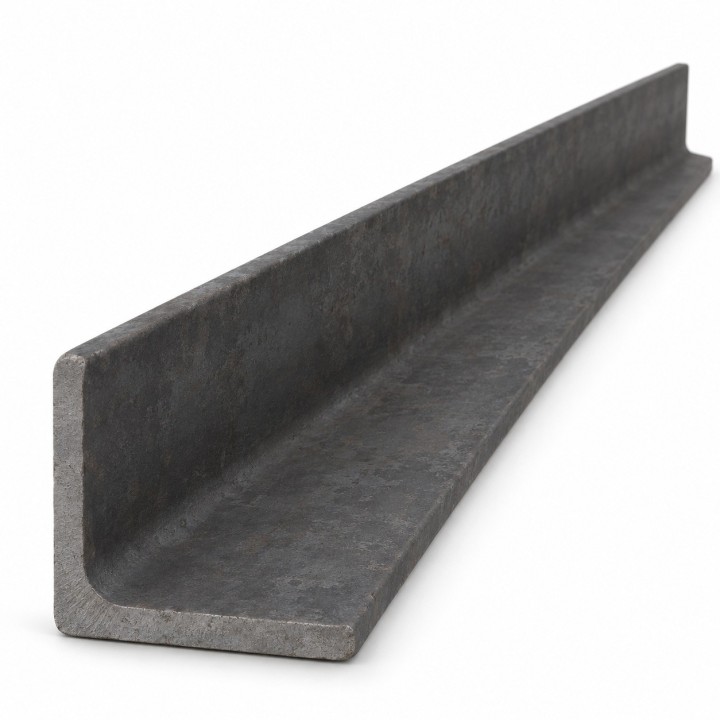
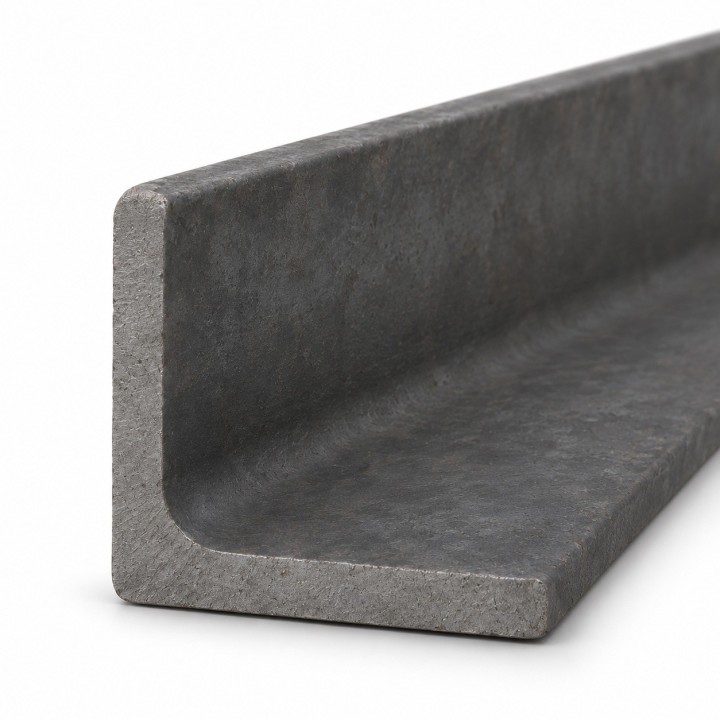
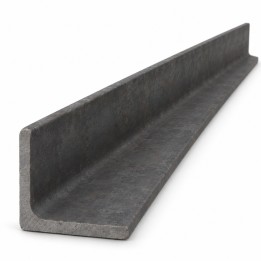
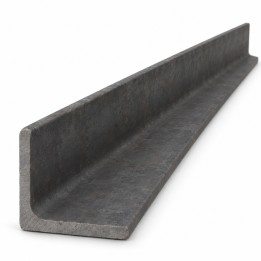
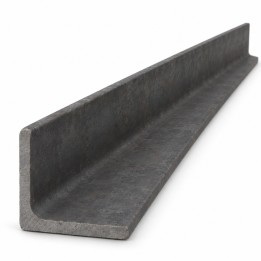
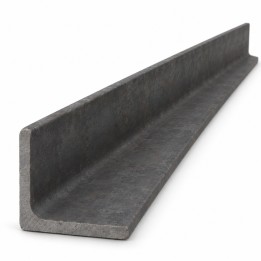
Angle S235 hot-rolled — 100 × 100 × 10 × 1000 mm, 1 piece
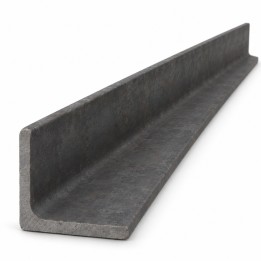
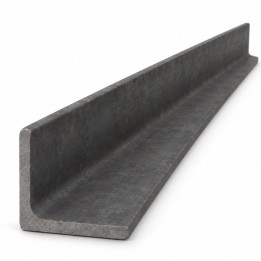
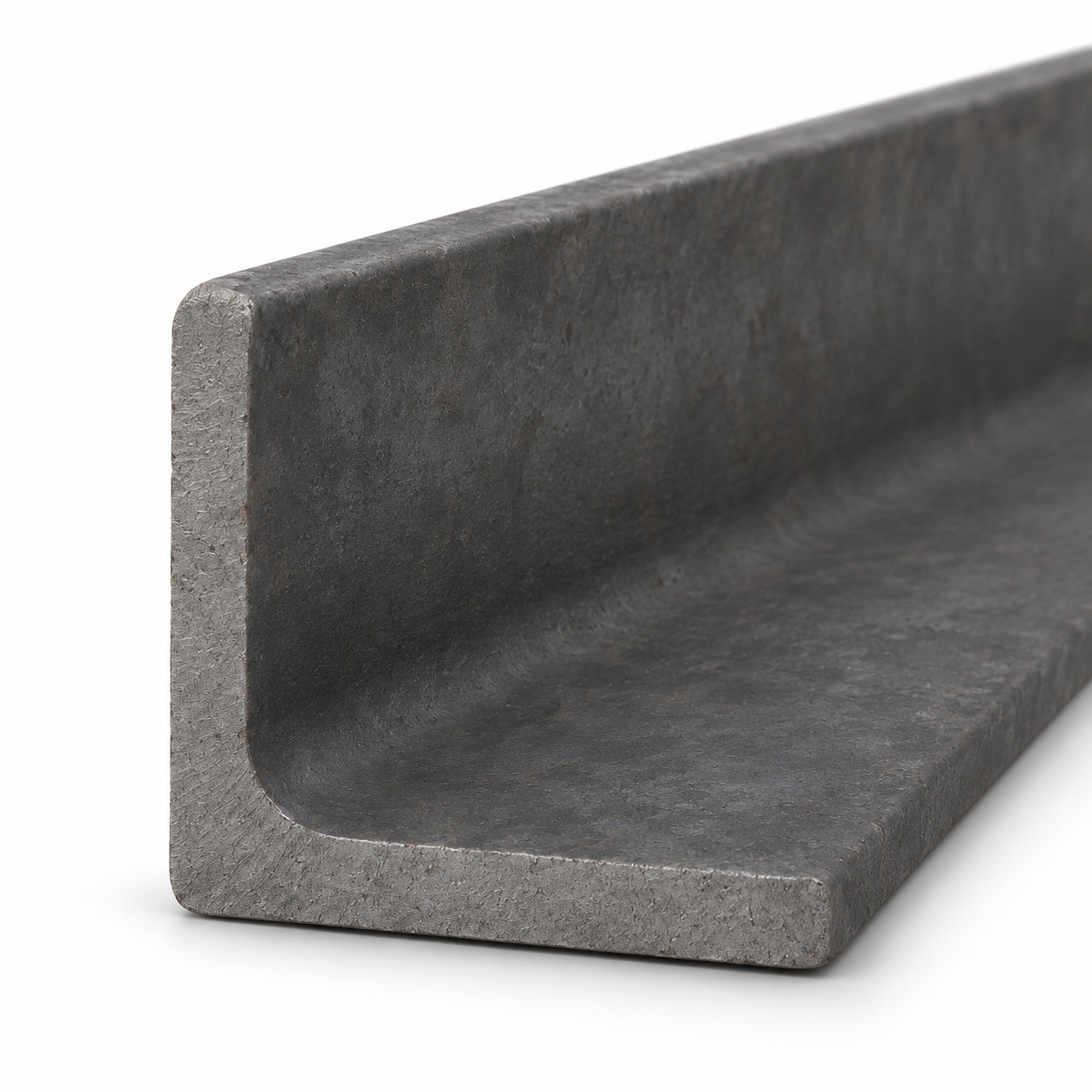
Equal-leg hot-rolled angle made of S235 steel. The open L section consists of two perpendicular legs with nominal dimensions 100 × 100 mm and 10 mm thickness. The offer covers one piece of 1000 mm length.
Technical parameters
| Parameter | Value |
|---|
| Product type | Equal-leg angle, open L section |
| Material | Steel S235 |
| Execution | Hot-rolled |
| Nominal leg dimensions a × b | 100 × 100 mm |
| Thickness of both legs t | 10 mm |
| Tolerance of legs a and b | EN 10056-2: ±2,000 mm; each leg 98,000–102,000 mm |
| Thickness tolerance t | EN 10056-2: ±0,750 mm; range 9,250–10,750 mm |
| Length of one component L | 1000 mm (100 cm) |
| Number of pieces in sales unit | 1 piece |
| Purchase unit | 1 piece = 1 angle 100 × 100 × 10 × 1000 mm |
| Theoretical weight per metre | 15,000 kg/m — nominal tabulated value |
| Theoretical weight of the complete sales unit | about 15,000 kg |
| Length tolerance of ordered length | To be agreed when ordering |
Steel S235 and hot-rolled surface
S235 is a non-alloy structural steel used for frames, brackets and general-purpose structural components. The hot-rolled angle surface is matt and may have mill scale. Prepare it appropriately before welding, painting or other finishing. The complete grade variant and properties of the specific batch are defined by delivery documentation.
Preparation and cutting
Cutting to ordered lengths can be agreed before purchase. In your enquiry, state the cross-section, length, number of lengths and required cutting tolerance.

Angle dimensions and cross-section
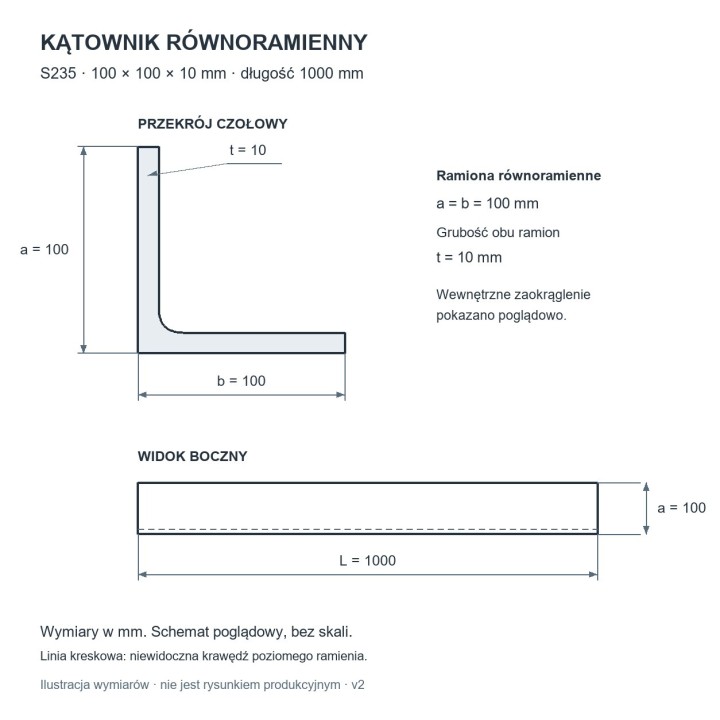
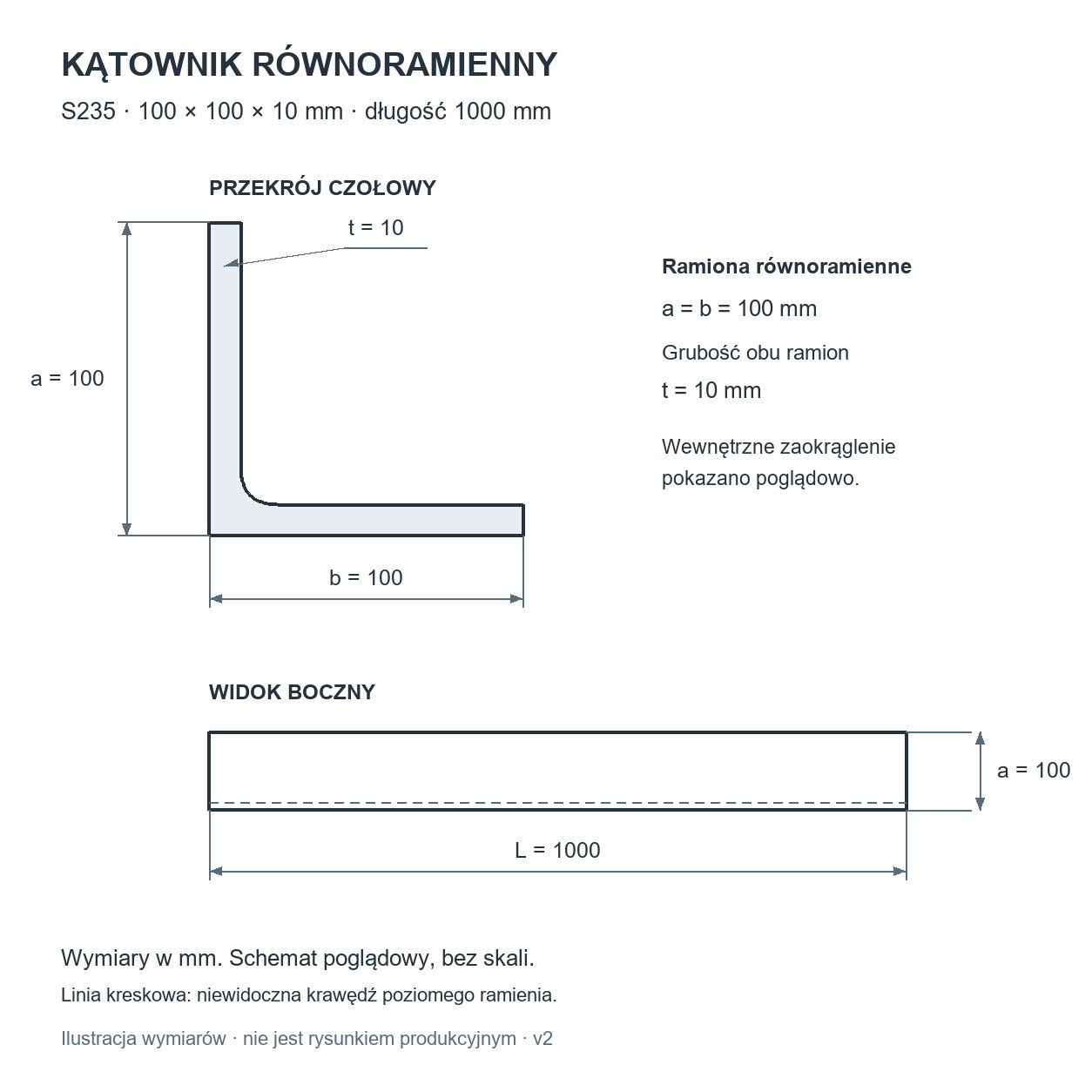
Symbols a and b denote external leg dimensions, t their thickness and L the length of one angle. On this card: a = b = 100 mm, t = 10 mm and L = 1000 mm. The end section shows the open L shape and the internal radius characteristic of hot rolling. The side view shows length and leg height; the dashed line denotes the hidden edge of the horizontal leg. The diagram is illustrative and not to scale; the internal radius is shown without a stated value.
Standards and tolerances
Nominal dimensions of hot-rolled equal-leg and unequal-leg angles are specified by PN-EN 10056-1:2017-03, implementing EN 10056-1:2017. It replaced PN-EN 10056-1:2000. Shape and dimensional tolerances are specified by PN-EN 10056-2:1998, implementing EN 10056-2:1993, with amendment Ap1:2003. These are two complementary parts of the standard.
Execution to EN 10056 is confirmed for the offered section: both legs a and b have deviations ±2,000 mm, giving a 98,000–102,000 mm range. The thickness of both legs t has deviations ±0,750 mm, giving a 9,250–10,750 mm range. Agree the length tolerance of the ordered length before purchase.
For the technical delivery conditions of non-alloy structural steel S235, the reference is PN-EN 10025-2:2019-11. The complete grade variant, delivery condition and conformity of the specific batch are defined by delivery documentation.
How to order
Buying 1 unit on this card means one angle 100 × 100 × 10 × 1000 mm. Buying 2 units means two separate angles, each 1000 mm long. Select other dimensions using the tiles below the price.
Order processing
Dispatch of an in-stock product: within 5 days. Delivery time depends on the carrier. If out of stock, availability time requires confirmation.
Questions and answers
Are the legs equal?
Yes. The nominal dimension of each leg is 100 mm and the thickness of both legs is 10 mm.
What is the price on this card for?
One piece of length 1000 mm.
What dimensions are permissible?
Legs a and b: 98,000–102,000 mm each. Thickness t: 9,250–10,750 mm to EN 10056-2.
How do I select another length?
Use the length tiles below the price. Each offer is for one piece.
Does the weight cover the complete sales unit?
Yes, 15,000 kg is the theoretical weight of one 1000 mm piece, without packaging.
NERON Piła — selection assistance
Contact NERON, stating steel grade, leg dimensions, thickness, length and number of angles.