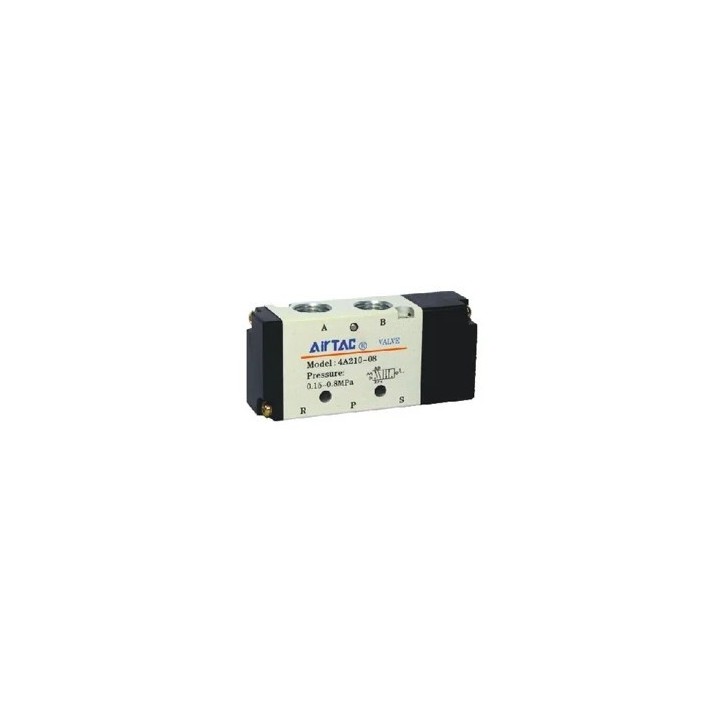
Pneumatic valve 5/2 M5 monostable 4A110M5
Characteristics of 5/2 and 5/3 pneumatic valves, M5 and G 1/8", 4A100 series, Airtac
- Airtac monostable and bistable 5/2 M5 and G 1/8" and 5/3 pneumatic valves control the direction of compressed-air flow and are available at a very good price
- 5/3 valves are available with different centre positions: closed centre, pressurized centre or exhausted centre
- 5/2 and 5/3 valves of the 4A100 series are mainly used to control double-acting pneumatic actuators
- 5/2 pneumatic valves are used in pneumatic control systems, for example to implement logic or memory functions
- 5/2 directional valves of the 4A100 series are used for indirect control of pneumatic cylinders, for example cylinders with large diameters
- 5/2 M5 and G 1/8" pneumatic valves require a minimum control pressure of 1,5 bar for operation
- 5/2 and 5/3 G1/8" and G 1/4" pneumatic directional valves are installed in-line in pneumatic systems using, for example,push-in fittings(so-called inline valves)
- For correct operation of the directional valve, it is recommended to screw a silencer into the exhaust port (marked 3)
Operating principle:
Monostable valvesoperate by being actuated when a pneumatic signal is applied; the signal must be maintained while the valve is switched. When the pressure at the control port disappears, the valve returns to its initial position (return by an air spring assisted by a mechanical spring)
Inbistable valvesswitching is performed by a brief pneumatic signal. When pressure at the control port disappears, the valve remains switched. To return the valve to its initial position, a pneumatic signal must be applied to the other control port
5/3 valveis switched to either end position by a pneumatic signal applied on the right or left side. The pneumatic signal must be maintained while switched. When pressure at the control port disappears, the valve moves to its centre position (return by centring springs)
Technical data:
Materials:
Body, pilot and spool: aluminium; seals: NBR
Return type: air and spring return
Centring method for 5/3 valves - centring springs
Nominal flow cross-section:
- for 5/2 valves: 10,2 mm2
- for 5/3 valves: 8,6 mm2
Control signal port: G 1/8"
Operating pressure: 1,5 to 8 bar
Switching frequency: from 3 to 5 cycles / sec.
Temperature range: -20°C to +70°C
Operating medium:
filtered compressed air, dry or lubricated



Comments (0)
Your review appreciation cannot be sent
Report comment
Report sent
Your report cannot be sent